


Dr Orit Wimpfheimer rolls out of bed in her home in Israel each morning, walks downstairs and reports to her job -- on the East Coast of the US.
Wimpfheimer, an Ivy League-trained radiologist, analyzes test results from US hospitals over the Internet. She is among a growing number of American Jews who immigrated to Israel because they were able to earn a US paycheck and enjoy a lifestyle few Israelis ever see -- thanks to e-mail, Internet and video-conferencing.
"You get to move to the country of your choice. You get to do what you did before in the comfort of a home office," said Wimpfheimer, who lives in the Jerusalem suburb of Beit Shemesh.
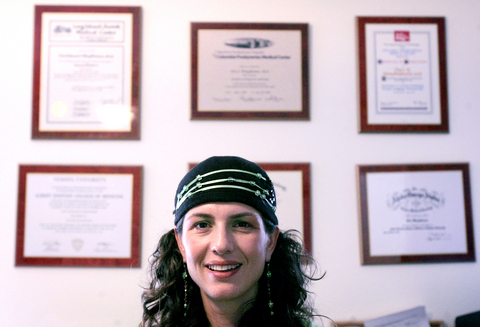
PHOTO: AP
Lack of high-paying jobs has been a major obstacle for potential immigrants to Israel from the US and other wealthy countries. Unemployment in Israel hovers around 9 percent, and Israeli professionals typically earn a fraction of what their counterparts make stateside.
A few thousand Americans immigrate to Israel each year, a tiny percentage of the more than 5 million Jews in the US. But the number has grown in recent years, in part because people can bring well-paying jobs with them, said Daniella Slasky, director of employment at Nefesh B'Nefesh, a nonprofit agency that helps North American Jews move to Israel.
"I wouldn't say this is the reason for increased aliya," said Slasky, using the Hebrew word for Jewish immigration to Israel. "I think this is a tool that helps people move to Israel. It is much easier to make aliya, coming here and knowing you have a job. Also, having the American salary while living here is very significant."
She estimated that 20 percent to 30 percent of the breadwinners among the new arrivals from North America maintain jobs overseas. When Nefesh B'Nefesh began work four years ago, the number was negligible, she said.
Among those keeping US jobs are medical professionals, accountants, lawyers, graphic designers and computer programmers. All do most of their work in Israel, though some periodically commute to offices overseas.
STAYING ON
When Adam Lubov, a database administrator, decided to immigrate in late 2004, the medical software firm where he worked in Savannah, Georgia, asked him to remain on board. Since he already did most of his work from home, the transition was easy.
"I thought this was great. I can continue in my job, then look for something else," he said.
After he saw what he would earn in the local market, however, he decided to stay on.
"Seeing the pay difference, I can't do it," said Lubov, 28, who lives outside Tel Aviv.
Joel Pomerantz, a psychologist at an alternative school for at-risk children in Cleveland, supervises a team of five people from his home in Beit Shemesh. He checks into work about 3pm and works through midnight -- corresponding with the business day in Ohio.
Using the Internet, he can review results of tests administered by colleagues, prepare reports or enter information into a database. He meets regularly with parents and students via video-conference.
Pomerantz said the setup has been a natural fit for his school, called the Virtual Schoolhouse, which uses Internet learning to augment classroom activities. He said his tech-savvy boss suggested the arrangement, and he spent several months preparing before moving with his wife and three children in July.
While the distance has created some obstacles, Pomerantz, 31, said it has also yielded some benefits. Many parents are enthralled with the technology, and he has become more efficient because there are fewer distractions here.
"So far so good. I foresee this going really well," he said.
SACRIFICE
Some of the arrangements require creativity and sacrifice. Shye Wortman, an internist who moved to Beit Shemesh last year, still flies to New York every two weeks to treat patients.
When in Israel, he reviews charts and test results and speaks to patients by phone. Using Internet phone service, he even maintains a New York phone number.
"Some patients don't know I'm in Israel," he said.
Despite the travel, he says he now has more time with his family than he had in the US.
In other cases, the seven-hour time difference with the eastern US can be an asset.
Wimpfheimer, the radiologist, works from 6am to 3pm, teaming with two partners to cover the overnight shift at 18 hospitals in the northeastern US.
She reviews CT scans, MRIs and ultrasounds and exchanges information instantaneously over secure Internet connections.
The arrangement benefits the hospitals, which don't need to hire an overnight crew or force doctors to be on call during the bleary-eyed graveyard shift.
"It works much better," said John Breckenridge, chairman of the radiology department at Abington Memorial Hospital in Abington, Pennsylvania. "They're awake and alert."
And thanks to real-time technology, the distance isn't an issue.
"She could be in the next room. It really doesn't matter," he said.
Wimpfheimer, 36, a mother of six, can spend the afternoons with her children. With her US salary, she can live comfortably in a three-level suburban house with a swimming pool.
"The business is growing. We're having fun doing it," said Wimpfheimer, who immigrated from New York four years ago. "I wouldn't even consider moving back."

Among the rows of vibrators, rubber torsos and leather harnesses at a Chinese sex toys exhibition in Shanghai this weekend, the beginnings of an artificial intelligence (AI)-driven shift in the industry quietly pulsed. China manufactures about 70 percent of the world’s sex toys, most of it the “hardware” on display at the fair — whether that be technicolor tentacled dildos or hyper-realistic personalized silicone dolls. Yet smart toys have been rising in popularity for some time. Many major European and US brands already offer tech-enhanced products that can enable long-distance love, monitor well-being and even bring people one step closer to

TRANSFORMATION: Taiwan is now home to the largest Google hardware research and development center outside of the US, thanks to the nation’s economic policies President Tsai Ing-wen (蔡英文) yesterday attended an event marking the opening of Google’s second hardware research and development (R&D) office in Taiwan, which was held at New Taipei City’s Banciao District (板橋). This signals Taiwan’s transformation into the world’s largest Google hardware research and development center outside of the US, validating the nation’s economic policy in the past eight years, she said. The “five plus two” innovative industries policy, “six core strategic industries” initiative and infrastructure projects have grown the national industry and established resilient supply chains that withstood the COVID-19 pandemic, Tsai said. Taiwan has improved investment conditions of the domestic economy

Malaysia’s leader yesterday announced plans to build a massive semiconductor design park, aiming to boost the Southeast Asian nation’s role in the global chip industry. A prominent player in the semiconductor industry for decades, Malaysia accounts for an estimated 13 percent of global back-end manufacturing, according to German tech giant Bosch. Now it wants to go beyond production and emerge as a chip design powerhouse too, Malaysian Prime Minister Anwar Ibrahim said. “I am pleased to announce the largest IC (integrated circuit) Design Park in Southeast Asia, that will house world-class anchor tenants and collaborate with global companies such as Arm [Holdings PLC],”

MAJOR BENEFICIARY: The company benefits from TSMC’s advanced packaging scarcity, given robust demand for Nvidia AI chips, analysts said ASE Technology Holding Co (ASE, 日月光投控), the world’s biggest chip packaging and testing service provider, yesterday said it is raising its equipment capital expenditure budget by 10 percent this year to expand leading-edge and advanced packing and testing capacity amid strong artificial intelligence (AI) and high-performance computing chip demand. This is on top of the 40 to 50 percent annual increase in its capital spending budget to more than the US$1.7 billion to announced in February. About half of the equipment capital expenditure would be spent on leading-edge and advanced packaging and testing technology, the company said. ASE is considered by analysts


 RSS
RSS