


Group of Seven finance ministers yesterday renewed a call on China to adopt greater exchange rate flexibility.
"We reaffirm that exchange rates should reflect economic fundamentals," the ministers said in a statement after a one-day meeting here. "Greater exchange rate flexibility is desirable in emerging economies with large current account surpluses, especially China, for necessary adjustments to occur."
The statement reiterated a call for China and other Asian economies to allow their currencies more freedom to appreciate that was issued by the G7 -- Britain, Canada, France, Germany, Italy, Japan and the US -- last April.
The US and some of its key trading partners have been prodding China to abandon its policy of confining its currency, the yuan, to a tightly controlled trading regime.
That policy, they argue, undervalues the yuan, giving Chinese exports an unfair advantage in global markets.
China did approve a small revaluation of the yuan in July last year but the currency remains bound in a narrow range, appreciating at a snail's pace to Washington's great disappointment.
Speaking ahead of the G7 statement, the head of China's central bank, Zhou Xiaochuan (
"Chinese policy is clear, so we are gradually moving towards more flexibility with the [currency] regime," Zhou told a seminar in Singapore on the sidelines of the IMF-World Bank annual meeting.
He said the shift from the US dollar peg in July last year to a managed exchange rate was "still in the first stage."
Zhou later told reporters that if market conditions demonstrated a need for a wider trading band for the yuan then "we may consider a wider band."
He declined to say when more flexibility would be allowed in the yuan exchange rate but explained China was still working on reform of its banking and financial sector which would take time.
Zhou said one of Beijing's priorities was to stimulate domestic demand to reduce China's dependency on exports as a key driver of growth.
On interest rates, he noted that the Chinese central bank had hiked rates in May and last month, so "we still need a bit of time to observe the response of our economy" before considering further monetary policy tightening.
Both Zhou and China's finance minister Jin Renqing (

Among the rows of vibrators, rubber torsos and leather harnesses at a Chinese sex toys exhibition in Shanghai this weekend, the beginnings of an artificial intelligence (AI)-driven shift in the industry quietly pulsed. China manufactures about 70 percent of the world’s sex toys, most of it the “hardware” on display at the fair — whether that be technicolor tentacled dildos or hyper-realistic personalized silicone dolls. Yet smart toys have been rising in popularity for some time. Many major European and US brands already offer tech-enhanced products that can enable long-distance love, monitor well-being and even bring people one step closer to

Malaysia’s leader yesterday announced plans to build a massive semiconductor design park, aiming to boost the Southeast Asian nation’s role in the global chip industry. A prominent player in the semiconductor industry for decades, Malaysia accounts for an estimated 13 percent of global back-end manufacturing, according to German tech giant Bosch. Now it wants to go beyond production and emerge as a chip design powerhouse too, Malaysian Prime Minister Anwar Ibrahim said. “I am pleased to announce the largest IC (integrated circuit) Design Park in Southeast Asia, that will house world-class anchor tenants and collaborate with global companies such as Arm [Holdings PLC],”

TRANSFORMATION: Taiwan is now home to the largest Google hardware research and development center outside of the US, thanks to the nation’s economic policies President Tsai Ing-wen (蔡英文) yesterday attended an event marking the opening of Google’s second hardware research and development (R&D) office in Taiwan, which was held at New Taipei City’s Banciao District (板橋). This signals Taiwan’s transformation into the world’s largest Google hardware research and development center outside of the US, validating the nation’s economic policy in the past eight years, she said. The “five plus two” innovative industries policy, “six core strategic industries” initiative and infrastructure projects have grown the national industry and established resilient supply chains that withstood the COVID-19 pandemic, Tsai said. Taiwan has improved investment conditions of the domestic economy
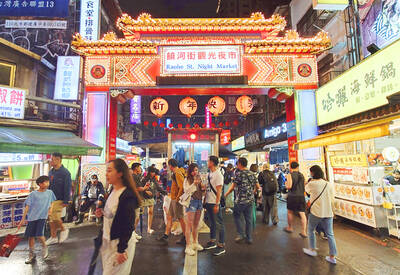
Sales in the retail, and food and beverage sectors last month continued to rise, increasing 0.7 percent and 13.6 percent respectively from a year earlier, setting record highs for the month of March, the Ministry of Economic Affairs said yesterday. Sales in the wholesale sector also grew last month by 4.6 annually, mainly due to the business opportunities for emerging applications related to artificial intelligence (AI) and high-performance computing technologies, the ministry said in a report. The ministry forecast that retail, and food and beverage sales this month would retain their growth momentum as the former would benefit from Tomb Sweeping Day


 RSS
RSS