


Wall Street has shifted into rally mode amid indications that the US economy is cooling along with inflation pressures, providing the Federal Reserve with the "soft landing" it has been seeking.
But after a strong week for equities, investors will be looking to the Fed on Wednesday to confirm this scenario and to leave interest rates unchanged. The central bank paused last month after 17 straight quarter-point rate hikes.
In the week to Friday, the blue-chip Dow Jones Industrial Average rose 1.48 percent to 11,560.77, and is now less than 200 points from its all-time hit in January 2000 of 11,722.98.
The broad-market Standard and Poor's 500 advanced 1.61 percent on the week to 1,319.87.
The tech-dominated NASDAQ composite meanwhile soared 3.2 percent to 2,235.59.
Slowing economy
Economic reports over the past week appeared to confirm the notion of an economy that is slowing, easing inflation pressures. Also helping the market has been the sharp drop in oil prices, down nearly 20 percent from peaks hit in July and last month.
Dick Green at Briefing.com said the most recent inflation data "indicate that the soft landing in the economy is proceeding almost exactly as the Fed would draw it up."
"It may very well be that the macro-fundamentals are settling into a sweet spot for the stock market. Inflation is restrained, interest rates are likely to remain at current levels, the economy is growing at a moderate pace, and earnings growth is continuing," Green said.
Douglas Porter, economist at BMO Nesbitt Burns, said that even though inflation has been running hotter than the Fed would like, the trend is downward. He said the Fed may hint at further rate hikes but probably will not act on rates.
Much attention will be focused on the Fed meeting on Wednesday, with most analysts expecting policymakers to hold the federal funds target at 5.25 percent.
This comes in part from data showing a soft 0.2 percent gain in US retail sales -- an indication of consumer spending that makes up two-thirds of economic activity -- and a tame 0.2 percent rise in consumer prices last month.
"Underlying trends remain just firm enough to keep the Fed's tightening bias intact, but moderate enough to keep the Fed from acting on that bias again anytime soon," Porter said.
"The main reason why the Fed is content to bide its time, even as core inflation trends grind higher, is that officials are expectant that slower growth will undercut price pressures. And there were plenty of indications this week that growth is indeed slowing," Porter said.
Fear factor
Fred Dickson, market strategist at DA Davidson, said inflation fears have been a main factor holding back the market in recent months, and that if investors see inflation as tamed it will be a big positive.
"Inflation fears continue to subside and along with it fears of the Fed tightening rates," Dickson said.
"We suspect the stock market will continue to drift up going into next week's [Fed] meeting on September 20. The Fed has received several data points suggesting that inflation is moderating as expected. Our sense is that if the Fed decides to leave interest rates unchanged next Wednesday, the stock market will rally sharply on that news," he said.
Bond prices drifted down over the past week. The yield on the 10-year Treasury bond rose to 4.798 percent from 4.771 percent a week earlier, while that on the 30-year bond climbed to 4.919 percent against 4.916 percent.
Bond yields and prices move in opposite directions.

Among the rows of vibrators, rubber torsos and leather harnesses at a Chinese sex toys exhibition in Shanghai this weekend, the beginnings of an artificial intelligence (AI)-driven shift in the industry quietly pulsed. China manufactures about 70 percent of the world’s sex toys, most of it the “hardware” on display at the fair — whether that be technicolor tentacled dildos or hyper-realistic personalized silicone dolls. Yet smart toys have been rising in popularity for some time. Many major European and US brands already offer tech-enhanced products that can enable long-distance love, monitor well-being and even bring people one step closer to

Malaysia’s leader yesterday announced plans to build a massive semiconductor design park, aiming to boost the Southeast Asian nation’s role in the global chip industry. A prominent player in the semiconductor industry for decades, Malaysia accounts for an estimated 13 percent of global back-end manufacturing, according to German tech giant Bosch. Now it wants to go beyond production and emerge as a chip design powerhouse too, Malaysian Prime Minister Anwar Ibrahim said. “I am pleased to announce the largest IC (integrated circuit) Design Park in Southeast Asia, that will house world-class anchor tenants and collaborate with global companies such as Arm [Holdings PLC],”

Sales in the retail, and food and beverage sectors last month continued to rise, increasing 0.7 percent and 13.6 percent respectively from a year earlier, setting record highs for the month of March, the Ministry of Economic Affairs said yesterday. Sales in the wholesale sector also grew last month by 4.6 annually, mainly due to the business opportunities for emerging applications related to artificial intelligence (AI) and high-performance computing technologies, the ministry said in a report. The ministry forecast that retail, and food and beverage sales this month would retain their growth momentum as the former would benefit from Tomb Sweeping Day
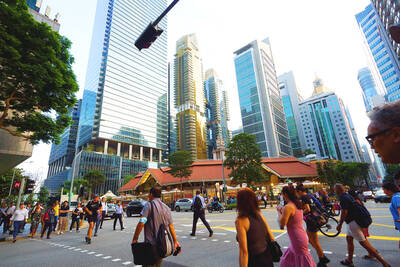
Thousands of parents in Singapore are furious after a Cordlife Group Ltd (康盛人生集團), a major operator of cord blood banks in Asia, irreparably damaged their children’s samples through improper handling, with some now pursuing legal action. The ongoing case, one of the worst to hit the largely untested industry, has renewed concerns over companies marketing themselves to anxious parents with mostly unproven assurances. This has implications across the region, given Cordlife’s operations in Hong Kong, Macau, Indonesia, the Philippines and India. The parents paid for years to have their infants’ cord blood stored, with the understanding that the stem cells they contained


 RSS
RSS