


It began in 1981, in a town in western India.
Seven young middle-class friends from the western town of Pune, most of them co-workers at a small software company, quit their jobs to chase a dream: to build a global software company in a country with few computer-users and a socialist-style economy that rarely rewarded entrepreneurship.
And the risk has paid off.
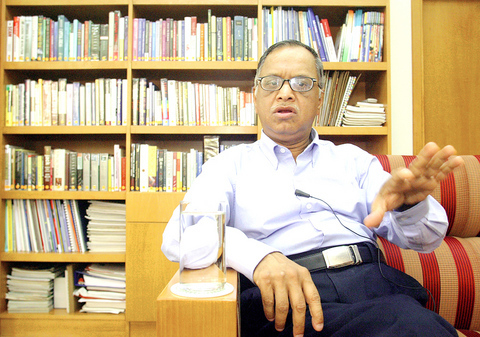
PHOTO: AP
Twenty-five years on, repeated surveys say Infosys Technologies Ltd, now headquartered in the high-tech city of Bangalore, is India's most admired company, and the outsourcing giant is the country's best-known brand in the global market.
Starting today, the company that writes software for such firms as Goldman Sachs and J.C. Penny celebrates its 25th anniversary in the southern Indian city of Mysore, at its new engineering training center.
Among other events, the celebrations will include remotely ringing tomorrow's bell to open trading on the NASDAQ stock exchange in New York -- the first time an Indian company will do so, and the latest in a string of Infosys firsts.
Infosys was India's first global company, with more than 90 percent of its US$2.1 billion in annual revenues coming from overseas. It was also the first in India to adopt a code of corporate transparency, offer stock options to employees and list shares in the US -- on the NASDAQ in 1999.
Today, many young Indian engineers shun offers from global giants like IBM to work at Infosys, where just one of every 100 applicants is accepted.
"We have demonstrated that it is possible to be world-class from India," said Chairman N.R. Narayana Murthy, who, as a principal founder, had to borrow money from his wife to set up the company with just 10,000 rupees (then US$1,000).
"Today, no matter where you go in India, if you talk to entrepreneurs in the country, they would say, `We want to be like Infosys,'" said Murthy, whom Time magazine ranked among the world's 25 most influential businessmen in 2001.
That said, the company faces formidable challenges.
With the founders still dominating Infosys' top rungs -- and with most of them in their early 50s -- a number of high-level executives have left in recent years, frustrated by their inability to rise.
Also, competition is mounting quickly. Where Infosys and its Indian peers once had much of the software outsourcing industry to themselves, companies such as IBM and Accenture are now spending enormous sums to create and expand their own Indian operations.
Infosys' culture is hardly typical of India, a country where bus-inesses long thrived on government protection and tax manipulation and where the corporate world was dominated by a tiny clique of family-owned conglomerates.
Even today, Infosys isn't India's biggest software company. Tata Consultancy Services makes nearly US$3 billion in annual revenue.
And while its competition thrived on government contracts in those early outsourcing days, Infosys always looked abroad for customers.
That wasn't easy. There were no venture capital firms then to pump up the company, and India had many currency restrictions.
Through the 1980s, there were few big contracts. The founders kept their salaries low, says Nandan Nilekani, now the company's chief executive, who in the early days would share a scooter with co-founder S.D. Shibulal as they drove around Bangalore looking for business.
But they had ambition.
"Even when they were a small company, they had a global vision," said Avinash Vashistha, chief executive of Tholons, a Bangalore-based consulting firm. "The company was never distracted from its vision ... You don't often see that happening here."
The first major break came in 1991, with a contract from Canadian telecommunication equipment maker Nortel Networks, Vashistha said. As the months passed, a few more contracts trickled in, slowly bringing the company into global reckoning.
Still, revenues totaled just US$100 million in 1999, a fraction of its rivals' earnings.
But when the dotcom bubble burst in 2000, it proved a blessing as scores of cost-slashing US companies began shifting software development and back-office work to India, with its low wages and educated workforce.
Between 1999 and 2004, Infosys' revenues grew tenfold, reaching US$1 billion.
With many experts doubting the company could sustain such growth, revenue doubled in the following two years -- now totaling a little over US$2 billion annually.
It didn't always go so well. When Infosys shares were first offered on the Indian stock market in 1993, there were not enough buyers.
But US$1 invested in the company then is now worth US$3,300.

Among the rows of vibrators, rubber torsos and leather harnesses at a Chinese sex toys exhibition in Shanghai this weekend, the beginnings of an artificial intelligence (AI)-driven shift in the industry quietly pulsed. China manufactures about 70 percent of the world’s sex toys, most of it the “hardware” on display at the fair — whether that be technicolor tentacled dildos or hyper-realistic personalized silicone dolls. Yet smart toys have been rising in popularity for some time. Many major European and US brands already offer tech-enhanced products that can enable long-distance love, monitor well-being and even bring people one step closer to

Malaysia’s leader yesterday announced plans to build a massive semiconductor design park, aiming to boost the Southeast Asian nation’s role in the global chip industry. A prominent player in the semiconductor industry for decades, Malaysia accounts for an estimated 13 percent of global back-end manufacturing, according to German tech giant Bosch. Now it wants to go beyond production and emerge as a chip design powerhouse too, Malaysian Prime Minister Anwar Ibrahim said. “I am pleased to announce the largest IC (integrated circuit) Design Park in Southeast Asia, that will house world-class anchor tenants and collaborate with global companies such as Arm [Holdings PLC],”

TRANSFORMATION: Taiwan is now home to the largest Google hardware research and development center outside of the US, thanks to the nation’s economic policies President Tsai Ing-wen (蔡英文) yesterday attended an event marking the opening of Google’s second hardware research and development (R&D) office in Taiwan, which was held at New Taipei City’s Banciao District (板橋). This signals Taiwan’s transformation into the world’s largest Google hardware research and development center outside of the US, validating the nation’s economic policy in the past eight years, she said. The “five plus two” innovative industries policy, “six core strategic industries” initiative and infrastructure projects have grown the national industry and established resilient supply chains that withstood the COVID-19 pandemic, Tsai said. Taiwan has improved investment conditions of the domestic economy

MAJOR BENEFICIARY: The company benefits from TSMC’s advanced packaging scarcity, given robust demand for Nvidia AI chips, analysts said ASE Technology Holding Co (ASE, 日月光投控), the world’s biggest chip packaging and testing service provider, yesterday said it is raising its equipment capital expenditure budget by 10 percent this year to expand leading-edge and advanced packing and testing capacity amid strong artificial intelligence (AI) and high-performance computing chip demand. This is on top of the 40 to 50 percent annual increase in its capital spending budget to more than the US$1.7 billion to announced in February. About half of the equipment capital expenditure would be spent on leading-edge and advanced packaging and testing technology, the company said. ASE is considered by analysts


 RSS
RSS