


The local bourse saw its third-largest plunge in two years yesterday, driven by weakening global markets on concern over tightening monetary policy and domestic jitters about the escalating political conflict.
The TAIEX shed 219.49 points, or 3.33 percent, to 6,363.55 on turnover of NT$96.49 billion (US$2.96 billion) yesterday, the third steepest dive since a 5.1 percent in May 2004. The nation's market experienced all of its top three biggest drops this month.
Foreign and local institutional investors collectively offloaded NT$11.948 billion worth of shares yesterday. Overseas investors have sold a net of NT$65.57 billion this month.
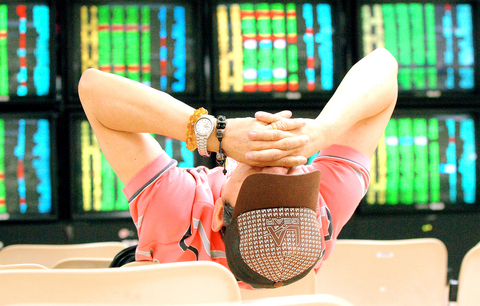
PHOTO: SAM YEH, AFP
The nation's market posted the sharpest fall yesterday compared to its neighbors, with South Korea's sliding 2 percent and Japan dropping 1.4 percent.
"The sentiment of local investors is weak ... and we think the market has overreacted," Ken Chen (陳安), managing director of UBS Securities Ltd's Taiwan Branch, told a media briefing yesterday.
Foreign investors are more concerned about the potential rise in US interest rates and a possible macroeconomic slowdown than local political dis-putes, Chen said at a two-day forum dubbed the "UBS Taiwan Conference."
More than 70 Taiwanese companies joined the conference, including 10 of the nation's 14 financial holding firms including Cathay Financial Holding Co (國泰金控), high-tech companies such as Taiwan Semiconductor Manufacturing Corp (台積電) and Acer Inc, traditional manufacturing firms like Uni-President Enterprises Corp (統一企業) and China Steel Corp (中鋼) and services industry companies like Formosa International Hotels Corp (晶華酒店).
Looking ahead, the TAIEX is expected to remain in a period of consolidation for the next two months with a support point at about 6,000, said Chen, who retained his forecast of a peak at 8,700 points in the next 12 months.
Yet, the industry outlook and conservative guidance from companies at the forum to some extent worried investors, who are especially concerned about inventory pileups in the high-tech sector due to a weakening global economy that could weaken demand for such products, Chen said.
Liquidity is another issue, as foreign investors have been pulling funds out of the relatively volatile emerging markets in the region recently, he added.
However, the analysts declined to comment on whether or when they may revise earnings forecasts and the rating of the Taiwan market.
Meanwhile, Morgan Stanley's chief Asian economist Andy Xie (謝國忠) said in his latest report released yesterday that a bear market is coming, driven by tightening monetary policy and looming inflation worldwide.
Interest rate hikes and inflation that constrains liquidity would remain the major risks to the global markets in the next two years, especially due to expectations of higher oil prices and rising manufacturing costs in China, Xie warned in the report.

Among the rows of vibrators, rubber torsos and leather harnesses at a Chinese sex toys exhibition in Shanghai this weekend, the beginnings of an artificial intelligence (AI)-driven shift in the industry quietly pulsed. China manufactures about 70 percent of the world’s sex toys, most of it the “hardware” on display at the fair — whether that be technicolor tentacled dildos or hyper-realistic personalized silicone dolls. Yet smart toys have been rising in popularity for some time. Many major European and US brands already offer tech-enhanced products that can enable long-distance love, monitor well-being and even bring people one step closer to

Malaysia’s leader yesterday announced plans to build a massive semiconductor design park, aiming to boost the Southeast Asian nation’s role in the global chip industry. A prominent player in the semiconductor industry for decades, Malaysia accounts for an estimated 13 percent of global back-end manufacturing, according to German tech giant Bosch. Now it wants to go beyond production and emerge as a chip design powerhouse too, Malaysian Prime Minister Anwar Ibrahim said. “I am pleased to announce the largest IC (integrated circuit) Design Park in Southeast Asia, that will house world-class anchor tenants and collaborate with global companies such as Arm [Holdings PLC],”

TRANSFORMATION: Taiwan is now home to the largest Google hardware research and development center outside of the US, thanks to the nation’s economic policies President Tsai Ing-wen (蔡英文) yesterday attended an event marking the opening of Google’s second hardware research and development (R&D) office in Taiwan, which was held at New Taipei City’s Banciao District (板橋). This signals Taiwan’s transformation into the world’s largest Google hardware research and development center outside of the US, validating the nation’s economic policy in the past eight years, she said. The “five plus two” innovative industries policy, “six core strategic industries” initiative and infrastructure projects have grown the national industry and established resilient supply chains that withstood the COVID-19 pandemic, Tsai said. Taiwan has improved investment conditions of the domestic economy
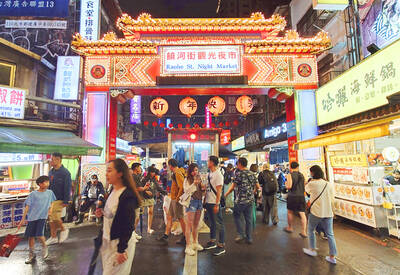
Sales in the retail, and food and beverage sectors last month continued to rise, increasing 0.7 percent and 13.6 percent respectively from a year earlier, setting record highs for the month of March, the Ministry of Economic Affairs said yesterday. Sales in the wholesale sector also grew last month by 4.6 annually, mainly due to the business opportunities for emerging applications related to artificial intelligence (AI) and high-performance computing technologies, the ministry said in a report. The ministry forecast that retail, and food and beverage sales this month would retain their growth momentum as the former would benefit from Tomb Sweeping Day


 RSS
RSS