


The Consumers' Foundation wants the government to establish a mechanism to stabilize produce prices during typhoon season or heavy rains to eliminate profiteering by middlemen.
As of 4pm yesterday, agricultural losses nationwide were estimated to have reached NT$975.96 million (US$30 million), with damages to produce accounting for 90 percent, or NT$885.93 million, according to statistics posted on the Council of Agriculture's Web site.
Retail prices of vegetables have soared dramatically as supplies have dropped.
Prices of leafy vegetables on Sunday rose 150.14 percent from May 26 with those for Chinese cabbage soaring a whopping 429.2 percent, the statistics showed.
Although rootstocks prices only rose 51.39 percent during the same period, the price of green onions skyrocketed 374.29 percent.
While some price hikes are reasonable given that 24,840 hectares of farmland have been flooded, the foundation said others are the result of profiteering.
"The government has pledged to hunt down greedy middlemen for more than two decades, to no avail. Every year when the rainy and typhoon seasons come, exploitation of vegetable prices occurs again and again," Consumers' Foundation (消基會) chairman Jason Lee (李鳳翱) said yesterday.
The foundation suggested that the government help establish a nationwide network of distribution centers, refrigeration facilities and transportation fleet so that farmers are able to ship their farm produce directly to retailers, reducing their dependence on middlemen.
But this does not mean that the role of middlemen should be eliminated, said Sun Lih-chyun (孫立群), an associate professor of agricultural economics at National Taiwan University.
"The existence of middlemen is a result of the market economy and most of them are good businesspeople making reasonable profits," said Sun, who is also the Consumers' Foundation's director and controller.
The government's major task, however, is to crack down on the handful of black sheep who drive up prices to cause market instability, he said.
Council for Economic Planning and Development Chairman Hu Sheng-cheng (胡勝正) said on Sunday that consumer prices were likely to increase more than 2 percent this year if bad weather continues to push up fruit and vegetable prices.
The government should map out measures to prevent massive price fluctuations, rather than scrambling to resolve the problem afterwards, the foundation said.
Sun suggested consumers can make purchases at supermarkets run by farmers' associations, the Taipei Agricultural Products Marketing Co (台北農產運銷公司), or major hypermarkets.

HSBC Holdings PLC is deepening its commitment to Taiwan as the economy emerges as one of the bank’s fastest-growing markets globally, driven by an artificial intelligence (AI) investment boom, expanding cross-border trade, and rising wealth creation. “The advantage that Taiwan has is a growth story linked to the semiconductor and broader AI industries, strong underlying corporate performance, and wealth creation,” said Surendra Rosha, HSBC’s co-chief executive for Asia and the Middle East, in an exclusive interview with the Taipei Times on June 2, during this year’s HSBC Taiwan Conference. That combination has helped HSBC cement its position as the most profitable international
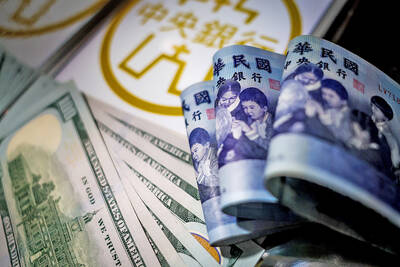
The New Taiwan dollar yesterday fell sharply against the US dollar to close at its lowest level since May 22 amid a massive outflow of funds from the country because of investors panicking over global equity markets. The NT dollar ended at NT$31.580 against the US dollar, slightly lower than its close of NT$31.568 on May 22, after moving between NT$31.5 and NT$31.648 on combined turnover of US$3.062 billion on the Taipei Foreign Exchange and the Cosmos Foreign Exchange. The NT dollar received a significant hit in the morning session, slumping as much as NT$0.173 at a time when other Asian currencies
Taiwan Semiconductor Manufacturing Co (TSMC, 台積電) is now ranked ninth among the world’s 100 most valuable companies after its market capitalization more than doubled over the past year, PricewaterhouseCoopers (PwC) Taiwan said in a report last month. TSMC’s market capitalization surged 101 percent year-on-year to US$1.427 trillion as of March 31, the accounting and consulting firm’s 2026 Global Top 100 Companies by Market Capitalization report said. The gain catapulted the world’s largest contract chipmaker from 12th place to ninth in the rankings, and it was the fastest-growing among the global top 10, it said. TSMC was the only Taiwanese company among the top
Taiwan Semiconductor Manufacturing Co (TSMC, 台積電) yesterday reported record revenue of NT$416.975 billion (US$13.17 billion) for last month, putting the world’s largest contract chipmaker on track to set a record for quarterly revenue. Last month’s figure surpassed March’s record NT$415.19 billion and represented increases of 1.5 percent from April and 30.1 percent from a year earlier. For the first five months of the year, TSMC generated NT$1.96 trillion in revenue, up 30 percent year-on-year, it said in a statement. TSMC has forecast second-quarter revenue of between US$39 billion and US$40.2 billion, representing sequential growth of about 10 percent and year-on-year growth of about


 RSS
RSS