


Global chip sales may rise 10.1 percent this year, the World Semiconductor Trade Statistics said, increasing its previous estimate on demand for memory chips used in personal computers and consumer electronics.
Chip sales will probably rise to US$250.5 billion this year, after increasing 6.8 percent to US$227.5 billion last year, according to the group, whose members include companies such as Intel Corp that account for about 90 percent of the industry. The San Jose, California-based group in October had predicted 8 percent industry revenue growth this year.
Sales growth in Japan will probably outpace global expansion, jumping 14 percent to ¥rillion (US$49.5 billion) this year, the group said. Annual revenue from memory chips is also likely to increase faster than overall sales, advancing 14 percent to US$55.3 billion, led by dynamic random access memory (DRAM) for PCs and flash for consumer electronics.
Market researchers ISuppli Corp and Gartner Inc have also raised their projections for industry. The estimates suggest demand for memory chips made by companies such as Samsung Electronics Co and used in products such as Apple Computer Inc's iPod Nano, is fueling sales.
Stamford, Connecticut-based Gartner on May 19 raised its revenue growth outlook for the industry this year to 11 percent from a 9.5 percent forecast in February, citing demand for DRAM for personal computers and NAND flash memory for consumer electronics.
Gartner forecast 11 percent revenue growth to US$259.5 billion this year on March 19.
ISuppli, based in El Segundo, California, expects global chip sales to rise 7.4 percent to US$254.7 billion this year, it said on April 7. The estimate compares with 6.8 percent forecast in January.

Macronix International Co (旺宏), the world’s biggest NOR flash memory supplier, yesterday said it would spend NT$22 billion (US$699.1 million) on capacity expansion this year to increase its production of mid-to-low-density memory chips as the world’s major memorychip suppliers are phasing out the market. The company said its planned capital expenditures are about 11 times higher than the NT$1.8 billion it spent on new facilities and equipment last year. A majority of this year’s outlay would be allocated to step up capacity of multi-level cell (MLC) NAND flash memory chips, which are used in embedded multimedia cards (eMMC), a managed
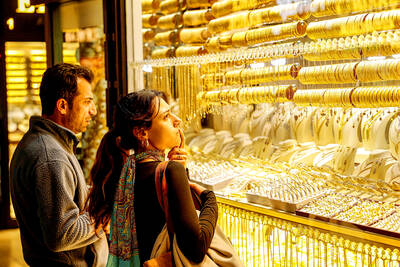
In Italy’s storied gold-making hubs, jewelers are reworking their designs to trim gold content as they race to blunt the effect of record prices and appeal to shoppers watching their budgets. Gold prices hit a record high on Thursday, surging near US$5,600 an ounce, more than double a year ago as geopolitical concerns and jitters over trade pushed investors toward the safe-haven asset. The rally is putting undue pressure on small artisans as they face mounting demands from customers, including international brands, to produce cheaper items, from signature pieces to wedding rings, according to interviews with four independent jewelers in Italy’s main
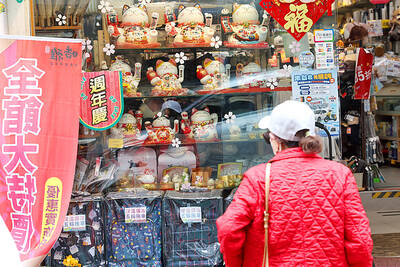
CULPRITS: Factors that affected the slip included falling global crude oil prices, wait-and-see consumer attitudes due to US tariffs and a different Lunar New Year holiday schedule Taiwan’s retail sales ended a nine-year growth streak last year, slipping 0.2 percent from a year earlier as uncertainty over US tariff policies affected demand for durable goods, data released on Friday by the Ministry of Economic Affairs showed. Last year’s retail sales totaled NT$4.84 trillion (US$153.27 billion), down about NT$9.5 billion, or 0.2 percent, from 2024. Despite the decline, the figure was still the second-highest annual sales total on record. Ministry statistics department deputy head Chen Yu-fang (陳玉芳) said sales of cars, motorcycles and related products, which accounted for 17.4 percent of total retail rales last year, fell NT$68.1 billion, or

In the wake of strong global demand for AI applications, Taiwan’s export-oriented economy accelerated with the composite index of economic indicators flashing the first “red” light in December for one year, indicating the economy is in booming mode, the National Development Council (NDC) said yesterday. Moreover, the index of leading indicators, which gauges the potential state of the economy over the next six months, also moved higher in December amid growing optimism over the outlook, the NDC said. In December, the index of economic indicators rose one point from a month earlier to 38, at the lower end of the “red” light.


 RSS
RSS