


Asian stocks closed sharply lower on Friday in response to Wall Street's overnight plummet amid deepening concerns over the outlook for interest rates in the US.
However, Shanghai stood out as a major anomaly by soaring 4.28 percent with investors positioning themselves on the back of a stronger yuan, government reforms and the sale of state-owned shares.
Elsewhere the mood was far more somber as disappointment over the US federal Reserve's failure to indicate whether a quarter-point rate hike earlier in the week would be the last in the current cycle took hold over regional markets.
And the trend that recently pushed many markets to record or multi-year highs was then thrown into reverse as surging commodity prices added to pessimism over inflation and the prospect that Asian central banks will follow the Fed's lead and push interest rates higher.
A weakening US dollar, which punishes the region's all important exporters, capped off the day and investors were left in the wings anxiously awaiting the release of crucial US trade data, due later on Friday, for their next lead.
Taipei, Tokyo, Hong Kong, Jakarta, Wellington, Seoul and Manila all shed more than 1 percent while losses in Sydney were limited to 0.65 percent due to Australia's position as a commodity export nation.
Bangkok, Singapore and Kuala Lumpur were closed for public holidays.
Taipei
Share prices closed down 1.12 percent in reduced trade following Wall Street's sharp falls overnight amid mounting concerns over inflation.
Dealers said the technology sector was also hit by a report that companies will be required to start declaring employee bonuses as an expense in their financial results staring next year.
The weighted index closed down 82.49 points at 7,278.96 on turnover of NT$127.72 billion (US$4.07 billion).
"The big decline on Wall Street triggered a knee-jerk reaction here, at a time when the local bourse was expected to experience a hiatus anyway," said Alex Huang, an assistant vice-president at Barits International Securities.
It makes perfect sense for local shares to consolidate recent gains as the benchmark index approaches technical resistance at its 24-day moving average, he said.
Huang said foreign investors became somewhat cautious after their extended buying spree over the past month.
But "the fact that our market did not lose as much ground as regional counterparts indicates they would not call it a day yet," he said, adding that "downside support could readily emerge at 7,200 points."
Taiwan Semiconductor Manufacturing Co closed down 1.70 at 64.90.
Tokyo
Share prices closed down 1.54 percent at a seven-week low, jolted by heavy losses on Wall Street and a stronger yen which undermines exporters' earnings.
Dealers said the market extended its losing streak to a fourth day after the US dollar fell below the ¥110 level for the first time for eight months.
The Nikkei-225 index declined 260.36 points to 16,601.78. Volume rose to 2.0 billion shares from 1.75 billion on Thursday.
"The market was hit by the yen's strength and by falls in US stocks overnight," said Hideyuki Suzuki, a strategist at SBI Securities.
"But after a plunge, the market saw some buying back in view of the reasonable prices," he said.
The US dollar was changing hands at ¥110.06 at the close of equities trading here after falling to as low as ¥109.93 in morning deals.
A stronger yen undermines the competitiveness of Japanese exporters and reduces the value of earnings repatriated from overseas.
Fujitsu shed ¥21 to ¥878.
Seoul
Share prices closed 1.33 percent lower after Thursday's record-breaking performance as sentiment was hurt by Wall Street's overnight losses and the latest spike in oil and commodity prices.
Dealers said the New York downturn hit the region as a whole, prompting heavy profit-taking after recent sustained gains.
The KOSPI index fell 19.50 points at 1,445.20. Volume was 253 million shares worth 3.7 trillion won (US$3.94 billion).
Samsung Electronics fell 8,000 won to 655,000.
Hong Kong
Share prices closed 1.39 percent lower following heavy falls on Wall Street overnight as rising commodity prices sparked fresh concerns over inflation and the outlook for interest rates.
Dealers said sharp losses across the region, especially in Japan, also weighed on sentiment.
The Hang Seng Index was down 238.93 points at 16,901.85. Turnover was HK$34.88 billion (US$4.5 billion).
"Wall Street and other overseas markets have fallen sharply and the local market took their lead, with selling across the board," said Brook McConnel, president of South Ocean Management.
Uncertainty over the interest rate outlook added to anxiety, he said, adding that local banks' decision not to follow the latest US rate hike did little to soothe the worries.

HSBC Holdings PLC is deepening its commitment to Taiwan as the economy emerges as one of the bank’s fastest-growing markets globally, driven by an artificial intelligence (AI) investment boom, expanding cross-border trade, and rising wealth creation. “The advantage that Taiwan has is a growth story linked to the semiconductor and broader AI industries, strong underlying corporate performance, and wealth creation,” said Surendra Rosha, HSBC’s co-chief executive for Asia and the Middle East, in an exclusive interview with the Taipei Times on June 2, during this year’s HSBC Taiwan Conference. That combination has helped HSBC cement its position as the most profitable international
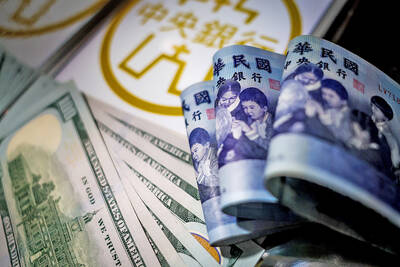
The New Taiwan dollar yesterday fell sharply against the US dollar to close at its lowest level since May 22 amid a massive outflow of funds from the country because of investors panicking over global equity markets. The NT dollar ended at NT$31.580 against the US dollar, slightly lower than its close of NT$31.568 on May 22, after moving between NT$31.5 and NT$31.648 on combined turnover of US$3.062 billion on the Taipei Foreign Exchange and the Cosmos Foreign Exchange. The NT dollar received a significant hit in the morning session, slumping as much as NT$0.173 at a time when other Asian currencies
Taiwan Semiconductor Manufacturing Co (TSMC, 台積電) is now ranked ninth among the world’s 100 most valuable companies after its market capitalization more than doubled over the past year, PricewaterhouseCoopers (PwC) Taiwan said in a report last month. TSMC’s market capitalization surged 101 percent year-on-year to US$1.427 trillion as of March 31, the accounting and consulting firm’s 2026 Global Top 100 Companies by Market Capitalization report said. The gain catapulted the world’s largest contract chipmaker from 12th place to ninth in the rankings, and it was the fastest-growing among the global top 10, it said. TSMC was the only Taiwanese company among the top
Taiwan Semiconductor Manufacturing Co (TSMC, 台積電) yesterday reported record revenue of NT$416.975 billion (US$13.17 billion) for last month, putting the world’s largest contract chipmaker on track to set a record for quarterly revenue. Last month’s figure surpassed March’s record NT$415.19 billion and represented increases of 1.5 percent from April and 30.1 percent from a year earlier. For the first five months of the year, TSMC generated NT$1.96 trillion in revenue, up 30 percent year-on-year, it said in a statement. TSMC has forecast second-quarter revenue of between US$39 billion and US$40.2 billion, representing sequential growth of about 10 percent and year-on-year growth of about


 RSS
RSS