


Asian stocks closed sharply lower on Friday in response to Wall Street's overnight plummet amid deepening concerns over the outlook for interest rates in the US.
However, Shanghai stood out as a major anomaly by soaring 4.28 percent with investors positioning themselves on the back of a stronger yuan, government reforms and the sale of state-owned shares.
Elsewhere the mood was far more somber as disappointment over the US federal Reserve's failure to indicate whether a quarter-point rate hike earlier in the week would be the last in the current cycle took hold over regional markets.
And the trend that recently pushed many markets to record or multi-year highs was then thrown into reverse as surging commodity prices added to pessimism over inflation and the prospect that Asian central banks will follow the Fed's lead and push interest rates higher.
A weakening US dollar, which punishes the region's all important exporters, capped off the day and investors were left in the wings anxiously awaiting the release of crucial US trade data, due later on Friday, for their next lead.
Taipei, Tokyo, Hong Kong, Jakarta, Wellington, Seoul and Manila all shed more than 1 percent while losses in Sydney were limited to 0.65 percent due to Australia's position as a commodity export nation.
Bangkok, Singapore and Kuala Lumpur were closed for public holidays.
Taipei
Share prices closed down 1.12 percent in reduced trade following Wall Street's sharp falls overnight amid mounting concerns over inflation.
Dealers said the technology sector was also hit by a report that companies will be required to start declaring employee bonuses as an expense in their financial results staring next year.
The weighted index closed down 82.49 points at 7,278.96 on turnover of NT$127.72 billion (US$4.07 billion).
"The big decline on Wall Street triggered a knee-jerk reaction here, at a time when the local bourse was expected to experience a hiatus anyway," said Alex Huang, an assistant vice-president at Barits International Securities.
It makes perfect sense for local shares to consolidate recent gains as the benchmark index approaches technical resistance at its 24-day moving average, he said.
Huang said foreign investors became somewhat cautious after their extended buying spree over the past month.
But "the fact that our market did not lose as much ground as regional counterparts indicates they would not call it a day yet," he said, adding that "downside support could readily emerge at 7,200 points."
Taiwan Semiconductor Manufacturing Co closed down 1.70 at 64.90.
Tokyo
Share prices closed down 1.54 percent at a seven-week low, jolted by heavy losses on Wall Street and a stronger yen which undermines exporters' earnings.
Dealers said the market extended its losing streak to a fourth day after the US dollar fell below the ¥110 level for the first time for eight months.
The Nikkei-225 index declined 260.36 points to 16,601.78. Volume rose to 2.0 billion shares from 1.75 billion on Thursday.
"The market was hit by the yen's strength and by falls in US stocks overnight," said Hideyuki Suzuki, a strategist at SBI Securities.
"But after a plunge, the market saw some buying back in view of the reasonable prices," he said.
The US dollar was changing hands at ¥110.06 at the close of equities trading here after falling to as low as ¥109.93 in morning deals.
A stronger yen undermines the competitiveness of Japanese exporters and reduces the value of earnings repatriated from overseas.
Fujitsu shed ¥21 to ¥878.
Seoul
Share prices closed 1.33 percent lower after Thursday's record-breaking performance as sentiment was hurt by Wall Street's overnight losses and the latest spike in oil and commodity prices.
Dealers said the New York downturn hit the region as a whole, prompting heavy profit-taking after recent sustained gains.
The KOSPI index fell 19.50 points at 1,445.20. Volume was 253 million shares worth 3.7 trillion won (US$3.94 billion).
Samsung Electronics fell 8,000 won to 655,000.
Hong Kong
Share prices closed 1.39 percent lower following heavy falls on Wall Street overnight as rising commodity prices sparked fresh concerns over inflation and the outlook for interest rates.
Dealers said sharp losses across the region, especially in Japan, also weighed on sentiment.
The Hang Seng Index was down 238.93 points at 16,901.85. Turnover was HK$34.88 billion (US$4.5 billion).
"Wall Street and other overseas markets have fallen sharply and the local market took their lead, with selling across the board," said Brook McConnel, president of South Ocean Management.
Uncertainty over the interest rate outlook added to anxiety, he said, adding that local banks' decision not to follow the latest US rate hike did little to soothe the worries.

BUSINESS UPDATE: The iPhone assembler said operations outlook is expected to show quarter-on-quarter and year-on-year growth for the second quarter Hon Hai Precision Industry Co (鴻海精密) yesterday reported strong growth in sales last month, potentially raising expectations for iPhone sales while artificial intelligence (AI)-related business booms. The company, which assembles the majority of Apple Inc’s smartphones, reported a 19.03 percent rise in monthly sales to NT$510.9 billion (US$15.78 billion), from NT$429.22 billion in the same period last year. On a monthly basis, sales rose 14.16 percent, it said. The company in a statement said that last month’s revenue was a record-breaking April performance. Hon Hai, known also as Foxconn Technology Group (富士康科技集團), assembles most iPhones, but the company is diversifying its business to
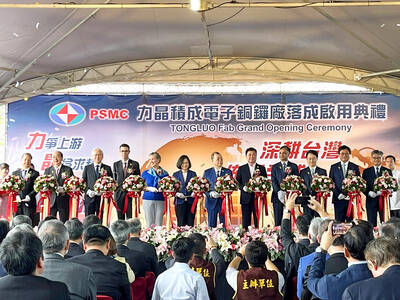
ARTIFICIAL INTELLIGENCE: The chipmaker last month raised its capital spending by 28 percent for this year to NT$32 billion from a previous estimate of NT$25 billion Contract chipmaker Powerchip Semiconductor Manufacturing Corp (力積電子) yesterday launched a new 12-inch fab, tapping into advanced chip-on-wafer-on-substrate (CoWoS) packaging technology to support rising demand for artificial intelligence (AI) devices. Powerchip is to offer interposers, one of three parts in CoWoS packaging technology, with shipments scheduled for the second half of this year, Powerchip chairman Frank Huang (黃崇仁) told reporters on the sidelines of a fab inauguration ceremony in the Tongluo Science Park (銅鑼科學園區) in Miaoli County yesterday. “We are working with customers to supply CoWoS-related business, utilizing part of this new fab’s capacity,” Huang said, adding that Powerchip intended to bridge

Qualcomm Inc, the world’s biggest seller of smartphone processors, gave an upbeat forecast for sales and profit in the current period, suggesting demand for handsets is increasing after a two-year slump. Revenue in the three months ended in June will be US$8.8 billion to US$9.6 billion, the company said in a statement Wednesday. Excluding certain items, earnings will be US$2.15 to US$2.35 a share. Analysts had projected sales of US$9.08 billion and earnings of US$2.16 a share. The outlook signals that the smartphone market has begun to bounce back, tracking with Qualcomm’s forecast that demand would gradually recover this year. The San

Clambering hand-over-hand, sweat dripping into his eyes, a durian laborer expertly slices a cumbersome fruit from a tree before tossing it down to land with a soft thump in his colleague’s waiting arms about 15m below. Among Thailand’s most famous and lucrative exports, the pungent “king of fruits” is as distinctive in its smell as its spiky green-brown carapace, and has been farmed in the kingdom for hundreds of years. However, a vicious heat wave engulfing Southeast Asia has resulted in smaller yields and spiraling costs, with growers and sellers increasingly panicked as global warming damages the industry. “This year is a crisis,”


 RSS
RSS