


The recovery in the liquid-crystal-display (LCD) industry will arrive several months later than expected as overcapacity further drives down prices, investment research firm Merrill Lynch said yesterday.
The comments came after LG.Philips LCD Co, the world's top LCD panel maker, on Tuesday lowered its forecast for panel prices and shipments in the first quarter. The panel maker, however, raised its outlook for profits on falling costs.
"We don't think it's something new ... Prices are falling faster than expected. The strength of growth momentum of all panel companies is weakening," Merrill Lynch technology analyst Daniel Kim told reporters after the conclusion of the second day of the firm's annual technology forum in Taipei.
The market expects panel prices to stabilize this month or next, and the rebound would be pushed back another few months, Kim said.
Kim blamed fast capacity growth for the unexpected fall in prices.
"This has nothing to do with demand ... However, the capacity growth rate is faster than the demand growth rate, especially [from] the two South Korean companies," Kim said. "That is resulting in the oversupply."
LG.Philips LCD and Samsung Electronics Co have ramped up their new production lines, which manufacture panels for big-screen slim units such as 40-inch and 42-inch TVs, rather than for more mainstream 32-inch TVs.
Kim expects panel prices for TVs and computers to be weak before the TV shopping season in the second half of the year.
Another Merrill Lynch analyst, Jeffrey Su (蘇志凱), said the firm had retained an "overweight" rating on the LCD component sector, especially Coretronic Corp (中光電), chipmaker Novatek Microelectronics Corp (聯詠) and the Hong Kong-listed LCD TV and computer monitor assembler TPV Technology Ltd (冠捷).

DAMAGE REPORT: Global central banks are assessing war-driven inflation risks as the law of unintended consequences careens around the world, spiking oil prices Central banks from Washington to London and from Jakarta to Taipei are about to make their first assessments of economic damage after more than two weeks of conflict between the US and Iran. Decisions this week encompassing every member of the G7 and eight of the world’s 10 most-traded currency jurisdictions are likely to confirm to investors that the specter of a new inflation shock is already worrying enough to prompt heightened caution. The US Federal Reserve is widely expected to do exactly what everyone anticipated weeks ahead of its March 17-18 policy gathering: hold rates steady. The narrative surrounding that

Taiwan Semiconductor Manufacturing Co’s (TSMC, 台積電) share of the global foundry market rose to almost 70 percent last year amid booming demand for artificial intelligence (AI), market information advisory firm TrendForce Corp (集邦科技) said on Thursday. The contract chipmaker posted US$122.54 billion in revenue, up 36.1 percent from a year earlier, accounting for 69.9 percent of the global market, TrendForce said. Its share was up from 64.4 percent in 2024, it said. TSMC’s closest rival, Samsung Electronics, was a distant second, posting US$12.63 billion in sales, down 3.9 percent from a year earlier, for a 7.2 percent share of the global market. In the
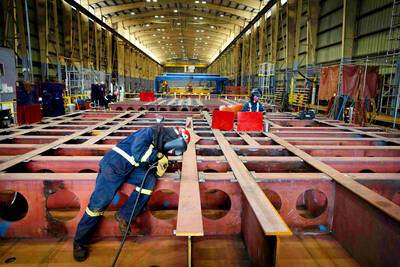
At a massive shipyard in North Vancouver, Canadian workers grind metal beams for a powerful new icebreaker crucial to cementing the country’s presence in the increasingly contested arctic. Icebreakers are specialized, expensive vessels able to navigate in the frozen far north. And “this is the crown jewel,” said Eddie Schehr, vice president of production at the Seaspan shipyard. For Canadian Prime Minister Mark Carney, who heads to Norway next Friday to observe arctic defense drills involving troops from 14 NATO states, Canada’s extreme north has emerged as a strategic priority. “Canada is and forever will be an Arctic nation,” he said ahead of

Chinese entrepreneur Frank Gao used to spend long hours running his social media accounts but now outsources the chore to artificial intelligence (AI) agent tool OpenClaw, which is taking China by storm despite official warnings over cybersecurity. OpenClaw, created in November by an Austrian coder, differs from bots such as ChatGPT because it can execute real-life tasks such as sending e-mails, organizing files or even booking flight tickets. “Since January, I’ve spent hours on the lobster every day,” Gao said in an interview, referring to OpenClaw’s red crustacean mascot. “We’re family.” After downloading OpenClaw, users connect it to artificial intelligence models of their


 RSS
RSS