


Taiwan's top official in charge of environmental protection said yesterday that he supports a plan by the Yunlin County magistrate to impose "green taxes" on major industrial factories located in Yunlin as they are major sources of air pollution in the south-central county.
Environmental Protection Administration (EPA) Minister Chang Kow-lung (張國龍) said during an interpellation session at the Legislative Yuan that he is determined to support the implementation of green taxes, or eco-taxes, in Yunlin County, even if it means he loses his job as a result of policy controversies between the EPA and the Ministry of Finance.
Yunlin County Comissioner Su Chih-fen (蘇治芬) has reportedly been planning to allow the Yunlin County government to impose green taxes on large industrial factories in the county, including a naphtha cracking plant owned by the Formosa Plastics Group (
A group of legislators from across the political spectrum also threw their support behind Su's idea.
Yin Ling-ying (尹伶瑛), an opposition Taiwan Solidarity Union (TSU) legislator representing Yunlin, said green taxes are "taxes of justice" and it is right that industries should pay for the pollution they produce. If polluting factories operating in Yunlin are required to pay "taxes of justice," the revenue generated can be used to beef up infrastructure development in the county, Yin said.
Under the existing taxation system, however, Yunlin County receives only a mere NT$200 million (US$6.15 million) in subsidies annually from the central government, which levies an average of NT$23.6 billion (US$726 million) in tax on the Formosa Plastics Group each year, Su said.
Su added that it is pitifully unfair that Yunlin County receives the second-smallest appropriation from the central government among all cities and counties around the country while playing host to an array of major polluters, resulting in continuous deterioration in the environment without having enough budget to spend on improving local development.
Chinese Nationalist Party (KMT) legislators Hsu Shu-po (許舒博), Chang Shuo-wen (張碩文) and independent Legislator Chang Li-shan (張麗善) asked the Ministry of Economic Affairs to convene supra-ministerial meetings to build up clear and workable measures to save Yunlin County from the quagmire in which the county suffers from environmental pollution and damage but receives little in return from the industries.
Responding to the legislators, Minister of Economic Affairs Morgan Hwang (黃營杉) said he would call on Su in person shortly to gain a better understanding of Su's plans before consulting the finance ministry over the issue.
Huang promised that the Ministry of Economic Affairs will assess the taxation proposal thoroughly, taking overall national interests and local needs into consideration.

Elon Musk’s lieutenants have reached out to chip industry suppliers, including Applied Materials Inc, Tokyo Electron Ltd and Lam Research Corp, for his envisioned Terafab, early steps in an audacious and likely arduous attempt to break into the production of cutting-edge chips. Staff working for the joint venture between Tesla Inc and Space Exploration Technologies Corp (SpaceX) have sought price quotes and delivery times for an array of chipmaking gear, people familiar with the matter said. In past weeks, they’ve contacted makers of photomasks, substrates, etchers, depositors, cleaning devices, testers and other tools, according to the people, who asked not to
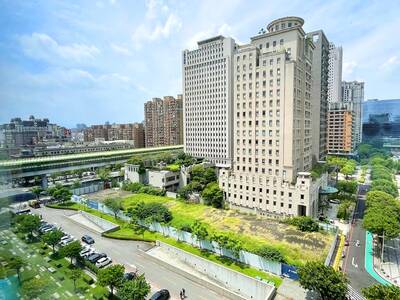
Taichung reported the steepest fall in completed home prices among the six special municipalities in the first quarter of this year, data compiled by Taiwan Realty Co (台灣房屋) showed yesterday. From January through last month, the average transaction price for completed homes in Taichung fell 8 percent from a year earlier to NT$299,000 (US$9,483) per ping (3.3m²), said Taiwan Realty, which compiled the data based on the government’s price registration platform. The decline could be attributed to many home buyers choosing relatively affordable used homes to live in themselves, instead of newly built homes in the city’s prime property market, Taiwan Realty

JET JUICE: The war on Iran’s secondary effects have seen fuel prices skyrocket, knocking flight schedules down to earth in return as airlines struggle with costs Airline passengers should brace for more irritation in the next few months as carriers worldwide cancel flights and ground planes to cope with stratospheric increases in jet-fuel prices. Dutch flag carrier KLM is the latest company to cut its schedule, saying on Thursday that it would scrap 80 return flights at Amsterdam’s Schiphol Airport in the coming month. That puts it in the same league as United Airlines Holdings Inc, Deutsche Lufthansa AG and Cathay Pacific Airways Ltd, which have all pruned itineraries to mitigate costs. Global capacity for next month has been reduced by about 3 percentage points, with all

Taiwan is attracting a growing number of foreign jobseekers as companies increasingly recruit overseas talent to ease labor shortages and expand global reach, recruitment platform 104 Job Bank (104人力銀行) said yesterday. More than 40,000 foreign nationals searched for jobs in Taiwan through the platform last year, a 28 percent increase from a year earlier, the company said. Malaysians accounted for the largest share of overseas jobseekers at 12.2 percent, followed by Indonesians at 11.9 percent and Vietnamese at 10.8 percent. Indonesian applicants surged more than 50 percent year-on-year, while Vietnamese jobseekers rose by more than 30 percent. Applicants from the


 RSS
RSS