


American appetites for all things foreign, from oil to cars to clothing, pushed the trade deficit to yet another record last year.
And the year's US$201.6 billion deficit with China, the largest ever recorded with a single country, brought demands for a crackdown on what the US sees as unfair trade practices.
The US Commerce Department reported on Friday that the overall trade gap climbed to an all-time high of US$725.8 billion last year. The deficit was up 17.5 percent from 2004, marking the fourth straight record.
On Wall Street, the Dow Jones industrial average rose 35.70 points to close at 10,919.05 on Friday after being down as much as 63 points earlier in the session.
The chief culprit in pushing the deficit up last year was record global oil prices and increased US demand because of a loss of Gulf Coast production following Hurricane Katrina. The US foreign oil bill soared to a record US$251.6 billion, up 39.4 percent from 2004.
Imports of other consumer goods including foreign autos hit record levels as well, a development that is causing major woes for US automakers.
Analysts predicted that the trade gap will be even worse this year, with Global Insight forecasting it could hit US$810 billion, reflecting lagging economic growth overseas that could hold back US exports.
"Trade is far and away the largest weight on the US economy at present. This is a risky time," said Mark Zandi, chief economist at Moody's Economy.com.
The record amounts of dollars that are flowing into foreign hands to pay for imports are being invested in US stocks, bonds and other investments. Economists worry that if foreigners suddenly decide they want to hold fewer US assets, they could send the value of the dollar, stocks and bonds all plunging.
The record flow of foreign goods into this country has given consumers a wide array of choices at low prices, helping to keep a lid on inflation. But critics contend the trade deficits have contributed to the loss of nearly 3 million manufacturing jobs since mid-2000 as US companies moved production overseas to lower-waged nations. Many economists believe those manufacturing jobs will never come back.
"America's gargantuan trade deficit is a weight around American workers' necks that is pulling them into a cycle of debt, bankruptcy and low-wage service jobs," said Richard Trumka, secretary-treasurer of the American Federation of Labor-Congress of Industrial Organizations.
In an effort to counter economic anxiety, US President George W. Bush included in his new budget an American Competitiveness Initiative to double government spending on basic research, extend tax breaks for company spending on research and hire thousands of new math and science teachers for the nation's high schools.
Many in Congress want a tougher approach. Legislation with broad support in the House and Senate would impose across-the-board tariffs of 27.5 percent on Chinese imports unless China stops what critics charge is a blatant manipulation of its currency to gain trade advantages.
Other legislation introduced on Thursday by Senators Byron Dorgan and Lindsey Graham would make China's current low tariffs subject to annual review by Congress to make sure the country is following global trade rules.
Last year, imports rose by 12.9 percent to an all-time high of US$2 trillion, swamping a 10.4 percent increase in exports, which reached a record high of US$1.27 trillion.
For December, the trade deficit edged up a slight 1.5 percent to US$65.7 billion, the third highest monthly figure on record.
The US$201.6 billion US trade deficit with China was the highest ever recorded with any country. It was up 24.5 percent above the previous record deficit of US$161.9 billion with China set in 2004.
The US ran up record deficits with much of the rest of the world including Japan, the EU, OPEC nations, Canada, Mexico and Central and South America.
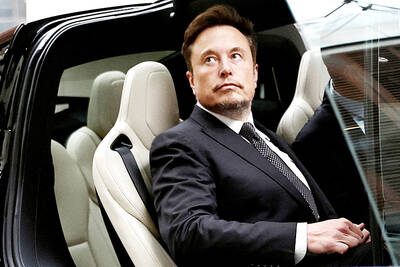
purpose: Tesla’s CEO sought to meet senior Chinese officials to discuss the rollout of its ‘full self-driving’ software in China and approval to transfer data they had collected Tesla Inc CEO Elon Musk arrived in Beijing yesterday on an unannounced visit, where he is expected to meet senior officials to discuss the rollout of "full self-driving" (FSD) software and permission to transfer data overseas, according to a person with knowledge of the matter. Chinese state media reported that he met Premier Li Qiang (李強) in Beijing, during which Li told Musk that Tesla's development in China could be regarded as a successful example of US-China economic and trade cooperation. Musk confirmed his meeting with the premier yesterday with a post on social media platform X. "Honored to meet with Premier Li
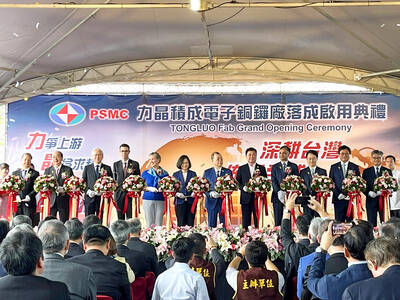
ARTIFICIAL INTELLIGENCE: The chipmaker last month raised its capital spending by 28 percent for this year to NT$32 billion from a previous estimate of NT$25 billion Contract chipmaker Powerchip Semiconductor Manufacturing Corp (力積電子) yesterday launched a new 12-inch fab, tapping into advanced chip-on-wafer-on-substrate (CoWoS) packaging technology to support rising demand for artificial intelligence (AI) devices. Powerchip is to offer interposers, one of three parts in CoWoS packaging technology, with shipments scheduled for the second half of this year, Powerchip chairman Frank Huang (黃崇仁) told reporters on the sidelines of a fab inauguration ceremony in the Tongluo Science Park (銅鑼科學園區) in Miaoli County yesterday. “We are working with customers to supply CoWoS-related business, utilizing part of this new fab’s capacity,” Huang said, adding that Powerchip intended to bridge
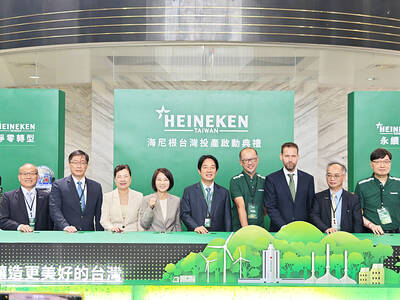
Dutch brewing company Heineken NV on Friday announced an investment of NT$13.5 billion (US$414.62 million) over the next five years in Taiwan. The first multinational brewing company to operate in Taiwan, Heineken made the statement at a ceremony held at its brewery in Pingtung County. It also outlined its efforts to make the brewery “net zero” by 2030. Heineken has been in the Taiwanese market for 20 years, Heineken Taiwan managing director Jeff Wu (吳建甫) said. With strong support from local consumers, the Dutch brewery decided to transition from sales to manufacturing in the country, Wu said. Heineken assumed majority ownership and management rights

Microsoft Corp yesterday said that it would create Thailand’s first data center region to boost cloud and artificial intelligence (AI) infrastructure, promising AI training to more than 100,000 people to develop tech. Bangkok is a key economic player in Southeast Asia, but it has lagged behind Indonesia and Singapore when it comes to the tech industry. Thailand has an “incredible opportunity to build a digital-first, AI-powered future,” Microsoft chairman and chief executive officer Satya Nadella said at an event in Bangkok. Data center regions are physical locations that store computing infrastructure, allowing secure and reliable access to cloud platforms. The global embrace of AI


 RSS
RSS