


The Year of the Dog is not likely to be any easier for the nation's already glum banking sector, as the snowballing problem of bad consumer loans will continue to plague the industry, market watchers said.
"The mounting number of bad consumer loans will remain a major theme and pose a downside risk to the banking sector this year," said Jesse Wang (王嘉樞), head of research at BNP Paribas Securities (Taiwan) Co.
The black hole of bad debts is expected to expand if the legislature passes the drafted amendments to the Bankruptcy Law (破產法) aimed at helping heavily indebted individual borrowers, Wang said.
Having already written off up to NT$70 billion (US$2.22 billion) in bad debts, local banks still have to deal with another NT$20 billion worth of non-performing loans generated by credit and cash-card businesses. This is equivalent to 2.5 percent of the nation's total credit and cash-card lending balance, which amounted to some NT$800 billion as of December last year, according to the Financial Supervisory Commission's (FSC) Banking Bureau.
The issue has also become a social problem, as a number of insolvent debtors have committed suicide after being hounded by debt-collecting companies, which are notorious for using illegal or even violent measures to scare borrowers into paying their debts.
Since the public is eagerly anticipating a quick solution to the debt problem, Wang expects the Bankruptcy Law amendments to be approved in the next legislative session, but he warned that it may take another three months after the passage of the amendments before the impact on bad loans becomes apparent.
If this is the case, the problem with bad loans would not ease off until after the third quarter of this year at the earliest, Wang said.
The Judicial Yuan designed the draft amendments to offer individual borrowers facing insolvency easier payback solutions, in the hope of systematically eradicating the credit problem and relieving borrowers' burden.
The amendments would allow courts to grant insolvent individuals with debts amounting to between NT$2 million and NT$20 million graded exemption from their full credit obligations. People who have been declared bankrupt would be allowed to pay off their remaining outstanding debt in installments over a maximum term of five years.
"We do not want an overly loose bankruptcy mechanism," Financial Supervisory Commission spokesman Lin Chung-cheng (
The commission expects to back up debt-relief efforts with thorough supporting measures, such as stricter criteria limiting bankruptcy filings, Lin said.
Currently, debtors can negotiate with banks under a bail-out program implemented by the Bankers Association (銀行公會), which provides reduced interest rates at a minimum of 3.88 percent, compared with the 20 percent revolving rate levied on credit or cash cards, and longer payback terms of up to 80 months.
The consumer debt problem began to flash alarm signals around the middle of last year, triggering a snowball effect on lenders and forcing them to tighten up credit to borrowers amid concerns of a systematic crisis in the consumer banking sector. Nonetheless, Banking Bureau director-general Gary Tseng (曾國烈) appears optimistic about the issue.
Tseng said last month that the problem is expected to start dwindling toward the end of the first half of this year.
The NT$20 billion in defaulted loans is likely to deal a limited blow to the banking industry, which has provisioned only NT$16 billion in reserves to cover the bad debts, Tseng said.
However, Tseng said that local banks are doing well, and with their combined pre-tax income amounting to NT$140 billion last year, they should be able to absorb the loss.
Nonetheless, more bad debts could emerge, as the number of potential debtors who borrow money to pay other debts could double to 800,000 from the commission's original estimate of 400,000 after banks moved to tighten lending in order to minimize their default risks, according to a research report released by ABN AMRO Asset Management Taiwan Ltd last month.
The tightening-up of consumer lending, which used to be the major growth driver, will drag overall lending growth down to below previous estimates of 5 percent for this year, SinoPac Securities Corp's (
The profitability of local banks could further weaken this year after plunging to about NT$130 billion in post-provision earnings last year, down from NT$155.3 billion in 2004, she warned.
Since financial groups have more capital to help themselves survive the sluggishness, small-scale and standalone banks with fewer resources are more likely to fall prey to acquisitions by their bigger rivals, rather than by the financial holding firms as the government expects, said Shirley Yang (
Mergers and acquisitions are likely to remain a theme this year, as the government has vowed to halve the number of financial holding companies by the year's end in the final phase of its second-stage financial reforms designed to consolidate the nation's fragmented banking sector.
"It is highly challenging to achieve the goal in time as planned, especially when most of the financial groups are private," said Felice Chen (陳嫦芬), vice chairman of investment banking at UBS Securities Ltd Taiwan Branch, which advised SinoPac Financial Holding Co (建華金控) on its takeover of the International Bank of Taipei (台北國際商銀) last year.
In spite of the government's master plan, 11 of the nation's 14 financial holding companies have expressed opposition to being taken over by rivals during a legislative hearing in December.
Nevertheless, the nation's financial regulator appears determined to fulfill its task through stick-and-carrot measures designed to stimulate consolidation among financial groups.
The commission is formulating a competitiveness assessment mechanism, which includes quantifiable criteria like return-on-assets (ROA) and return-on-equity (ROE) ratios, as well as qualitative requirements such as credit ratings given by international ratings firms, overseas operations, contribution to public welfare and corporate governance, FSC Chairman Kong Jaw-sheng (
Financial groups that fail to meet requirements could face penalties like the revocation of branch licenses for their banking units, according to the commission.

Among the rows of vibrators, rubber torsos and leather harnesses at a Chinese sex toys exhibition in Shanghai this weekend, the beginnings of an artificial intelligence (AI)-driven shift in the industry quietly pulsed. China manufactures about 70 percent of the world’s sex toys, most of it the “hardware” on display at the fair — whether that be technicolor tentacled dildos or hyper-realistic personalized silicone dolls. Yet smart toys have been rising in popularity for some time. Many major European and US brands already offer tech-enhanced products that can enable long-distance love, monitor well-being and even bring people one step closer to

Malaysia’s leader yesterday announced plans to build a massive semiconductor design park, aiming to boost the Southeast Asian nation’s role in the global chip industry. A prominent player in the semiconductor industry for decades, Malaysia accounts for an estimated 13 percent of global back-end manufacturing, according to German tech giant Bosch. Now it wants to go beyond production and emerge as a chip design powerhouse too, Malaysian Prime Minister Anwar Ibrahim said. “I am pleased to announce the largest IC (integrated circuit) Design Park in Southeast Asia, that will house world-class anchor tenants and collaborate with global companies such as Arm [Holdings PLC],”

Sales in the retail, and food and beverage sectors last month continued to rise, increasing 0.7 percent and 13.6 percent respectively from a year earlier, setting record highs for the month of March, the Ministry of Economic Affairs said yesterday. Sales in the wholesale sector also grew last month by 4.6 annually, mainly due to the business opportunities for emerging applications related to artificial intelligence (AI) and high-performance computing technologies, the ministry said in a report. The ministry forecast that retail, and food and beverage sales this month would retain their growth momentum as the former would benefit from Tomb Sweeping Day
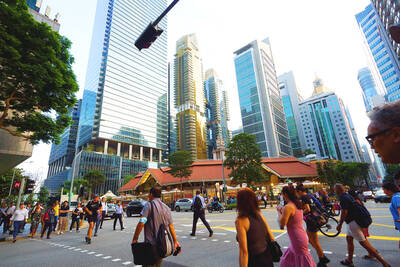
Thousands of parents in Singapore are furious after a Cordlife Group Ltd (康盛人生集團), a major operator of cord blood banks in Asia, irreparably damaged their children’s samples through improper handling, with some now pursuing legal action. The ongoing case, one of the worst to hit the largely untested industry, has renewed concerns over companies marketing themselves to anxious parents with mostly unproven assurances. This has implications across the region, given Cordlife’s operations in Hong Kong, Macau, Indonesia, the Philippines and India. The parents paid for years to have their infants’ cord blood stored, with the understanding that the stem cells they contained


 RSS
RSS