


On Lunar New Year's Eve, sitting around a big table feasting on homemade dishes has been a long-held tradition in Chinese societies. But with career women appearing to outnumber housewives, this custom has lately undergone a modern twist, giving rise to diverse new ways of celebrating the holidays.
One of the marked changes is that a growing number of families are choosing to keep away from the dreaded chore of preparing New Year feasts, and retailers and restaurants are scrambling to share their burdens by offering family reunion dinners -- which you can have either at the restaurant or at home.
Frozen Style
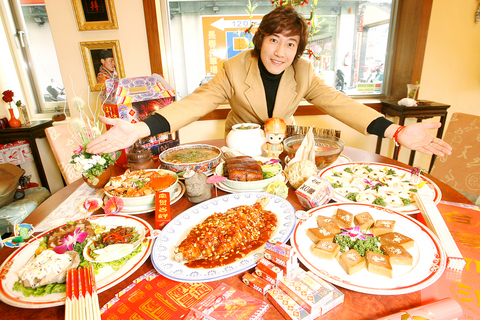
PHOTO: TAI TA-HSIANG, TAIPEI TIMES
Five years ago, major retailers like convenience-store chains and hypermarkets started developing frozen set meals, marketed with colorful flysheets giving consumers the opportunity to make pre-paid purchases at least a month ahead. Claimed to be good for 12 months if frozen properly, the dishes can be served after being microwaved or steamed.
This new market segment soon gained popularity with a growing number of non-retail competitors, such as gas stations and bus companies, which jumped in to grab a share last year.
"The burgeoning frozen-meal market was hyped into such a big issue last year, and the segment felt some slight disorder. Consolidation is being experienced this year because non-retailers decided to drop out of competition," said Vivien Hsu (徐崇嵐), a public relations official with President Chain Store Corp (統一超商), operator of the world's third-largest 7-Eleven franchise.
Over the past five years, the overall Lunar New Year frozen dish market has expanded into an industry Hsu estimates to be worth NT$600 million (US$19 million) per year.
Convenience stores, hypermarkets and supermarkets are the main contenders, with the nation's 8,000 convenience stores occupying about half of the market, Hsu said.
President Chain offers five set meals this year, priced between NT$2,888 and NT$3,788, and a non-set menu of 22 dishes, up from last year's eight.
"The proportion of non-set food has been raised. We found from last year's experience that consumers like to make their own combinations. Dishes that require time-consuming cooking procedures are especially popular, such as `Buddha Jumps the Wall' (
Although most of the non-set meals offered are reasonably economical at around NT$500 apiece, at NT$2,888 the "Buddha Jumps the Wall" still has its fans.
Hsu is confident that the frozen meal market will continue to grow, albeit at a slower pace.
The non-set menu should develop toward a more sophisticated style next year to drive growth, Hsu added.
Fresh and Hot
While popular retailers are churning out lower-priced food and providing convenient home-delivery services, some gourmets choose to side with delicacies rather than their purses.
Margaret Chung (
"Doing the shopping at convenience stores is really easy, but my husband thinks the food loses some taste during the freezing and heating process. We'd like to order some dishes from hotel restaurants this year," she said.
Although the choices are pricier, her family prefers treating themselves to a good meal on this important day, she said.
Hotels like the five-star Grand Formosa Regent Taipei spotted the trend long ago and jumped on the bandwagon to develop this niche market.
Offering various selections of Taiwanese, Cantonese and Shanghai-style meals, dishes on Grand Formosa's a la carte takeout menu are priced from NT$1,000 to NT$3,200 apiece. Consumers have to pick up their pre-ordered, freshly made dishes on Lunar New Year's Eve, but no reheating is required to maintain quality and freshness, said Beth Tsai (蔡惠茹), the hotel's promotions and public relations assistant manager.
In addition to enjoying the sumptuous fare themselves, the more affluent are also ordering food as special gifts for VIP guests or relatives.
Grand Formosa is working with the porcelain manufacturer Franz Collection Inc (
This year, Howard Plaza Hotel Taipei is offering limited-edition shark fin soup in porcelain containers made by the Japanese company Narumi which retails for NT$13,800.
"As the container can be displayed as a piece of art after the meal is finished, we believe this deluxe gift-giving trend will continue to catch on," Tsai said.
Five-star Service
While some people still prefer eating at home, others have moved away from this tradition and are turning to restaurants or hotels.
"We noticed that people liked to wei lu [sit around a pot] at hotels starting two or three years ago. The booking demand is even stronger this year," said Luanne Li (李佳燕), marketing communications manager at Grand Hyatt Taipei.
Grand Hyatt's two Chinese restaurants, Pearl Liang (漂亮) and Shanghai Court (滬悅庭), were already fully booked in mid-November, a month earlier than the previous year, Li said. The hotel charges NT$26,000 for a table of 10, and one for 12 costs NT$28,000.
To meet surging demand, the hotel will open its grand ballroom, which can accommodate 35 to 40 tables, to offer buffet services on Lunar New Year's Eve.
"Demand for seating has reached 90 percent of capacity. Those who want to enjoy the five-star festive atmosphere should hurry up," she suggested yesterday.
Branching Out
Taiwanese modern alternatives for the Lunar New Year's feast have expanded across the Taiwan Strait, with a local company testing the water in Shanghai this year.
Taipei-based Netec Technology Corp (
Teaming up with some of Grand Formosa's chefs, Netec prepares frozen set meals targeted at the tens of thousands of Taiwanese businesspeople as well as the locals in Shanghai, aiming to secure NT$50 million in sales on its first try, said Maggie Chou (周美裕), Netec's director-manager.
"To maintain freshness and take local tastes into account, the food is manufactured in factories in Shanghai and delivered through two convenience stores and one hypermarket there," she said.
With an eye on the 20 million people living in the metropolis, Netec plans to stand firm and offer a more complete line-up of products and services next year.
"The market is huge there. We don't rule out expanding the scale of our operations, but we'll conduct market research to gradually introduce diversified services across the Strait," Chou said.

ISSUES: Gogoro has been struggling with ballooning losses and was recently embroiled in alleged subsidy fraud, using Chinese-made components instead of locally made parts Gogoro Inc (睿能創意), the nation’s biggest electric scooter maker, yesterday said that its chairman and CEO Horace Luke (陸學森) has resigned amid chronic losses and probes into the company’s alleged involvement in subsidy fraud. The board of directors nominated Reuntex Group (潤泰集團) general counsel Tamon Tseng (曾夢達) as the company’s new chairman, Gogoro said in a statement. Ruentex is Gogoro’s biggest stakeholder. Gogoro Taiwan general manager Henry Chiang (姜家煒) is to serve as acting CEO during the interim period, the statement said. Luke’s departure came as a bombshell yesterday. As a company founder, he has played a key role in pushing for the

China has claimed a breakthrough in developing homegrown chipmaking equipment, an important step in overcoming US sanctions designed to thwart Beijing’s semiconductor goals. State-linked organizations are advised to use a new laser-based immersion lithography machine with a resolution of 65 nanometers or better, the Chinese Ministry of Industry and Information Technology (MIIT) said in an announcement this month. Although the note does not specify the supplier, the spec marks a significant step up from the previous most advanced indigenous equipment — developed by Shanghai Micro Electronics Equipment Group Co (SMEE, 上海微電子) — which stood at about 90 nanometers. MIIT’s claimed advances last

CROSS-STRAIT TENSIONS: The US company could switch orders from TSMC to alternative suppliers, but that would lower chip quality, CEO Jensen Huang said Nvidia Corp CEO Jensen Huang (黃仁勳), whose products have become the hottest commodity in the technology world, on Wednesday said that the scramble for a limited amount of supply has frustrated some customers and raised tensions. “The demand on it is so great, and everyone wants to be first and everyone wants to be most,” he told the audience at a Goldman Sachs Group Inc technology conference in San Francisco. “We probably have more emotional customers today. Deservedly so. It’s tense. We’re trying to do the best we can.” Huang’s company is experiencing strong demand for its latest generation of chips, called

GLOBAL ECONOMY: Policymakers have a choice of a small 25 basis-point cut or a bold cut of 50 basis points, which would help the labor market, but might reignite inflation The US Federal Reserve is gearing up to announce its first interest rate cut in more than four years on Wednesday, with policymakers expected to debate how big a move to make less than two months before the US presidential election. Senior officials at the US central bank including Fed Chairman Jerome Powell have in recent weeks indicated that a rate cut is coming this month, as inflation eases toward the bank’s long-term target of two percent, and the labor market continues to cool. The Fed, which has a dual mandate from the US Congress to act independently to ensure


 RSS
RSS