


A former employee of the giant US glass maker Corning Inc has pleaded guilty to a charge of stealing documents for the production of ultrathin glass used in flat-panel televisions and computer monitors and trying to sell them to one of Taiwan's pioneering electronics companies, Picvue Electronics Ltd (
The man, Jonathan Sanders, 37, admitted in a US District Court to stealing blueprints for Corning's liquid-crystal-display (LCD) glass manufacturing process and selling them to Picvue executives in 2000 for US$34,000.
The theft led to a patent infringement suit in which Picvue agreed last October to pay Corning US$15 million in damages.
The prosecutor, assistant US attorney Tiffany Lee, told the federal court in Rochester, New York, where Corning is headquartered, that the secrets were valued at more than US$100 million. Picvue intended to use the technology to make thin-film-transistor LCDs to compete with Corning, she said.
However, as part of the patent suit settlement, Picvue returned the documents to Corning and agreed not to use the patented process.
Under a plea agreement signed on Tuesday when he pleaded guilty to a felony charge of conspiracy to commit trade-secret theft, Sanders faces a prison term of five years plus a fine of US$250,000 or more. He will be sentenced on April 18.
The technology at the center of the case involves the overflow down-drawing fusion process to produce glass for flat-panel monitors. In addition to producing the glass in the US, Corning in 2001 opened a facility in Tainan and recently completed a second plant in Taichung.
According to court records, Sanders said he found the blueprints for the glass-making process in 1999 in a waste bin at a Corning plant in Kentucky where he was employed. The waste bin contained confidential material to be destroyed.
In December 1999, he was introduced to former Picvue president Jacob W. Lin (
In early 2000, Jacob Lin again traveled to Kentucky, and offered Sanders a job, which Sanders eventually turned down.
That same year, Picvue agreed to purchase drawings of the glass-making technology blueprints from Sanders and sent him a US$25,000 payment. Sanders later received another US$9,000.
Sometime that year, Picvue formed Picvue Optoelectonics (
The FBI investigation began in September 2001, when Picvue executives visited a company in Niagara Falls, New York, to purchase its subsidiary that manufactured a key component in the glass-making process. The Picvue representatives presented the US firm with technical drawings which it recognized as similar to Corning's process. The drawings were shown to Corning, which confirmed that they were stolen.
Last October, an FBI special agent questioned Jacob Lin about how Picvue came into possession of the Corning technology. A week later, Picvue and Corning announced the US$15 million patent-infringement suit settlement.
At the same time, the FBI arrested Sanders and charged him with stealing the Corning trade secrets. Sanders at the time pleaded not guilty.
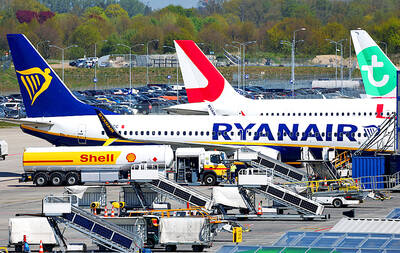
Ryanair, Transavia, Volotea and other low-cost airlines are feeling the financial pain from high jet fuel prices as a result of the Middle East war and are cutting flights. The closure of the Strait of Hormuz has taken a huge chunk of oil supplies off the market, sending the price of jet fuel soaring and triggering fears of shortages that could force airlines to cancel flights. Airlines are not waiting for a lack of supplies to react. “Travel alert: Airlines are cutting thousands of flights right now,” Travel Therapy host Karen Schaler said in an Instagram reel this past weekend.
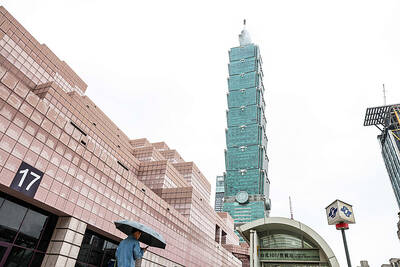
MANAGING RISKS: Taiwan has secured LNG sufficient to cover 95 percent of electricity demand for next month, UBS said, describing the government’s approach as proactive UBS Group AG has raised its forecast for Taiwan’s economic growth this year to 8 percent, up from 6.9 percent previously, and said expansion could reach as high as 8.6 percent if external energy shocks are avoided. The upgrade reflects a stronger-than-expected first-quarter performance and sustained momentum in artificial intelligence (AI)-driven exports, which UBS said are providing a firm foundation for growth despite geopolitical and energy risks. Taiwan’s GDP expanded 13.69 percent year-on-year in the first quarter, the fastest growth since the second quarter of 1987, the Directorate-General of Budget, Accounting and Statistics (DGBAS) reported on Thursday. On a seasonally

The Fair Trade Commission’s (FTC) ongoing review of Grab Holdings Ltd’s US$600 million acquisition of Foodpanda Taiwan’s operations, announced on March 23, has taken on fresh urgency as industry experts warn that the transaction could embed significant Chinese cybersecurity vulnerabilities into Taiwan’s digital infrastructure through Grab’s deep ties to autonomous-driving firm WeRide (文遠知行). Less than 16 months after the FTC blocked Uber Eats’ direct attempt to acquire Foodpanda Taiwan — citing potential combined market shares of 80 to 90 percent — the emergence of Grab as the buyer has prompted questions about whether the same competitive harm is simply being rerouted

The list of Asian stocks that benefit from business partnership with Nvidia Corp is getting longer, as the region further integrates into the artificial intelligence (AI) chip giant’s business ecosystem. Just in the past week, South Korea’s LG Electronics Inc, Taiwan’s Nanya Technology Corp (南亞科技), as well as China’s Huizhou Desay SV Automotive Co (德賽西威) and Pateo Connect Technology Shanghai Corp (博泰車聯) have become the latest to rally on news of tie-ups, supply-chain participation or product collaboration with the US chip designer. Asian suppliers account for about 90 percent of Nvidia’s production costs, up from about 65 percent last year, data compiled


 RSS
RSS