


The government should come up with a more effective supervisory mechanism for build-operate-transfer (BOT) projects, in order to regain the public's confidence in the model, experts said yesterday.
Their comments came after the recent public uproar over the implementation of the BOT system in Taiwan, following the Kaohsiung rapid transit system scandal and the money-sucking high-speed rail project. Both projects were designed under the BOT model.
Their remarks were also noteworthy in light of comments earlier this week from Minister of Transportation and Communications Lin Lin-san (
Given the bumpy experience of BOT projects, Lin suggested on Monday at the legislature's Transportation and Communications Committee that future BOT projects be nixed. But his remarks were overruled on Wednesday by his boss, Premier Frank Hsieh (
Lin's disappointment was understandable, the experts said. BOT projects are supposed to improve cost efficiency for the government, but the government has paid enormous sums to take over the high speed rail project to ease private contractor's funding difficulties, and the Kaohsiung rapid transit project has reportedly had ballooning construction costs due to circumvention of the Government Procurement Law (
Kuo Yao-chi (
When the government invited private sector firms to bid for the high-speed rail in 1997 and the KRTS project in early 1999, both the government and private sector were subject to the regulations set by this Statute. The Government Procurement Law was passed in late 1999.
Aiming to set clearer guidelines for risk allocation on public-private projects, the government passed the Statute for Promoting Private Participation in Public Construction (
"The effort is still not enough," said Ho Shih-ping (
Tsai Tui (
To emerge from what he called a "lame BOT system," Ho suggested that the Ministry of Finance should also be the administrator of the projects, and be involved in both budgeting and inspecting implementation.
James Ku (
To ensure that contracting companies abide by the contract and plan, Ku suggested that the government should work with an independent board director or supervisor in the companies.
Responding to the criticism, Huang Hsi-hsun (
"Taiwan is still in the early stage of adopting the BOT model, but I believe the effects will be seen in the near future," Huang said.
Citing statistics from the UK, Huang said about 80 percent of traditional projects run over budget or miss completion deadlines, compared to only 20 percent of BOT projects.
Moreover, according to one government estimate, Taiwan's GDP will increase by more than 2 percent for every year that the government draws NT$100 billion (US$3 billion) of private investment in BOT projects.

purpose: Tesla’s CEO sought to meet senior Chinese officials to discuss the rollout of its ‘full self-driving’ software in China and approval to transfer data they had collected Tesla Inc CEO Elon Musk arrived in Beijing yesterday on an unannounced visit, where he is expected to meet senior officials to discuss the rollout of "full self-driving" (FSD) software and permission to transfer data overseas, according to a person with knowledge of the matter. Chinese state media reported that he met Premier Li Qiang (李強) in Beijing, during which Li told Musk that Tesla's development in China could be regarded as a successful example of US-China economic and trade cooperation. Musk confirmed his meeting with the premier yesterday with a post on social media platform X. "Honored to meet with Premier Li
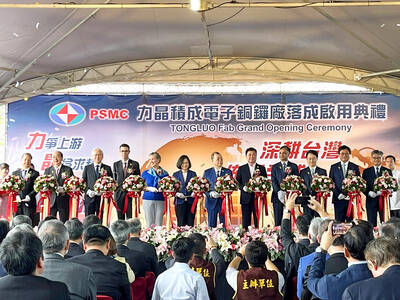
ARTIFICIAL INTELLIGENCE: The chipmaker last month raised its capital spending by 28 percent for this year to NT$32 billion from a previous estimate of NT$25 billion Contract chipmaker Powerchip Semiconductor Manufacturing Corp (力積電子) yesterday launched a new 12-inch fab, tapping into advanced chip-on-wafer-on-substrate (CoWoS) packaging technology to support rising demand for artificial intelligence (AI) devices. Powerchip is to offer interposers, one of three parts in CoWoS packaging technology, with shipments scheduled for the second half of this year, Powerchip chairman Frank Huang (黃崇仁) told reporters on the sidelines of a fab inauguration ceremony in the Tongluo Science Park (銅鑼科學園區) in Miaoli County yesterday. “We are working with customers to supply CoWoS-related business, utilizing part of this new fab’s capacity,” Huang said, adding that Powerchip intended to bridge
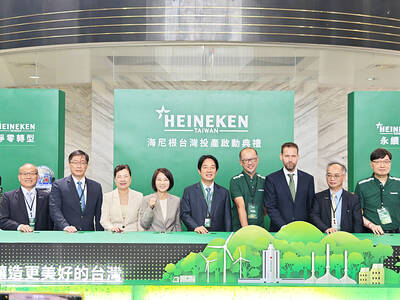
Dutch brewing company Heineken NV on Friday announced an investment of NT$13.5 billion (US$414.62 million) over the next five years in Taiwan. The first multinational brewing company to operate in Taiwan, Heineken made the statement at a ceremony held at its brewery in Pingtung County. It also outlined its efforts to make the brewery “net zero” by 2030. Heineken has been in the Taiwanese market for 20 years, Heineken Taiwan managing director Jeff Wu (吳建甫) said. With strong support from local consumers, the Dutch brewery decided to transition from sales to manufacturing in the country, Wu said. Heineken assumed majority ownership and management rights

Microsoft Corp yesterday said that it would create Thailand’s first data center region to boost cloud and artificial intelligence (AI) infrastructure, promising AI training to more than 100,000 people to develop tech. Bangkok is a key economic player in Southeast Asia, but it has lagged behind Indonesia and Singapore when it comes to the tech industry. Thailand has an “incredible opportunity to build a digital-first, AI-powered future,” Microsoft chairman and chief executive officer Satya Nadella said at an event in Bangkok. Data center regions are physical locations that store computing infrastructure, allowing secure and reliable access to cloud platforms. The global embrace of AI


 RSS
RSS