


Taipei Times: China Motor (
Huang Wen-cheng (黃文成): The automotive market in Taiwan has become saturated with demand for only 450,000-500,000 units each year. The stiff competition has prompted an excess of supply and therefore local makers need to expand their business beyond Taiwan's borders.
The development capabilities of Taiwanese makers in autos and auto components have matured in recent years, and we now have the ability to export them to overseas markets. Just as Taiwan is able to export its locally made bicycles and motorcycles to other countries, now exporting cars should be the trend.
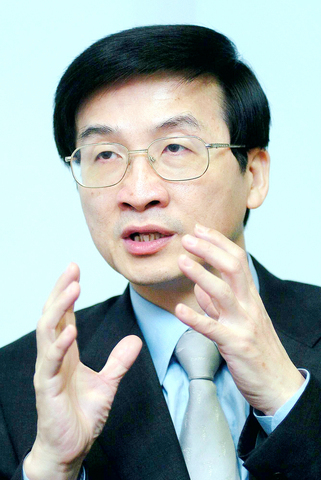
PHOTO: LIAO CHEN-HUEI, TAIPEI TIMES
Compared to our competitors, who work closely with other foreign automakers, China Motor is a more independent company. We can lay out our own development plans, and we decided to be a pioneer in the export business. It's never easy in the beginning, but we are convinced that this segment will grow tremendously in the future.
Our major export markets for vehicles now include Southeast Asia, North America and the Middle East, and we have some components being sold in Australia, Venezuela and China as well. We are now evaluating the possibilities of exporting cars to Japan. Mitsubishi Motors has sent its staff to Taiwan to discuss opportunities with us. We need to study the investment costs and the price acceptance in the Japanese market and will make a decision within the next three months.
TT: In addition to South-East Motors Co (
Huang: China is now the world's third-largest auto market with estimated demand at 5.6 million units this year. Next year it will pass Japan and become the second-largest market, behind the US.
Moving into China will enable us to increase our economies of scale as we are currently selling only around 90,000 vehicles in Taiwan. The huge Chinese market will offer us cheaper production costs and help us to improve our profit margins.
If the prospect of China forming a free-trade zone with ASEAN becomes a reality, the lower taxation will benefit us in terms of production costs. The free-trade zone might even become one of our export markets in future.
However, the macroeconomic controls instituted by the Chinese government in order to prevent the economy from overheating last year have made the auto market there fairly competitive. These controls have made it difficult for Chinese consumers to obtain car loans from banks, thereby affecting their willingness to buy new cars.
We expect our business there will be much better next year as the effect of the macroeconomic controls will begin to fade and we will introduce more new models.
In the case of South-East Motors, it was profitable in the first few years.
We didn't make profits for the first half of this year, but we broke even from August. We expect to make small profits for the whole year and sell around 70,000 cars in China this year. The number will increase to 80,000 units next year.
TT: How is the new DCVC venture progressing?
Huang: DCVC represents a total investment of 160 million euros (US$188 million), with China Motor contributing 25.96 million euros. It will be the Asian production and export base for light commercial vehicles under the Mercedes-Benz brand. Related planning such as land allocation and plant construction is complete, and we are now only waiting for official approval from the Chinese government, which we expect next month. The deployment of resellers and development of auto components will be the main tasks for DCVC next year. Mass production will begin in 2007, and will center on models such as the NV3 and Vito/Viano.
TT: China Motor invested ?10 billion (US$83.8 million) to buy preferred stocks in Mitsubishi Motors in May last year. Would you consider increasing your investment in this company (which in turn owns a 13.96 percent stake in China Motor)?
Huang: We view Mitsubishi as a friend. Our investment in Mitsubishi Motors was a unique case, as it made us one of the shareholders in the company. We decided to invest in Mitsubishi Motors because it needed capital for its restructuring exercises.
We have become a strategic partner of Mitsubishi's and collaborate closely with the company. Mitsubishi continues to show us the greatest support in terms of component costs, new model development, export opportunities and collaboration in China. This will cement our leadership position in Taiwan.
We don't have any plans to invest further in Mitsubishi Motors right now, and it doesn't require any further capital at present, either. We are satisfied with the current status of our collaboration.
TT: Taiwan's auto market has reached a state of saturation. How would you evaluate the market?
Huang: The total market size next year will most probably be smaller than the estimated 50,000-51,000 units sold this year. One of the reasons for this decline is that consumers have already upgraded to newer models as, in the market cycle, this was the year for vehicle replacement. Also, the possible outbreak of avian flu might affect the industry's prospects. If an epidemic does occur in Taiwan, it will impact next year's economic growth, which will then affect consumers' spending on vehicles.
As the government canceled the subsidy on the commodity tax after Taiwan's entry into the WTO, automakers are burdened by 3 to 9 percent extra taxes. If the government doesn't come up with other solutions, automakers' profitability will be affected by heavier production costs which may be passed on to consumers. However, the drop in the price of steel on the global market since the second half of this year is good news for us, as it partly relieves the pressure of increased costs.
TT: What should Taiwanese automakers be doing to ensure they can survive amid such stiff competition?
Huang: Diversifying into non-mainstream segments would be a great way to capture market share. If we manage to attract consumers from different segments, we will be able to cement our leadership in the market.
For example, we tried to create an ambiance of felicity around our Savrin recreational vehicles, which allow all members of a family to come together in a single vehicle. And we positioned it in the recreational vehicle segment which offers the comfort of sedans, but more space. This is an instance where we successfully differentiated one of our products from our rivals'.
In addition, we will launch a new model called the "Zinger" next month in Taiwan. This is a multi-functional vehicle combining characteristics of an MPV, a recreational vehicle and a sedan. We believe this will help us to create another market segment.
TT: How are you finding your new position and what were some of the challenges you faced in the past year?
Huang: It was a difficult year with issues such as the Chinese macroeconomic controls posing stiff challenges. But the worst is now behind us as the situation in China will improve in the next few years. There were a few international partnerships to handle as well, including the DCVC venture in China and our collaboration with DaimlerChrysler here in Taiwan.
It has been a busy year as I spent most of my time traveling between Japan, China and Germany. As we were working hard to establish a solid foundation for international market deployment, I think next year will be a time for us to promote current businesses. It was a tough year, but I am glad that the groundwork has been done and we can now move forward.

BUSINESS UPDATE: The iPhone assembler said operations outlook is expected to show quarter-on-quarter and year-on-year growth for the second quarter Hon Hai Precision Industry Co (鴻海精密) yesterday reported strong growth in sales last month, potentially raising expectations for iPhone sales while artificial intelligence (AI)-related business booms. The company, which assembles the majority of Apple Inc’s smartphones, reported a 19.03 percent rise in monthly sales to NT$510.9 billion (US$15.78 billion), from NT$429.22 billion in the same period last year. On a monthly basis, sales rose 14.16 percent, it said. The company in a statement said that last month’s revenue was a record-breaking April performance. Hon Hai, known also as Foxconn Technology Group (富士康科技集團), assembles most iPhones, but the company is diversifying its business to
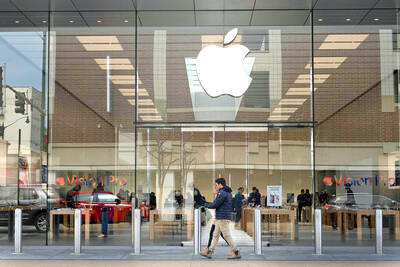
Apple Inc has been developing a homegrown chip to run artificial intelligence (AI) tools in data centers, although it is unclear if the semiconductor would ever be deployed, the Wall Street Journal reported on Monday. The effort would build on Apple’s previous efforts to make in-house chips, which run in its iPhones, Macs and other devices, according to the Journal, which cited unidentified people familiar with the matter. The server project is code-named ACDC (Apple Chips in Data Center) within the company, aiming to utilize Apple’s expertise in chip design for the company’s server infrastructure, the newspaper said. While this initiative has been

GlobalWafers Co (環球晶圓), the world’s No. 3 silicon wafer supplier, yesterday said that revenue would rise moderately in the second half of this year, driven primarily by robust demand for advanced wafers used in high-bandwidth memory (HBM) chips, a key component of artificial intelligence (AI) technology. “The first quarter is the lowest point of this cycle. The second half will be better than the first for the whole semiconductor industry and for GlobalWafers,” chairwoman Doris Hsu (徐秀蘭) said during an online investors’ conference. “HBM would definitely be the key growth driver in the second half,” Hsu said. “That is our big hope

The consumer price index (CPI) last month eased to 1.95 percent, below the central bank’s 2 percent target, as food and entertainment cost increases decelerated, helped by stable egg prices, the Directorate-General of Budget, Accounting and Statistics (DGBAS) said yesterday. The slowdown bucked predictions by policymakers and academics that inflationary pressures would build up following double-digit electricity rate hikes on April 1. “The latest CPI data came after the cost of eating out and rent grew moderately amid mixed international raw material prices,” DGBAS official Tsao Chih-hung (曹志弘) told a news conference in Taipei. The central bank in March raised interest rates by


 RSS
RSS