


A top Financial Supervisory Commission (FSC) official yesterday reiterated the importance of keeping lending rates flexible under the current regulatory ceiling in order to stem rampant underground financial activity.
"The Civil Code (
The two-day forum sponsored by the Consumers' Foundation (
Tseng said that under the 20-percent lending rate cap, banks are entitled to devise different consumer products serving various needs, from housing mortgages and car loans that carry lower rates, to unsecured financing through credit cards and cash-advance cards that come with higher revolving rates -- often in excess of 18 percent.
Because card issuers need to take into account operational costs, reserve funds for writing off bad loans and preparations for cardholder privilege programs, banks have to charge higher rates on plastic cards, he said.
Unhappy that banks are making "exorbitant profits" by failing to narrow the gap between lending rates and savings rates, Chinese Nationalist Party (KMT) lawmakers are planning to submit an amendment to the Banking Law (銀行法) and the Civil Code requiring that lending and revolving interest rates not exceed 10 percent.
Tseng said that if the government interferes with the free market mechanism, it would only end up fostering an environment conducive to loan sharks.
Taiwan's lending rate ceiling is not particularly high compared with Singapore (24 percent), Hong Kong (26 percent), South Korea (19 percent to 24.9 percent), the UK (35.9 percent) and the US (23.99 percent), according to statistics provided by the FSC.
"The more controls you place on money, the worse the situation will become," Tseng said in response to a foundation volunteer's comment that debt-ridden consumers had made despairing phone calls to the organization for help.
As of August, 400,000 people had defaulted on debts generated by credit cards, cash cards and unsecured loans that were overdue by more than three months, the FSC said earlier this month.
The nation's revolving interest on credit cards hit NT$488.3 billion (US$14.5 billion), or NT$10,705 per card in circulation, at the end of September. Total lending on cash cards surpassed NT$315.2 billion, or NT$84,504 per activated card, during the same period, Tseng said.
"Consumers must clearly choose the products most suitable for their situations and be responsible for negotiating with banks if they find it difficult to pay back the money," Tseng urged.

Among the rows of vibrators, rubber torsos and leather harnesses at a Chinese sex toys exhibition in Shanghai this weekend, the beginnings of an artificial intelligence (AI)-driven shift in the industry quietly pulsed. China manufactures about 70 percent of the world’s sex toys, most of it the “hardware” on display at the fair — whether that be technicolor tentacled dildos or hyper-realistic personalized silicone dolls. Yet smart toys have been rising in popularity for some time. Many major European and US brands already offer tech-enhanced products that can enable long-distance love, monitor well-being and even bring people one step closer to

Malaysia’s leader yesterday announced plans to build a massive semiconductor design park, aiming to boost the Southeast Asian nation’s role in the global chip industry. A prominent player in the semiconductor industry for decades, Malaysia accounts for an estimated 13 percent of global back-end manufacturing, according to German tech giant Bosch. Now it wants to go beyond production and emerge as a chip design powerhouse too, Malaysian Prime Minister Anwar Ibrahim said. “I am pleased to announce the largest IC (integrated circuit) Design Park in Southeast Asia, that will house world-class anchor tenants and collaborate with global companies such as Arm [Holdings PLC],”

Sales in the retail, and food and beverage sectors last month continued to rise, increasing 0.7 percent and 13.6 percent respectively from a year earlier, setting record highs for the month of March, the Ministry of Economic Affairs said yesterday. Sales in the wholesale sector also grew last month by 4.6 annually, mainly due to the business opportunities for emerging applications related to artificial intelligence (AI) and high-performance computing technologies, the ministry said in a report. The ministry forecast that retail, and food and beverage sales this month would retain their growth momentum as the former would benefit from Tomb Sweeping Day
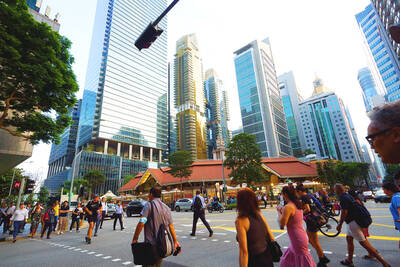
Thousands of parents in Singapore are furious after a Cordlife Group Ltd (康盛人生集團), a major operator of cord blood banks in Asia, irreparably damaged their children’s samples through improper handling, with some now pursuing legal action. The ongoing case, one of the worst to hit the largely untested industry, has renewed concerns over companies marketing themselves to anxious parents with mostly unproven assurances. This has implications across the region, given Cordlife’s operations in Hong Kong, Macau, Indonesia, the Philippines and India. The parents paid for years to have their infants’ cord blood stored, with the understanding that the stem cells they contained


 RSS
RSS