


The employees union of China Airlines Ltd (
"We decided to cancel the planned protest after the management made a positive and concrete response and signed a preliminary agreement on consensus items," Lee Cho-ping (李昭平), chairman of China Airlines Employees Union (
Despite the cancelation, a small group of flight attendants gathered on their own outside company headquarters to demonstrate anyway.
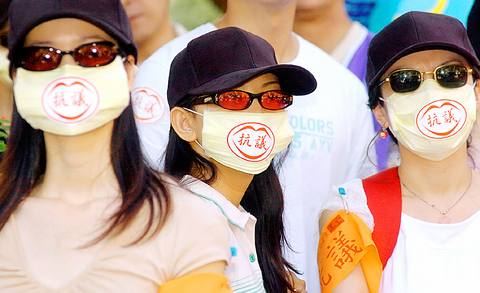
PHOTO: LIAO CHEN-HUEI, TAIPEI TIMES
The union originally gathered nearly 700 flight attendants who were on leave to take to the streets yesterday to demand that the carrier stop overworking them.
Prior to that threat, the union had reportedly negotiated with management on 84 occasions but still failed to reach an agreement. The employees' collective agreement expired last month.
Employees demanded a renewal of their collective agreement, a promise of no job or wage cuts if the company goes through with a planned share sale, and standard working hours and overtime pay for flight attendants.
Flight attendants were required to work without breaks that could last up to 24 hours per flight, the local channel USTV reported. Total flight hours could amount to 150 hours per month, higher than the 100 hours in international practice, the station reported.
Meanwhile, the union has also filed a lawsuit against the decision made last month by the government-funded China Aviation Development Foundation (
China Airlines said it accepted the employees' demand to sign a group agreement and to improve the working conditions of flight attendants.
"This will definitely increase our personnel costs," China Airlines spokesman Johnson Sun (
China Airlines' net profit for the first months of this year shrank to only NT$1.01 billion (US$30 million) from NT$3.39 billion a year ago. Weighed down by record high fuel prices, China Airlines in August cut its pre-tax income forecast for this year to NT$3.08 billion from a previous NT$4.4 billion prediction.
"So far, we have had no plan to again revise downward the financial forecast," Sun said.
Despite the big gap, the company will try to reach the target in the remaining two months of the year, in light of a traditionally high fourth quarter for cargo flights, higher revenues after an increase in the company's fuel surcharge, the government's approval to fly through Chinese airspace and robust business on popular routes to Japan, Hong Kong and Southeast Asian destinations, he said.

Among the rows of vibrators, rubber torsos and leather harnesses at a Chinese sex toys exhibition in Shanghai this weekend, the beginnings of an artificial intelligence (AI)-driven shift in the industry quietly pulsed. China manufactures about 70 percent of the world’s sex toys, most of it the “hardware” on display at the fair — whether that be technicolor tentacled dildos or hyper-realistic personalized silicone dolls. Yet smart toys have been rising in popularity for some time. Many major European and US brands already offer tech-enhanced products that can enable long-distance love, monitor well-being and even bring people one step closer to

Malaysia’s leader yesterday announced plans to build a massive semiconductor design park, aiming to boost the Southeast Asian nation’s role in the global chip industry. A prominent player in the semiconductor industry for decades, Malaysia accounts for an estimated 13 percent of global back-end manufacturing, according to German tech giant Bosch. Now it wants to go beyond production and emerge as a chip design powerhouse too, Malaysian Prime Minister Anwar Ibrahim said. “I am pleased to announce the largest IC (integrated circuit) Design Park in Southeast Asia, that will house world-class anchor tenants and collaborate with global companies such as Arm [Holdings PLC],”

TRANSFORMATION: Taiwan is now home to the largest Google hardware research and development center outside of the US, thanks to the nation’s economic policies President Tsai Ing-wen (蔡英文) yesterday attended an event marking the opening of Google’s second hardware research and development (R&D) office in Taiwan, which was held at New Taipei City’s Banciao District (板橋). This signals Taiwan’s transformation into the world’s largest Google hardware research and development center outside of the US, validating the nation’s economic policy in the past eight years, she said. The “five plus two” innovative industries policy, “six core strategic industries” initiative and infrastructure projects have grown the national industry and established resilient supply chains that withstood the COVID-19 pandemic, Tsai said. Taiwan has improved investment conditions of the domestic economy
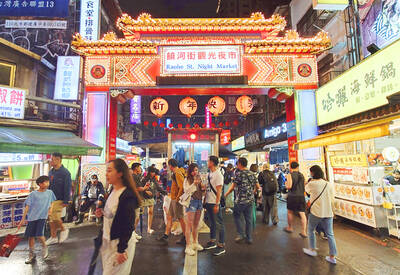
Sales in the retail, and food and beverage sectors last month continued to rise, increasing 0.7 percent and 13.6 percent respectively from a year earlier, setting record highs for the month of March, the Ministry of Economic Affairs said yesterday. Sales in the wholesale sector also grew last month by 4.6 annually, mainly due to the business opportunities for emerging applications related to artificial intelligence (AI) and high-performance computing technologies, the ministry said in a report. The ministry forecast that retail, and food and beverage sales this month would retain their growth momentum as the former would benefit from Tomb Sweeping Day


 RSS
RSS