


The rise and fall of Dbtel Inc (大霸電子), the first Taiwanese handset vendor to obtain Beijing's approval to sell branded phones in China, has shown in less than five years how important the company's integrity is to its business, no matter how big its original vision for a share of the China market.
The Chinese dream had sent shares of Dbtel skyrocketing to an all-time high of NT$149.5 on the Taiwan Stock Exchange in April of 2000. But dismal financial results along with recent insider-trading probes drove down its shares on Friday to the junk-bond level of NT$2.89 on the over-the-counter GRETAI Securities Market.
"Now we are facing similar difficulties to those that Acer Inc encountered when it operated a brand in the first few years," Dbtel Chairman Michael Mou (
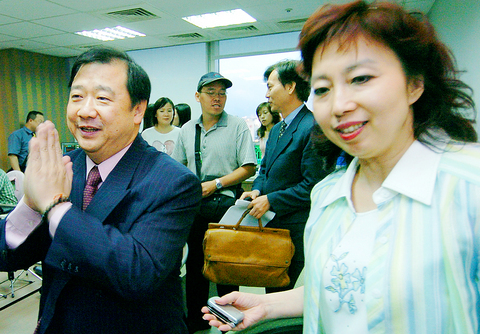
PHOTO: CHIEN JUNG-FONG, TAIPEI TIMES
The insider-trading investigation brought Dbtel back under the media spotlight, but dealt a further blow to investors' confidence in the stock.
"We haven't covered Dbtel for a long period of time and we have no plan to put the stock on our investment list," said Jonathan Liao (
"Untrustworthy financial forecasts have upset investors' stomachs," he said.
Apart from Dbtel, BenQ Corp (明基) and Inventec Appliances Corp (英華達) were granted approval in May to officially tap into the Chinese market.
But another analyst said investors have now expressed reservations about China's investment climate, citing vast market uncertainties and economic cyclical changes.
"It was seen as an advantage for local companies to get Beijing's approval for selling handsets in China, with an eye to potential growth. But now investors are not so excited anymore about tapping into the market," said an analyst surnamed Liao, an analyst with KGI Securities (中信證券).
Forecasts slashed
According to Dbtel's statements to the Taiwan Stock Exchange over the past five years, the company has sharply slashed its financial forecasts every year. In the latest adjustment of its financial projection, Dbtel said it would lose NT$898 million last year, rather than recording earnings of NT$1.37 billion like it estimated earlier.
Regarding China, not Taiwan, as its home market, Dbtel attributed the drastic cut to intensifying competition in China as well as weakening consumption after Beijing implemented measures to control the overheating economy, according to a statement to the Taiwan Stock Exchange.
Starting out as a contract manufacturer for telephony and communications equipment in 1979, Dbtel decided to expand into the brand business after ending its partnership with Motorola Inc, the world's No. 2 mobile-phone vendor in 2000. Motorola turned to BenQ and later Compal Communications Corp (華寶通訊) for its handset supplies.
Dbtel then kicked off its own-brand mobile phone business in China, which consumes 80 million units a year, in early 2001. With initial success on the mainland, the company had vowed to challenge Nokia Ojy's No. 1 position in the global handset market.
Shares rally
Rallies in its share price had helped the company raise more funds from local capital markets for further expansion in China, but some also started to question the company's sustained profitability as its business is absolutely connected to swings in China's economy.
A series of dramatic financial adjustments along with other factors drew the attention of investigators and the stock regulator. Government agencies recently joined forces to look into alleged abnormal trading of Dbtel shares during the period ahead of a proposed share sale last year.
The company had planned to raise NT$3.8 billion to finance the construction of its headquarters in the Dingpu High-tech Industrial Park (
"We are conservative about doing financial forecasts," company chairman Mou said in a press conference on Sept. 30, in an attempt to convince the public of his innocence in the abnormal trading debacle.
Mou and his wife Kuo Pei-chih (
`Too fast'
"We expanded too fast to develop the ability to cope with the industry's dramatic ups-and-downs," Mou told reporters.
Dbtel missed the financial forecast primarily because of faster-than-expected handset-price declines and its inability to put new products on the market, as well as an inability to manage channel inventories, Mou said in a letter to the public published in a local Chinese-language newspaper on Friday.
"Some Chinese cellphone brands exited the market for those reasons," Mou said.
However, he did not give a clear explanation of the trading of Dbtel shares through six investment companies he personally headed.
The company's Chinese unit, which used to be seen as a cash cow, now became a heavy burden for Dbtel. In the first half of this year, Dbtel's losses expanded to NT$2.4 billion -- NT$2 billion of this originating from its Chinese unit in Shanghai.
Though competition is intensifying, Dbtel said it is striving to return its Chinese unit to profitability via a restructuring plan. Dbtel now has 700 engineers in its research and development division in Shanghai.
"This is not the first time we have encountered serious operational difficulties. We hope the public will give us a chance to bring the 26-year-old Dbtel back to the level of its former glory days," Mou said.

Among the rows of vibrators, rubber torsos and leather harnesses at a Chinese sex toys exhibition in Shanghai this weekend, the beginnings of an artificial intelligence (AI)-driven shift in the industry quietly pulsed. China manufactures about 70 percent of the world’s sex toys, most of it the “hardware” on display at the fair — whether that be technicolor tentacled dildos or hyper-realistic personalized silicone dolls. Yet smart toys have been rising in popularity for some time. Many major European and US brands already offer tech-enhanced products that can enable long-distance love, monitor well-being and even bring people one step closer to

Malaysia’s leader yesterday announced plans to build a massive semiconductor design park, aiming to boost the Southeast Asian nation’s role in the global chip industry. A prominent player in the semiconductor industry for decades, Malaysia accounts for an estimated 13 percent of global back-end manufacturing, according to German tech giant Bosch. Now it wants to go beyond production and emerge as a chip design powerhouse too, Malaysian Prime Minister Anwar Ibrahim said. “I am pleased to announce the largest IC (integrated circuit) Design Park in Southeast Asia, that will house world-class anchor tenants and collaborate with global companies such as Arm [Holdings PLC],”
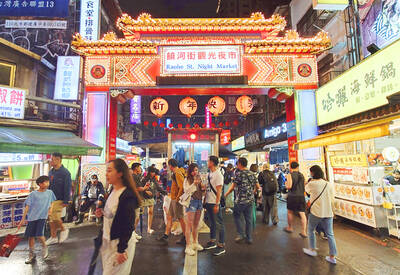
Sales in the retail, and food and beverage sectors last month continued to rise, increasing 0.7 percent and 13.6 percent respectively from a year earlier, setting record highs for the month of March, the Ministry of Economic Affairs said yesterday. Sales in the wholesale sector also grew last month by 4.6 annually, mainly due to the business opportunities for emerging applications related to artificial intelligence (AI) and high-performance computing technologies, the ministry said in a report. The ministry forecast that retail, and food and beverage sales this month would retain their growth momentum as the former would benefit from Tomb Sweeping Day
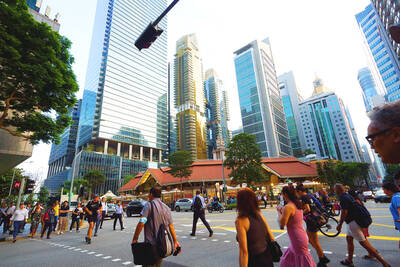
Thousands of parents in Singapore are furious after a Cordlife Group Ltd (康盛人生集團), a major operator of cord blood banks in Asia, irreparably damaged their children’s samples through improper handling, with some now pursuing legal action. The ongoing case, one of the worst to hit the largely untested industry, has renewed concerns over companies marketing themselves to anxious parents with mostly unproven assurances. This has implications across the region, given Cordlife’s operations in Hong Kong, Macau, Indonesia, the Philippines and India. The parents paid for years to have their infants’ cord blood stored, with the understanding that the stem cells they contained


 RSS
RSS