


Wal-Mart Stores, under pressure from faltering growth overseas just when it needs to offset a slowdown in the US, reshuffled top management to spread talent abroad and expanded to take over operations in Japan, the world's second-largest retail market.
Wal-Mart said on Friday it would increase its presence in Japan by spending almost US$600 million to take full control of Seiyu, its affiliate supermarket chain here.
Back at its headquarters in Bentonville, Arkansas, Wal-Mart announced that its top executives who separately run the US operations and international operations would effectively switch jobs in a move aimed at grooming the company's top talent and increasing overall growth.
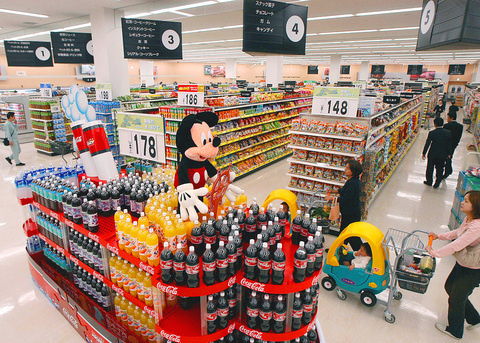
PHOTO: AP
But growth in Japan will not come easy. The move by Wal-Mart seems to plunge it further into this market despite losses at Seiyu every year since the company first purchased a stake in the Japanese retailer in 2002. Seiyu on Friday reiterated its projection of a fourth consecutive loss in the current fiscal year. In August, it posted a net loss of ¥10.6 billion (US$93 million) in the six months ended in June.
The purchase will increase Wal-Mart's stake in Seiyu to just over 50 percent, from 42 percent, enough to turn the Japanese company into a full subsidiary. Wal-Mart has been increasing its stake by steps in Seiyu, which is based in Tokyo.
"This investment is intended to give Seiyu increased financial stability and continue strengthening Wal-Mart's presence in the second-largest retail market in the world," said John Menzer, chief executive of Wal-Mart International.
Menzer will leave his post and take on a new leadership role that includes responsibility for not only Wal-Mart Stores USA, but also major units like real estate, logistics, information services, benefits, global procurement, financial services, store planning and strategic planning.
The new president and chief executive of Wal-Mart International will now be Michael Duke, currently president and chief executive of Wal-Mart Stores USA. The promotions come with significant challenges and spotlight Duke and Menzer as potential successors to Lee Scott, Wal-Mart's chief executive since 2000.
"These moves are consistent with the way we develop our people," said Sarah Clark, a company spokeswoman.
The executives are assuming their new roles at a time of sluggish growth in both divisions. Though the company has expanded quickly overseas, competitors have outpaced it in important markets like the UK. At home, Wal-Mart Stores USA has fallen short of its sales goals for the last two quarters, as rising gas prices have eaten into the spending power of its primary customers. In August, Wal-Mart reported its smallest quarterly rise in earnings in nearly four years, 5.8 percent.
Wal-Mart also has had a hard time carrying out its formula in Japan. Despite its involvement, Seiyu has failed to turn a profit from its 400 stores in Japan, where customers prefer clipping coupons to low prices and a complex web of distribution companies has thwarted efforts to wring lower prices from suppliers.
Japanese consumers are also notoriously finicky, demanding high levels of freshness and quality even if that means higher prices.

Among the rows of vibrators, rubber torsos and leather harnesses at a Chinese sex toys exhibition in Shanghai this weekend, the beginnings of an artificial intelligence (AI)-driven shift in the industry quietly pulsed. China manufactures about 70 percent of the world’s sex toys, most of it the “hardware” on display at the fair — whether that be technicolor tentacled dildos or hyper-realistic personalized silicone dolls. Yet smart toys have been rising in popularity for some time. Many major European and US brands already offer tech-enhanced products that can enable long-distance love, monitor well-being and even bring people one step closer to

Malaysia’s leader yesterday announced plans to build a massive semiconductor design park, aiming to boost the Southeast Asian nation’s role in the global chip industry. A prominent player in the semiconductor industry for decades, Malaysia accounts for an estimated 13 percent of global back-end manufacturing, according to German tech giant Bosch. Now it wants to go beyond production and emerge as a chip design powerhouse too, Malaysian Prime Minister Anwar Ibrahim said. “I am pleased to announce the largest IC (integrated circuit) Design Park in Southeast Asia, that will house world-class anchor tenants and collaborate with global companies such as Arm [Holdings PLC],”

TRANSFORMATION: Taiwan is now home to the largest Google hardware research and development center outside of the US, thanks to the nation’s economic policies President Tsai Ing-wen (蔡英文) yesterday attended an event marking the opening of Google’s second hardware research and development (R&D) office in Taiwan, which was held at New Taipei City’s Banciao District (板橋). This signals Taiwan’s transformation into the world’s largest Google hardware research and development center outside of the US, validating the nation’s economic policy in the past eight years, she said. The “five plus two” innovative industries policy, “six core strategic industries” initiative and infrastructure projects have grown the national industry and established resilient supply chains that withstood the COVID-19 pandemic, Tsai said. Taiwan has improved investment conditions of the domestic economy

Sales in the retail, and food and beverage sectors last month continued to rise, increasing 0.7 percent and 13.6 percent respectively from a year earlier, setting record highs for the month of March, the Ministry of Economic Affairs said yesterday. Sales in the wholesale sector also grew last month by 4.6 annually, mainly due to the business opportunities for emerging applications related to artificial intelligence (AI) and high-performance computing technologies, the ministry said in a report. The ministry forecast that retail, and food and beverage sales this month would retain their growth momentum as the former would benefit from Tomb Sweeping Day


 RSS
RSS