


Taiwan may sell as much as 25 percent of Taiwan Power Co (Taipower, 台電), the nation's biggest power producer, on overseas share markets, raising funds to narrow the government's budget deficit and increasing the company's independence.
The government will need to involve investors abroad because the value of the stake it plans to sell is too large for the domestic market to absorb, Taipower president Edward Chen (
He didn't say when the first shares may be sold.
"Issuance of depositary receipts is a must," Chen said in a report presented to a forum on privatization in Taipei yesterday.
Taipower will also seek "strategic investors" that can help improve efficiency, he said, without naming potential partners.
The government, which owns 97 percent of Taipower, had planned to cut its stake to less than half by the end of the year.
Selling shares in the utility would help plug the nation's budget deficit, projected to reach a record NT$334.7 billion (US$10.5 billion) this year.
Reducing state ownership to less than 50 percent frees companies from having lawmakers control their budgets and from obligations to meet civil-servant benefits for employees.
The government may also dispose of as much as 8 percent of Taipower in share sales to the public, Chen said.
The year-end goal of privatizing Taipower is unlikely to be met, and it may take more than six years and several share sales to reduce state ownership to less than 50 percent, Chen said.
The sale of Taipower's shares may be one of the nation's largest. The utility, which generates about 75 percent of the country's electricity and is its only power distributor, has capital of NT$330 billion, 34 percent more than that of Taiwan Semiconductor Manufacturing Co (台積電), the biggest company by market value on the Taiwan Stock Exchange.
The utility's assets are estimated at NT$1.3 trillion, according to Chen. That's equivalent to about 12 percent of the nation's GDP.
The year-end target date for Taipower's privatization already reflected a delay from a previous objective of June 2001.
Lawmakers have blocked the plan by insisting that the 40-year-old electricity laws be revised and that the legislature approve any Taipower share sale.
"Taipower's privatization is only possible about five years after the new electricity law is passed," said Tony Tsai (蔡東松), credit analyst at Taiwan Ratings Corp (中華信評), an affiliate of Standard & Poor's. "In Taiwan, privatization is often a lengthy process, as shown by the example of Chunghwa Telecom."
The government this month lowered its stake in Chunghwa Telecom Co (中華電信) to below 50 percent, almost five years after offering shares in the company, the nation's biggest telephone service provider, for the first time.
Sales of the company's shares had been delayed by weak market demand and opposition from workers, who feared job losses.
The Cabinet will send a new version of the electricity legislation to the legislature for lawmakers to review in the session starting next month, Bureau of Energy Deputy Director-General Wang Yunn-ming (
The present electricity law was enacted when Taipower was the nation's only power company. The government has since allowed the emergence of private power producers, which generate about 25 percent of the nation's electricity.

Among the rows of vibrators, rubber torsos and leather harnesses at a Chinese sex toys exhibition in Shanghai this weekend, the beginnings of an artificial intelligence (AI)-driven shift in the industry quietly pulsed. China manufactures about 70 percent of the world’s sex toys, most of it the “hardware” on display at the fair — whether that be technicolor tentacled dildos or hyper-realistic personalized silicone dolls. Yet smart toys have been rising in popularity for some time. Many major European and US brands already offer tech-enhanced products that can enable long-distance love, monitor well-being and even bring people one step closer to

Malaysia’s leader yesterday announced plans to build a massive semiconductor design park, aiming to boost the Southeast Asian nation’s role in the global chip industry. A prominent player in the semiconductor industry for decades, Malaysia accounts for an estimated 13 percent of global back-end manufacturing, according to German tech giant Bosch. Now it wants to go beyond production and emerge as a chip design powerhouse too, Malaysian Prime Minister Anwar Ibrahim said. “I am pleased to announce the largest IC (integrated circuit) Design Park in Southeast Asia, that will house world-class anchor tenants and collaborate with global companies such as Arm [Holdings PLC],”

Sales in the retail, and food and beverage sectors last month continued to rise, increasing 0.7 percent and 13.6 percent respectively from a year earlier, setting record highs for the month of March, the Ministry of Economic Affairs said yesterday. Sales in the wholesale sector also grew last month by 4.6 annually, mainly due to the business opportunities for emerging applications related to artificial intelligence (AI) and high-performance computing technologies, the ministry said in a report. The ministry forecast that retail, and food and beverage sales this month would retain their growth momentum as the former would benefit from Tomb Sweeping Day
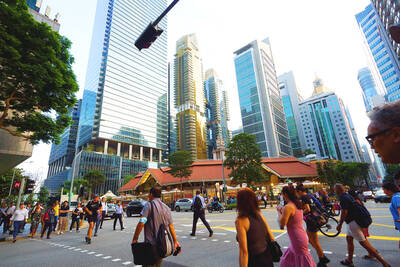
Thousands of parents in Singapore are furious after a Cordlife Group Ltd (康盛人生集團), a major operator of cord blood banks in Asia, irreparably damaged their children’s samples through improper handling, with some now pursuing legal action. The ongoing case, one of the worst to hit the largely untested industry, has renewed concerns over companies marketing themselves to anxious parents with mostly unproven assurances. This has implications across the region, given Cordlife’s operations in Hong Kong, Macau, Indonesia, the Philippines and India. The parents paid for years to have their infants’ cord blood stored, with the understanding that the stem cells they contained


 RSS
RSS