


Taiwanese and Chinese companies such as DBTEL Inc (大霸) and Lenovo Group Ltd (聯想) are seeking to cooperate on development of formats for mobile phones, flat panels and other digital devices to compete with European and US standards.
Adopting independent standards would reduce fees paid for US and European patents and may force foreign companies to pay for the right to use Chinese formats when selling products in the country, said Chin Wu (吳欽智), chief technology officer of Asustek Computer Inc (華碩電腦), Taiwan's largest computer motherboard maker.
China, the world's largest market for mobile phones in terms of the number of users, wants to tap Taiwanese companies to speed up the development of a home-grown standard for high-speed wireless service, called TD-SCDMA, for mobile phones, according to presentations given at a seminar in Beijing on Tuesday.
The two-day meeting was attended by representatives of China's Ministry of Information Industry and executives from both sides of the Taiwan Strait.
"China's market is so big that when TD-SCDMA is developed, international companies will have to use it," Archie Shyu, chief executive of a Chinese unit of Taiwan-based DBTEL, said in an interview at the seminar.
Patent fees account for about 20 percent of manufacturers' selling price of handsets in China, he said.
More than 40 executives from Taiwanese companies including DBTEL, Taiwan's biggest handset maker in China, Winbond Electronics Corp (華邦電子), Compal Electronics Inc (仁寶電子) and Asustek Computer are in Beijing to discuss standards for mobile phones, audio-visual systems, portable storage devices as well as liquid-crystal displays (LCDs).
But the US, which jointly develops weapons systems with Taiwan, would probably try to prevent Taiwan and China from forming close ties on technology standards, a Taipei-based defense analyst said.
"The US Congress is very nervous about China and the US only recently put pressure on the EU not to lift the weapons embargo on China," said Andrew Yang (楊念祖), secretary-general of the Chinese Council of Advanced Policy Studies, a defense think tank.
"This type of cooperation between China and Taiwan would only raise US concerns more," he said.
The US wouldn't let Taiwanese technology companies get "too close" with China on standards, Yang said.
"Just watch, the US should react very soon," he said.
China has the ability to set industry standards with its sizeable market, and Taiwanese companies can help promote formats, Chiang Ping-kun (江丙坤), chairman of the Taipei-based Sinocon Foundation and vice chairman of the Chinese Nationalist Party (KMT), said in a speech at the opening of the seminar.
Commenting on the Beijing seminar, Mainland Affairs Council Chairman Joseph Wu (吳釗燮) said on Tuesday that, "Chiang came to see me before his mainland visit to brief me about the seminar, which he said will enhance the industrial cooperation across the Strait and help improve Taiwan's industrial production."
"We have no way to oppose such a move," Wu said.
"I ask Chiang just to exchange ideas with them [his Chinese counterparts] and bring the concrete conclusions back to Taiwan for the government to follow up," he said.
The council, the nation's top policymaker toward China, has insisted that only the government or the private industry groups authorized by the government can negotiate with China.
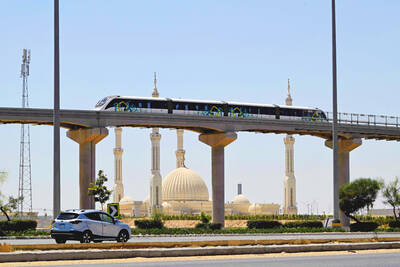
Cairo’s new monorail slices across the city skyline, running above the familiar chaos of blaring horns and aging buses’ exhaust fumes that mark rush hour below. The US$4.5 billion monorail, opened this month, is among Egypt’s most prominent new transport projects, part of a debt-funded infrastructure drive criticized for sapping state finances while bringing limited benefits to most of the country’s 109 million people. “It feels like you’re in a different country,” said Ramy Sayed, a restaurant manager, aboard a driverless Innovia 300 train. “No noise, no traffic, we’re not used to this.” The eastern line runs 56km from the bustling middle-class

Taiwanese firms have increased investment in the Philippines in recent years as Manila’s ties with Washington deepen and global supply chains continue to shift away from China, an expert at the Chung-Hua Institution for Economic Research (CIER, 中華經濟研究院) said yesterday. The Philippines had not been among Taiwanese investors’ top choices in Southeast Asia, CIER Taiwan ASEAN Studies Center director Kristy Hsu (徐遵慈) said at a seminar in Taipei. However, Taiwan’s investment in the country has grown significantly since the COVID-19 pandemic, reaching US $257 million last year, a high in recent years, she said. Although Taiwan’s total investment in the Philippines still lags

Intel Corp regards Taiwan Semiconductor Manufacturing Co (TSMC, 台積電) as a longstanding partner, as the US chipmaker would continue outsourcing production of advanced chips to TSMC, Intel chief executive officer Lip-Bu Tan (陳立武) said yesterday. “I don’t look at people as competitors. I look at the collaboration... Nvidia is also, you know, a good friend,” Tan told a news conference following his keynote speech at the Computex trade show in Taipei. “It’s a very trusted partnership for us... We are a big, top customer for them, and we’re going to continue doing that,” he said, referring to TSMC, the world’s largest foundry
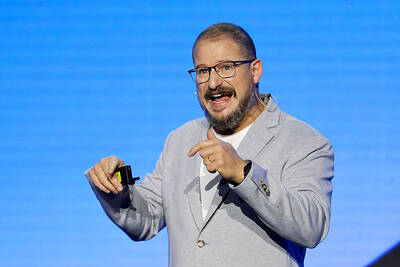
Artificial intelligence (AI) agents would supplant smartphones as the center of people’s digital lives, fundamentally reshaping personal devices and driving a major computing upgrade cycle, Qualcomm Inc CEO Cristiano Amon said yesterday. In his keynote speech for this year’s Computex trade show in Taipei, Amon said that the rise of "agentic AI" — AI systems capable of reasoning, planning and carrying out tasks autonomously — would transform how people interact with technology across phones, PCs, vehicles and wearable devices. Describing the technology as the next major evolution in computing, Amon said that "2026 is the year of agents.” For decades, smartphones have sat


 RSS
RSS