


Wall Street's momentum has suddenly turned negative as investors retreated in the face of skyrocketing oil prices and other signs of a cooling US economy, and brace for a new US Federal Reserve rate hike.
The Dow Jones Industrial Average posted its biggest weekly decline in more than two months, falling 3.1 percent to 10,297.84, a six-week low.
The Standard and Poor's 500 broad-market index, which poked into positive territory for the year a week earlier, slumped 2.1 percent for the week to 1,191.57. The NASDAQ tech-heavy index retreated 1.8 percent to end Friday at 2,053.27.
Market jitters were heightened as crude oil surged to an all-time record at US$60 a barrel over the past week, and ended Friday just shy of that record at US$59.84 a barrel.
Analysts said sky-high energy costs are likely to curb economic and profit growth, but that other factors are in play as well.
With the Fed set to meet in the coming week, the market will be expecting another quarter-point rate hike but also signs from the central bank on how far it intends to push up rates and how strong the economy is.
David Rosenberg at Merrill Lynch said the stock market and the economy are being hit by a "triple whammy" of high oil prices, a rising dollar that cuts into US profits and the Fed rate moves.
"The Fed's tightening to date has practically guaranteed that growth will slow going forward," he said.
"The economy is slowing down but does not appear to be in danger of recession so long as the Fed refrains from raising the funds rate above 4.0 percent," he said.
"There now seems to be nearly irrefutable evidence that the economy is slowing," Wachovia Securities economists wrote in a research note.
"The roots of the slowdown are not that hard to find. Surging oil prices are taking a huge bite out of household purchasing power and corporate profits, leading to less spending and investment. Moreover, the bulk of the stimulus from the tax cuts has largely been played out and short-term interest rates have increased, pushing up interest rates on home equity lines and credit cards," they said.
But Stephen Auth at Federated Investments said the selloff may be overblown along with fears about oil prices, which he said will self-correct downward as the economy cools.
"Higher prices themselves are slowing demand for crude," he said, adding that "new supplies are likely to come on line later this year." Federated projects oil prices to average US$47 per barrel for this year, and drop to US$42 next year.
Based on this, Auth said he is "still looking for mid-to-high, single-digit returns" for the stock market, which would mean a strong rebound for the second half and a pattern similar to that of last year.
One reason for Auth's upbeat outlook is that he sees an end to the Fed rate hikes soon.
"The end could be in sight, given tame inflation and a slow-growth economy," Auth said.
"Typically, equities rally in anticipation of an end to Fed tightening," he said.
Bonds benefited from the shift out of stocks. The yield on the 10-year US Treasury bond fell to 3.914 percent from 4.078 percent a week earlier while that on the 30-year bond eased to 4.215 percent from 4.365 percent. Bond yields and prices move in opposite directions.

Among the rows of vibrators, rubber torsos and leather harnesses at a Chinese sex toys exhibition in Shanghai this weekend, the beginnings of an artificial intelligence (AI)-driven shift in the industry quietly pulsed. China manufactures about 70 percent of the world’s sex toys, most of it the “hardware” on display at the fair — whether that be technicolor tentacled dildos or hyper-realistic personalized silicone dolls. Yet smart toys have been rising in popularity for some time. Many major European and US brands already offer tech-enhanced products that can enable long-distance love, monitor well-being and even bring people one step closer to

Malaysia’s leader yesterday announced plans to build a massive semiconductor design park, aiming to boost the Southeast Asian nation’s role in the global chip industry. A prominent player in the semiconductor industry for decades, Malaysia accounts for an estimated 13 percent of global back-end manufacturing, according to German tech giant Bosch. Now it wants to go beyond production and emerge as a chip design powerhouse too, Malaysian Prime Minister Anwar Ibrahim said. “I am pleased to announce the largest IC (integrated circuit) Design Park in Southeast Asia, that will house world-class anchor tenants and collaborate with global companies such as Arm [Holdings PLC],”

Sales in the retail, and food and beverage sectors last month continued to rise, increasing 0.7 percent and 13.6 percent respectively from a year earlier, setting record highs for the month of March, the Ministry of Economic Affairs said yesterday. Sales in the wholesale sector also grew last month by 4.6 annually, mainly due to the business opportunities for emerging applications related to artificial intelligence (AI) and high-performance computing technologies, the ministry said in a report. The ministry forecast that retail, and food and beverage sales this month would retain their growth momentum as the former would benefit from Tomb Sweeping Day
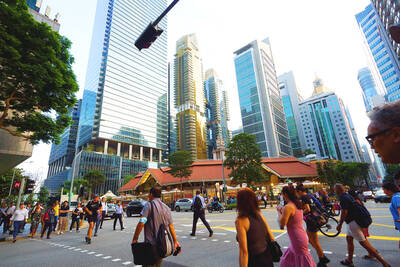
Thousands of parents in Singapore are furious after a Cordlife Group Ltd (康盛人生集團), a major operator of cord blood banks in Asia, irreparably damaged their children’s samples through improper handling, with some now pursuing legal action. The ongoing case, one of the worst to hit the largely untested industry, has renewed concerns over companies marketing themselves to anxious parents with mostly unproven assurances. This has implications across the region, given Cordlife’s operations in Hong Kong, Macau, Indonesia, the Philippines and India. The parents paid for years to have their infants’ cord blood stored, with the understanding that the stem cells they contained


 RSS
RSS