


The Bush administration has turned down the latest request for a trade case to be brought against China over its currency system, marking the third time it has refused to take the dispute to the World Trade Organization.
US Trade Representative Rob Portman rejected a petition filed in April by House and Senate members asking the administration to use a provision in US trade law, known as Section 301, that allows economic sanctions to be used against unfair trade practices.
"We do not believe that a Section 301 action is appropriate or a productive way" to achieve the goal of a flexible Chinese currency system, Portman's spokesman Richard Mills said on Friday in a statement.
The decision came a little more than a week after the US Treasury Department refused in a report to Congress to cite China as a country that manipulates its currency to gain trade advantages.
The latest petition was filed by 22 House members and 12 senators who raised the same arguments as US manufacturers: that China is unfairly manipulating its currency to gain trade advantages by retaining for the past decade a system that links the yuan to the US dollar at a fixed value of 8.28 yuan to the dollar.
"For a third time, the administration is turning a blind eye to China's unfair trade practices," said Democratic Senator Charles Schumer, in response to the latest rejection.
Democratic Representative Benjamin Cardin said if the administration keeps rejecting the petitions, "Congress will take other actions. This is a serious issue that harms American workers and businesses each day that it continues."
Legislation pending in both the House and Senate would impose across-the-board tariffs of 27.5 percent on China if it continues to refuse to drop its link to the dollar.
US manufacturers contend this has undervalued the yuan by as much as 40 percent, making Chinese products cheaper in the US market and American goods more expensive in China.
Critics blame China's currency system for contributing to the loss of 3 million US manufacturing jobs over the past five years. They also blame China's system for a soaring trade deficit that hit a record US$617 billion last year, including a US$162 billion imbalance just with China, the largest ever with a single country.
Friday's announcement marked the third time the administration has turned down a request for the US to bring a trade case against China over the issue before the World Trade Organization.
It rejected an earlier petition from lawmakers last November and before that turned down a petition by a group of unions and manufacturing companies that had sought to pressure the administration in the closing weeks of the presidential campaign.
In rejecting the latest petition, Mills said the administration shared the goals of the petitioners for a "flexible, market-based exchange rate system" in China but continued to feel there were better ways to achieve that goal than by filing a trade case.
Treasury Secretary John Snow, testifying before Congress on the issue on Thursday, predicted that China would move to make its currency system more flexible over the next five months, before the administration's next report on the issue to Congress in October.
The administration, which initially argued that China should allow its currency to float freely with its value set by global currency markets, now contends that such a move would be too disruptive in the near term. It argues that an interim step should be taken.
While the administration has not specified what that step would be, currency experts say China could link the yuan's value to a group of currencies from other countries, not just the dollar, or it could create a band within which the currency could trade.
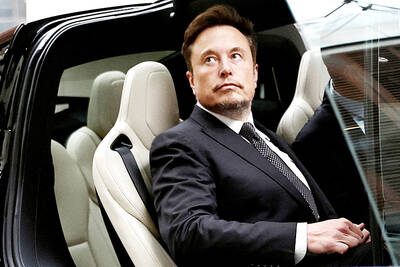
purpose: Tesla’s CEO sought to meet senior Chinese officials to discuss the rollout of its ‘full self-driving’ software in China and approval to transfer data they had collected Tesla Inc CEO Elon Musk arrived in Beijing yesterday on an unannounced visit, where he is expected to meet senior officials to discuss the rollout of "full self-driving" (FSD) software and permission to transfer data overseas, according to a person with knowledge of the matter. Chinese state media reported that he met Premier Li Qiang (李強) in Beijing, during which Li told Musk that Tesla's development in China could be regarded as a successful example of US-China economic and trade cooperation. Musk confirmed his meeting with the premier yesterday with a post on social media platform X. "Honored to meet with Premier Li
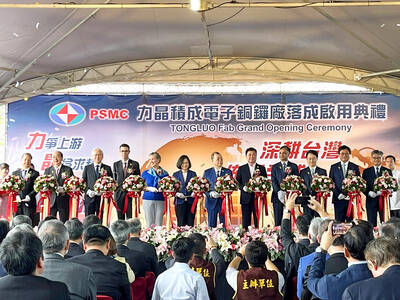
ARTIFICIAL INTELLIGENCE: The chipmaker last month raised its capital spending by 28 percent for this year to NT$32 billion from a previous estimate of NT$25 billion Contract chipmaker Powerchip Semiconductor Manufacturing Corp (力積電子) yesterday launched a new 12-inch fab, tapping into advanced chip-on-wafer-on-substrate (CoWoS) packaging technology to support rising demand for artificial intelligence (AI) devices. Powerchip is to offer interposers, one of three parts in CoWoS packaging technology, with shipments scheduled for the second half of this year, Powerchip chairman Frank Huang (黃崇仁) told reporters on the sidelines of a fab inauguration ceremony in the Tongluo Science Park (銅鑼科學園區) in Miaoli County yesterday. “We are working with customers to supply CoWoS-related business, utilizing part of this new fab’s capacity,” Huang said, adding that Powerchip intended to bridge
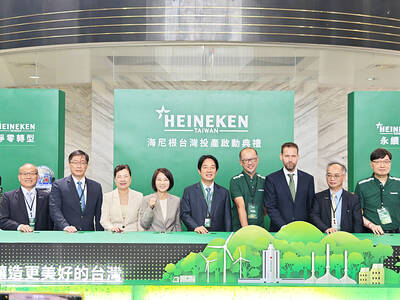
Dutch brewing company Heineken NV on Friday announced an investment of NT$13.5 billion (US$414.62 million) over the next five years in Taiwan. The first multinational brewing company to operate in Taiwan, Heineken made the statement at a ceremony held at its brewery in Pingtung County. It also outlined its efforts to make the brewery “net zero” by 2030. Heineken has been in the Taiwanese market for 20 years, Heineken Taiwan managing director Jeff Wu (吳建甫) said. With strong support from local consumers, the Dutch brewery decided to transition from sales to manufacturing in the country, Wu said. Heineken assumed majority ownership and management rights

Microsoft Corp yesterday said that it would create Thailand’s first data center region to boost cloud and artificial intelligence (AI) infrastructure, promising AI training to more than 100,000 people to develop tech. Bangkok is a key economic player in Southeast Asia, but it has lagged behind Indonesia and Singapore when it comes to the tech industry. Thailand has an “incredible opportunity to build a digital-first, AI-powered future,” Microsoft chairman and chief executive officer Satya Nadella said at an event in Bangkok. Data center regions are physical locations that store computing infrastructure, allowing secure and reliable access to cloud platforms. The global embrace of AI


 RSS
RSS