


While some United Airlines employees are using placards and pamphlets to protest the loss of their pensions, a group of flight attendants is taking a more risque tack -- showing some skin to publicize their plight.
The five women, ranging in age from 55 to 64, posed for a 2006 calendar that depicts them in various states of undress in front of a vintage plane, on a park bench and on a plane's wing, among other locations. Reflecting a mix of humor and anger, it was released to coincide with a bankruptcy court's approval this week of United's plan to terminate US$9.8 billion in employee pension obligations.
While United is never named nor its airplanes shown, every photograph in "Stewardesses Stripped (Of Their Pension?)" is accompanied by a zinger related to the record pension default by the Elk Grove Village, Illinois-based airline.
"Coffee, tea, or me without a pension?" reads one. "Marry me, fly free -- but don't expect anything from my pension," says another. And the cover shot: "Are your butts covered? We thought ours were too."
Retired flight attendant Connie Baker, the project's creator and one of its photo subjects, says it was inspired by the 2003 film Calendar Girls about the real-life story of a group of older British women who posed naked for a calendar to raise charity money.
"I thought if these English women can do this, we flight attendants can definitely do it," said Baker, 59, who lives outside Phoenix.
The real driving force, though, was United's announcement last summer that it intended to stop funding its pensions and dump them on the government's pension agency, which by law can guarantee just US$6.6 billion of the total.
Baker, who started working for United in 1967 when flight attendants were called stewardesses, now is bracing for her US$2,800-a-month pension to be cut in half.
"You can't really live on that," she said. "How am I going to live on 50 percent of it?"
But Baker wants it known that this isn't all about being bitter. She hopes some good can come from it, and not just the percentage of calendar and T-shirt sales that the women will donate to charity.
"We wanted to create a little humor in people's lives, make it fun, while at the same time getting our message across," she said.
Her husband, Bruce Baker, took the photos. The other retirees photographed are Linda Andrews, 59, and Rosemary Esparza, 64. Baker did not want to name the other two since they are active flight attendants for United.


Taiwanese firms have increased investment in the Philippines in recent years as Manila’s ties with Washington deepen and global supply chains continue to shift away from China, an expert at the Chung-Hua Institution for Economic Research (CIER, 中華經濟研究院) said yesterday. The Philippines had not been among Taiwanese investors’ top choices in Southeast Asia, CIER Taiwan ASEAN Studies Center director Kristy Hsu (徐遵慈) said at a seminar in Taipei. However, Taiwan’s investment in the country has grown significantly since the COVID-19 pandemic, reaching US $257 million last year, a high in recent years, she said. Although Taiwan’s total investment in the Philippines still lags

Intel Corp regards Taiwan Semiconductor Manufacturing Co (TSMC, 台積電) as a longstanding partner, as the US chipmaker would continue outsourcing production of advanced chips to TSMC, Intel chief executive officer Lip-Bu Tan (陳立武) said yesterday. “I don’t look at people as competitors. I look at the collaboration... Nvidia is also, you know, a good friend,” Tan told a news conference following his keynote speech at the Computex trade show in Taipei. “It’s a very trusted partnership for us... We are a big, top customer for them, and we’re going to continue doing that,” he said, referring to TSMC, the world’s largest foundry
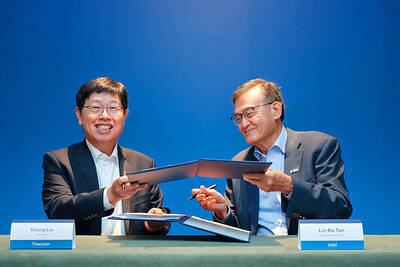
Hon Hai Precision Industry Co (鴻海精密) yesterday said it would work with US chipmaker Intel Corp to jointly develop and deploy next-generation artificial intelligence (AI) infrastructure and intelligent computing platforms in a move to capture booming demand for AI computing systems. Hon Hai, also known as Foxconn Technology Group (富士康), said in a statement that the partnership would combine its global manufacturing scale, system integration expertise and AI data center deployment capabilities with Intel’s strengths in processor architecture, silicon technologies and software ecosystem. The companies said they plan to work on equipment used in AI data centers, including server racks powered by

Artificial intelligence (AI) agents would supplant smartphones as the center of people’s digital lives, fundamentally reshaping personal devices and driving a major computing upgrade cycle, Qualcomm Inc CEO Cristiano Amon said yesterday. In his keynote speech for this year’s Computex trade show in Taipei, Amon said that the rise of "agentic AI" — AI systems capable of reasoning, planning and carrying out tasks autonomously — would transform how people interact with technology across phones, PCs, vehicles and wearable devices. Describing the technology as the next major evolution in computing, Amon said that "2026 is the year of agents.” For decades, smartphones have sat


 RSS
RSS