


Though China will broaden macroeconomic controls to check an overheated economy, unless it revalues its currency upward no amount of controls will be effective, a senior official at the Council for Economic Planning and Development said.
The number of approved investments for China fell significantly in the first quarter, and this represented growing concerns among Taiwanese businesses over the worsening economic environment in China, Council Vice Chairman Thomas Yeh (葉明峰) said in an interview published in the Chinese-language Liberty Times yesterday.
According to the Ministry of Economic Affairs, 289 China-bound investment applications were approved in the first quarter, a drop of 47.83 percent from a year earlier. The total value of investments also dropped by 6.57 percent to US$1.21 billion.
Yeh saw this as a cooling of the China-investment fever that has gripped Taiwan. He attributed it to the macroeconomic controls that are necessary because of China's unbalanced economy, and also to China's failure to resolve problems over water and electricity supplies, as well as the unpredictability of the government.
All these factors have caused Taiwanese businesspeople to be more cautious when investing in China, he added.
This year, China has seen GDP growth of 9.5 percent. Analysts are expecting Beijing to impose more macroeconomic controls in response.
Yeh said that China has already been using such controls for a year now, but with little effect. He said this was largely because the value of the yuan has remained unchanged.
While other currencies have risen in response to the weakening US dollar, the yuan, which has been pegged to the US dollar at around 8.3 since 1995, remains stable. China has gained a significant advantage in its exports because of this, and has also accrued over US$600 billion in foreign currency reserves.
"The fact that the Chinese government won't let the yuan rise in value is unthinkable, it is immoral," Yeh said.
He added that China was using the fixed exchange rate and a surging trade surplus to earn foreign exchange.
Because this was impacting negatively on international markets, he said, it was hardly surprising that the US Congress warned China that it would levy anti-dumping taxes on Chinese goods if Beijing did not allow the yuan to appreciate.
Yeh suggested that China's behavior had not only led to international criticism, but was also hampering its efforts to bring its economy under control.

Among the rows of vibrators, rubber torsos and leather harnesses at a Chinese sex toys exhibition in Shanghai this weekend, the beginnings of an artificial intelligence (AI)-driven shift in the industry quietly pulsed. China manufactures about 70 percent of the world’s sex toys, most of it the “hardware” on display at the fair — whether that be technicolor tentacled dildos or hyper-realistic personalized silicone dolls. Yet smart toys have been rising in popularity for some time. Many major European and US brands already offer tech-enhanced products that can enable long-distance love, monitor well-being and even bring people one step closer to

Malaysia’s leader yesterday announced plans to build a massive semiconductor design park, aiming to boost the Southeast Asian nation’s role in the global chip industry. A prominent player in the semiconductor industry for decades, Malaysia accounts for an estimated 13 percent of global back-end manufacturing, according to German tech giant Bosch. Now it wants to go beyond production and emerge as a chip design powerhouse too, Malaysian Prime Minister Anwar Ibrahim said. “I am pleased to announce the largest IC (integrated circuit) Design Park in Southeast Asia, that will house world-class anchor tenants and collaborate with global companies such as Arm [Holdings PLC],”

TRANSFORMATION: Taiwan is now home to the largest Google hardware research and development center outside of the US, thanks to the nation’s economic policies President Tsai Ing-wen (蔡英文) yesterday attended an event marking the opening of Google’s second hardware research and development (R&D) office in Taiwan, which was held at New Taipei City’s Banciao District (板橋). This signals Taiwan’s transformation into the world’s largest Google hardware research and development center outside of the US, validating the nation’s economic policy in the past eight years, she said. The “five plus two” innovative industries policy, “six core strategic industries” initiative and infrastructure projects have grown the national industry and established resilient supply chains that withstood the COVID-19 pandemic, Tsai said. Taiwan has improved investment conditions of the domestic economy
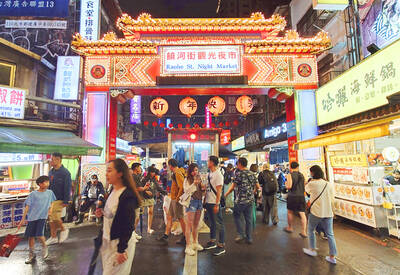
Sales in the retail, and food and beverage sectors last month continued to rise, increasing 0.7 percent and 13.6 percent respectively from a year earlier, setting record highs for the month of March, the Ministry of Economic Affairs said yesterday. Sales in the wholesale sector also grew last month by 4.6 annually, mainly due to the business opportunities for emerging applications related to artificial intelligence (AI) and high-performance computing technologies, the ministry said in a report. The ministry forecast that retail, and food and beverage sales this month would retain their growth momentum as the former would benefit from Tomb Sweeping Day


 RSS
RSS