


Synergy and Other Lies would be a good first reading assignment for Howard Stringer, Sony's new chief executive, to be followed by The Synergy Myth.
Then Stringer should recognize that the Sony he inherits is constitutionally incapable of making one (electronics) plus one (entertainment) equal three.
Both books were written by Harold Geneen, the number-cruncher who directed International Telephone & Telegraph during its heyday in the 1960s.
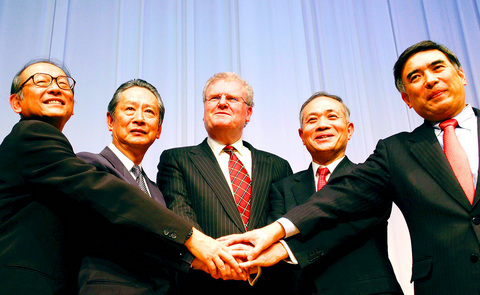
PHOTO: EPA
He engineered 350 mergers and acquisitions, which brought such names as Hartford, Avis, Sheraton and Madison Square Garden under one roof. Geneen, however, harbored no illusions that ITT's individual components could be coordinated in mutually beneficial ways. Each had to make its numbers wholly on its own.
`electronics and entertainment'
Stringer now presides over a company that appears -- superficially -- to be the polar opposite of an ITT-like conglomeration of unrelated businesses. Sony is accustomed to thinking of itself as consisting of two well-matched halves: electronics and entertainment.
At the Consumer Electronics Show last month, Stringer observed, "A device without content is nothing but scrap metal," a platitude beneath mention -- unless, perhaps, one were a mite defensive about owning both a widget factory and an entertainment factory.
Stringer is expected to gently coax the consumer electronics half to stop sulking and to walk over to shake hands with the Hollywood half.
And then, step back, everyone, for alchemical magic, convergence, synergy.
At first glance, digital music is the field in which Sony's considerable assets seem best suited, with a little rearrangement, for a comeback.
On one side, Sony has 50 years of experience in producing portable music players, beginning with transistor radios in the 1950s and extended by its Walkman franchise that has sold more than 340 million players.
On the other, it owns one of the world's largest music labels to supply content.
Yet in the iPod era, Sony's head start counts for nothing. It's as if the company were the Sony Gramophone & Wax Record Co.
The cassette-playing Walkman, even though it was outrageously successful, did not help Sony prepare for the digital player.
It was nothing but hardware, and surprisingly simple. The first one was built in 1979, when a Sony executive sent down a request to the company's tape recorder division to rig up a portable cassette player that could provide stereo sound but still be light enough for him to take along on international flights.
`21st-century Walkman'
A small team pulled out the recording mechanism and speaker of the company's monaural Pressman, a cassette recorder used by journalists, installed stereo circuitry and added earphones. It was ready in four days.
The predigital Walkman evolved over the years into more than an astounding 1,120 models. But its essential nature remained unchanged: It was dumb hardware. When Apple Computer introduced the iPod in November 2001, Steve Jobs described his new player as "the 21st-century Walkman."
With 99 years remaining in the century, that was an early call. But he was correct.
The iPod in 2001 was a Walkman successor, but smarter, its hard drive easily navigated with well-designed software.
In April 2003, however, when the iTunes Music Store opened, the iPod became something else again: part of an ingeniously conceived blend of hardware, software and content that made buying and playing music ridiculously easy.
Apple accomplished this feat by relying on its own expertise in the twin fields of hardware and software, but without going into the music business itself.
Much earlier than this, Sony had gone Hollywood.
Flush with profits generated in no small measure by the Walkman, and taking advantage of the strong Japanese yen, Sony acquired CBS Records for US$2 billion in 1988 and Columbia Pictures for US$3.4 billion the next year.
Neither transaction could be said to have been the outcome of thoughtful internal discussions about strategy.
The possibility of marrying hardware and entertainment was a consideration, but a fuzzy one.
However dubious the original rationale, the music and movie acquisitions have turned into Sony's brightest, most profitable spot at the moment. It's the portfolio effect you would expect in a classic conglomerate:
Parts of the business that are doing well cover for those that are not. Of course, the theory assumes that a given unit's difficulties are merely cyclical.
But Stringer's consumer electronics business, whose DNA only supports premium pricing and lacks the software gene, may not bounce back, ever.

Among the rows of vibrators, rubber torsos and leather harnesses at a Chinese sex toys exhibition in Shanghai this weekend, the beginnings of an artificial intelligence (AI)-driven shift in the industry quietly pulsed. China manufactures about 70 percent of the world’s sex toys, most of it the “hardware” on display at the fair — whether that be technicolor tentacled dildos or hyper-realistic personalized silicone dolls. Yet smart toys have been rising in popularity for some time. Many major European and US brands already offer tech-enhanced products that can enable long-distance love, monitor well-being and even bring people one step closer to

Malaysia’s leader yesterday announced plans to build a massive semiconductor design park, aiming to boost the Southeast Asian nation’s role in the global chip industry. A prominent player in the semiconductor industry for decades, Malaysia accounts for an estimated 13 percent of global back-end manufacturing, according to German tech giant Bosch. Now it wants to go beyond production and emerge as a chip design powerhouse too, Malaysian Prime Minister Anwar Ibrahim said. “I am pleased to announce the largest IC (integrated circuit) Design Park in Southeast Asia, that will house world-class anchor tenants and collaborate with global companies such as Arm [Holdings PLC],”

TRANSFORMATION: Taiwan is now home to the largest Google hardware research and development center outside of the US, thanks to the nation’s economic policies President Tsai Ing-wen (蔡英文) yesterday attended an event marking the opening of Google’s second hardware research and development (R&D) office in Taiwan, which was held at New Taipei City’s Banciao District (板橋). This signals Taiwan’s transformation into the world’s largest Google hardware research and development center outside of the US, validating the nation’s economic policy in the past eight years, she said. The “five plus two” innovative industries policy, “six core strategic industries” initiative and infrastructure projects have grown the national industry and established resilient supply chains that withstood the COVID-19 pandemic, Tsai said. Taiwan has improved investment conditions of the domestic economy

Sales in the retail, and food and beverage sectors last month continued to rise, increasing 0.7 percent and 13.6 percent respectively from a year earlier, setting record highs for the month of March, the Ministry of Economic Affairs said yesterday. Sales in the wholesale sector also grew last month by 4.6 annually, mainly due to the business opportunities for emerging applications related to artificial intelligence (AI) and high-performance computing technologies, the ministry said in a report. The ministry forecast that retail, and food and beverage sales this month would retain their growth momentum as the former would benefit from Tomb Sweeping Day


 RSS
RSS