


China Airlines (CAL,
"Our focus isn't profit, but the goodwill across the Taiwan Strait that may lead to future talks on direct links and great business opportunities," said Nieh Kuo-wei (
"We broke even in 2003, but other airlines lost money," Nieh said.
The flights, for four weeks beginning Jan. 29, will be an expanded version, with carriers from China participating for the first time. Instead of having to stop over in a third country, the nonstop flights will be required merely to pass through Hong Kong airspace.
Shares in China Airlines, the nation's biggest carrier, and No. 2 EVA Airways rose as investors bet the resumption, after cross-strait bickering derailed them last year, portends warmer relations between China and Taiwan. The TAIEX rose 1 percent to 5,945.27.
"The flights will help restore investor confidence," said Celine Chiang (
CAL said in a statement it's planning to operate the first flight this year, scheduling 4:05am service on Jan. 29 to Beijing from Taipei. EVA Air plans four charters, beginning Jan. 29.
CAL shares rose 0.5 percent to close at NT$18.50, while EVA was up 1.3 percent at NT$16.
China Airlines, which made history two years ago when it was the first Taiwanese carrier to land in Shanghai in more than a half century, said the flights have publicity value.
"Profit is a secondary consideration," said Johnson Sun (
Do the special flights bring regularly scheduled service between China and Taiwan closer?
"We don't dare make predictions about the future," Sun said. "If the government wants us to fly, we will."
Under an agreement announced on Jan. 15 after talks in Macau, six Taiwanese carriers and six Chinese ones will operate a combined 48 flights. It will be the first time airlines from China will land in Taiwan in more than half a century.
Political analysts like Philip Yang (
"I'm more cautious on whether this will lead to improving cross-strait relations," Yang, a political scientist at National Taiwan University, said of the flights.
"China wants to balance its hardline image after it decided to propose an anti- secession law. Still, this could lay a good foundation for future dialogue on non-political issues," he said.
The other local carriers involved in the flights are TransAsia Airways(復興), Far Eastern Air Transport Corp (遠東), Mandarin Airlines (華信) and UNI Airways Corp (立榮).
The charters aren't expected to be big money-spinners this year because so many airlines are participating and because many Taiwanese businessmen may have already booked holiday tickets on regular flights.
Sun said the carrier's Hong Kong-Taipei flights before Feb. 7 are already 90 percent booked and no surcharge will be imposed for those wishing to switch to the charters.
China Airlines and subsidiary Mandarin Airlines said ticket costs will be 20 percent lower than fares on existing, indirect cross-strait services. EVA said it has yet to set the ticket prices.
"Since each will have only four flights, the contribution to our revenue and profit will be limited," Nieh said.

HSBC Holdings PLC is deepening its commitment to Taiwan as the economy emerges as one of the bank’s fastest-growing markets globally, driven by an artificial intelligence (AI) investment boom, expanding cross-border trade, and rising wealth creation. “The advantage that Taiwan has is a growth story linked to the semiconductor and broader AI industries, strong underlying corporate performance, and wealth creation,” said Surendra Rosha, HSBC’s co-chief executive for Asia and the Middle East, in an exclusive interview with the Taipei Times on June 2, during this year’s HSBC Taiwan Conference. That combination has helped HSBC cement its position as the most profitable international
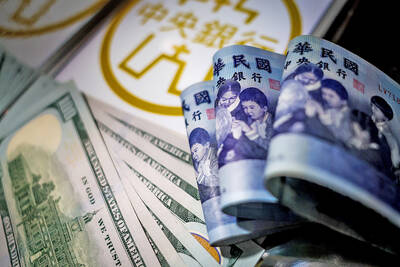
The New Taiwan dollar yesterday fell sharply against the US dollar to close at its lowest level since May 22 amid a massive outflow of funds from the country because of investors panicking over global equity markets. The NT dollar ended at NT$31.580 against the US dollar, slightly lower than its close of NT$31.568 on May 22, after moving between NT$31.5 and NT$31.648 on combined turnover of US$3.062 billion on the Taipei Foreign Exchange and the Cosmos Foreign Exchange. The NT dollar received a significant hit in the morning session, slumping as much as NT$0.173 at a time when other Asian currencies
Taiwan Semiconductor Manufacturing Co (TSMC, 台積電) is now ranked ninth among the world’s 100 most valuable companies after its market capitalization more than doubled over the past year, PricewaterhouseCoopers (PwC) Taiwan said in a report last month. TSMC’s market capitalization surged 101 percent year-on-year to US$1.427 trillion as of March 31, the accounting and consulting firm’s 2026 Global Top 100 Companies by Market Capitalization report said. The gain catapulted the world’s largest contract chipmaker from 12th place to ninth in the rankings, and it was the fastest-growing among the global top 10, it said. TSMC was the only Taiwanese company among the top
Taiwan Semiconductor Manufacturing Co (TSMC, 台積電) yesterday reported record revenue of NT$416.975 billion (US$13.17 billion) for last month, putting the world’s largest contract chipmaker on track to set a record for quarterly revenue. Last month’s figure surpassed March’s record NT$415.19 billion and represented increases of 1.5 percent from April and 30.1 percent from a year earlier. For the first five months of the year, TSMC generated NT$1.96 trillion in revenue, up 30 percent year-on-year, it said in a statement. TSMC has forecast second-quarter revenue of between US$39 billion and US$40.2 billion, representing sequential growth of about 10 percent and year-on-year growth of about


 RSS
RSS