


Nearly the size of an old station wagon, a bright orange machine here mashes plastic pellets into rows of 6-inch-long blue clips for hospitals across the US. Pan Guotao, a 29-year-old worker from a village in northern China, sits on a plastic stool next to the machine and wields a straight razor to slice apart the clips, which are used to hold ice packs in plastic sleeves.
It looks like a simple operation, but it lies at the heart of the US trade deficit with China.
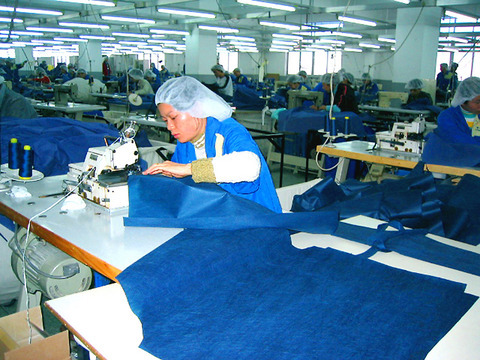
PHOTO: NY TIMES
The Bush administration and many private economists have urged that the authorities in Beijing allow China's currency, the yuan, to rise in value against the dollar. They want the Chinese to stop buying up US dollars in large amounts and issuing more and more yuan to hold down the value of the currency.
But many Chinese and foreign executives in China say that a revaluation of the yuan, whose exchange value is linked to the dollar, is unlikely to be a silver bullet for dealing with the US deficit. Costs here are so low, they say, that a revaluation is unlikely to narrow the deficit appreciably, and might even increase it.
China's edge in exports these days goes far beyond the low wages of Pan, who earns US$1 an hour, plus free room and board. Her employer, Charles Hubbs, who owns the plastics factory, calculates that the rent for his operation here, built by workers earning even less than Pan, is a quarter of what it would be in a city like Houston. Perhaps more important, China has learned to build factories and many kinds of equipment at a fraction of the cost in Western countries.
The big orange plastic injection molding machine costs US$18,000 here, compared with as much as US$60,000 for US models; the Chinese-made machine breaks down a little more often, but it can be quickly fixed because the assembly plant is less than two miles away. The costliest part, the specially hardened and shaped molds in which the clips are formed, cost less than US$8,000, against US$70,000 in the US.
Such savings leave Hubbs feeling well insulated from even a big shift in the value of the yuan, which trades around 8.28 to the dollar.
"With the currency where it is today," he said, "we can save 30 percent over our competition in the Caribbean easily."
Making the yuan more expensive against the dollar would mean that US exporters to China, like Boeing, could sell more goods. Importers like Wal-Mart would have to pay more for the toys, clothes and other goods they buy. That would give Wal-Mart and others an incentive to import from other nations, perhaps even US suppliers.
Revaluation not a cure
Yet executives in many industries say that China's competitive advantages are so great that even the largest increase in the yuan that Beijing might approve this year, perhaps 10 percent, would not significantly cut into the US trade deficit with China. Indeed, revaluation is likely to increase the deficit for months and perhaps years to come, by immediately driving up the already considerable cost of what the US imports from China.
A stronger yuan would give a boost to US companies exporting to China because their goods would become cheaper here. But the US currently buys nearly five times as much from China as China does from the US. So the gains from a rise in a smaller amount of exports are likely to be overwhelmed by the higher cost of the larger amount of imports.
Alan Hassenfeld, the chairman of Hasbro, said that a revaluation of 3 percent to 5 percent this spring seemed the most likely. But that degree of change would not prompt toy manufacturers to look seriously at moving production to lower-wage countries like Vietnam or India. Chinese toy factories, he said, had a big advantage over factories elsewhere in the quality and dedication of their work forces and management.
Even a 25 percent increase in the value of the yuan, which few say they expect, would still allow many toymakers to successfully export a wide range of products from China. An increase that big would probably prompt manufacturers to move some of their bulkiest products, like car-racing sets, to countries closer to the US to save on shipping costs, Hassenfeld said.
"You wouldn't run," he said, "but you would take some items and move them back to a Mexico" or some other nearby country.
Companies, like toy makers, that use a lot of Chinese labor are the most likely to be affected by a stronger yuan. That is because the workers are paid in yuan, and wages are already rising in China -- even without an appreciating yuan.
Daniel Chou, export manager at the Ningbo Keerdeng Toys Co. near Shanghai, said that its average assembly-line wages had nearly doubled in the last five years, to US$181 a month from US$97. His factory, unlike Hubbs', does not provide free room and board. Space in a nearby shared apartment costs US$12 a month and food US$30. And improving conditions in rural areas have left workers more reluctant to move to the cities unless they are paid more. Still, the cost of living remains relatively low.
Ningbo Keerdeng has dealt with rising wages the same way as factories in industrial nations -- by automating and investing more in design. The company makes Santa dolls that push themselves across the floor on skis, and machines now sew the zippers and hems for the dolls' garments.
How much would hurt?
It would take a much larger revaluation of the yuan to create a serious problem for the business, and few people expect that, Chou said. If the currency "increases 15 percent, that would be very high, and 20 percent would be a disaster," he said.
The notable exception to corporate China's ability to withstand an increase in the yuan may be the industry that requires the most labor of all: apparel, especially low-end garments that require a lot of very basic sewing that can be done by unskilled and even illiterate workers.
Peter Peng, a manager at the Xiamen Point Light Industrial Co. in southeastern China, which makes inexpensive knapsacks for children, said it would be "a disaster" if Beijing allowed the yuan to increase by 10 percent. A few competitors from Taiwan have already begun setting up operations in Vietnam to take advantage of the lower wages, he said.
A rising yuan would also offer some consolation to a sizable number of Chinese exporters. Factories that are less labor-intensive, like auto parts and computers, tend to rely heavily on imported material, from oil to computer chips, and those imports are priced mostly in dollars. So a rise in the yuan would reduce the cost of their material.
Hubbs, for example, buys various plastic resins from Saudi Arabia, Thailand and the US, supplied by ExxonMobil and Dow Chemical. He calculates that nearly a third of his total costs are incurred in dollars.
Thus, in some ways, a stronger yuan might not only allow Chinese to continue selling their exports to Americans, but have a muted effect on the US' relatively modest exports to China. These totaled US$25.06 billion in the first 11 months of last year, compared with US$114.19 billion in imports from China.
The US is strongest in exports to China of food, notably soybeans, and infrastructure equipment, like the big turbines that General Electric ships and the powerful digging equipment Caterpillar sells.
Limited ability to compete
US equipment makers do not compete directly with Chinese manufacturers in many products. The Chinese companies either do not produce the equipment at all or they produce equipment that is much inferior in quality. That limits the potential for the US to take advantage of a higher yuan to sell more products and take market share from the Chinese companies.
At the same time, China's demand is growing more slowly for food than for many other kinds of products. Although the Chinese are eating more meat, which requires more tons of animal feed than importing food for direct consumption, overall increases remain modest.
A revaluation of the yuan, said Phil Laney, China director in Beijing for the American Soybean Association, "could mean feed millers increase the amount of soybeans they mix in their feed, but it's not going to make a big difference in demand."
Merle Hinrichs, chief executive of Global Sources, an online intermediary and catalog company for 140,000 overseas suppliers to the US market, the majority in China, said the company's surveys of consumer-goods industries had found no sign that anything short of a very large revaluation would make much difference.
"It has more of a perception impact than an actual impact," he said. "It's not going to impact the actual trade a lot."

Among the rows of vibrators, rubber torsos and leather harnesses at a Chinese sex toys exhibition in Shanghai this weekend, the beginnings of an artificial intelligence (AI)-driven shift in the industry quietly pulsed. China manufactures about 70 percent of the world’s sex toys, most of it the “hardware” on display at the fair — whether that be technicolor tentacled dildos or hyper-realistic personalized silicone dolls. Yet smart toys have been rising in popularity for some time. Many major European and US brands already offer tech-enhanced products that can enable long-distance love, monitor well-being and even bring people one step closer to

Malaysia’s leader yesterday announced plans to build a massive semiconductor design park, aiming to boost the Southeast Asian nation’s role in the global chip industry. A prominent player in the semiconductor industry for decades, Malaysia accounts for an estimated 13 percent of global back-end manufacturing, according to German tech giant Bosch. Now it wants to go beyond production and emerge as a chip design powerhouse too, Malaysian Prime Minister Anwar Ibrahim said. “I am pleased to announce the largest IC (integrated circuit) Design Park in Southeast Asia, that will house world-class anchor tenants and collaborate with global companies such as Arm [Holdings PLC],”

TRANSFORMATION: Taiwan is now home to the largest Google hardware research and development center outside of the US, thanks to the nation’s economic policies President Tsai Ing-wen (蔡英文) yesterday attended an event marking the opening of Google’s second hardware research and development (R&D) office in Taiwan, which was held at New Taipei City’s Banciao District (板橋). This signals Taiwan’s transformation into the world’s largest Google hardware research and development center outside of the US, validating the nation’s economic policy in the past eight years, she said. The “five plus two” innovative industries policy, “six core strategic industries” initiative and infrastructure projects have grown the national industry and established resilient supply chains that withstood the COVID-19 pandemic, Tsai said. Taiwan has improved investment conditions of the domestic economy

MAJOR BENEFICIARY: The company benefits from TSMC’s advanced packaging scarcity, given robust demand for Nvidia AI chips, analysts said ASE Technology Holding Co (ASE, 日月光投控), the world’s biggest chip packaging and testing service provider, yesterday said it is raising its equipment capital expenditure budget by 10 percent this year to expand leading-edge and advanced packing and testing capacity amid strong artificial intelligence (AI) and high-performance computing chip demand. This is on top of the 40 to 50 percent annual increase in its capital spending budget to more than the US$1.7 billion to announced in February. About half of the equipment capital expenditure would be spent on leading-edge and advanced packaging and testing technology, the company said. ASE is considered by analysts


 RSS
RSS