


Easing fears about inflation in the US, wholesale prices fell by the largest amount in 20 months in December, aided by a big decline in the cost of energy.
In other good economic news, output at the US' beleaguered manufacturing companies rose strongly last month, helping factories enjoy their first annual increase in output since 2000.
Analysts said Friday's reports depicted an economy that began the new year on a good footing with mild inflation and signs of strength in the long-suffering manufacturing sector, which has seen the loss of 2.7 million jobs over the past four years.
"These are very positive reports showing solid production at year's end with moderating inflation," said Mark Zandi, chief economist at Economy.com.
The Labor Department's Producer Price Index, which tracks inflation before it reaches the consumer, posted a decline of 0.7 percent last month as gasoline and other energy prices plunged by 4 percent, the biggest drop since April 2003.
Meanwhile, the Federal Reserve said industrial production rose by 0.8 percent in December, far above the modest 0.2 percent rise in November. Manufacturing production was up 0.7 percent during the month while output at utilities rose by 2.7 percent and mining saw a 0.4 percent increase.
For the year, industrial production rose by 4.1 percent, the best showing since 2000 and a sharp turnaround from the past three years when production either fell or was flat.
"Manufacturing has finally broken out of its slump," said David Huether, chief economist at the National Association of Manufacturers, noting that last year's rebound was broad-based with growth in 16 of 19 major industries.
Huether predicted further strong gains in factory output this year as businesses boost capital spending and the decline in the value of the dollar against other currencies helps to boost exports.
However, David Wyss, chief economist at Standard & Poor's in New York, noted that the trade deficit is still worsening as domestic manufacturers continue to be battered by imports.
"I think we are through the worst of manufacturing's troubles although we are still not seeing much in the way of actual strength, especially in employment growth," he said.
The better-than-expected 0.7 percent drop in wholesale prices last month, the biggest decline since a 1.5 percent fall in April 2003, followed sharp increases of 1.7 percent in October and 0.5 percent in November, gains that were propelled by skyrocketing energy prices.
The 4 percent drop in energy prices in December reflected unusually warm weather, especially in the Northeast where there is a heavy reliance on home heating oil.
But analysts cautioned that energy prices rebounded again this week amid worries about upcoming cold weather, the turmoil in Iraq and a dip in crude oil and heating oil inventories.
For all of last year, wholesale prices rose by 4.1 percent, up slightly from a 4 percent increase in 2003. Both years recorded the biggest wholesale inflation increases since a 5.7 percent surge in 1990, another year when turmoil in the Middle East sent world oil prices soaring.
Outside of the volatile energy and food sectors, inflation was better behaved with the so-called core rate of wholesale inflation rising by just 2.2 percent last year, up from a 1 percent increase in 2003.
Analysts said the performance of core inflation should satisfy Federal Reserve policy-makers that despite the jump in energy prices last year, inflation is not threatening to get out of control. Many economists predicted that the Fed would keep raising interest rates at a moderate pace of quarter-point moves this year.
Food prices at the wholesale level edged up a tiny 0.1 percent in December after rising by 0.4 percent in November. The price moderation reflected a big 26.4 percent drop in the cost of vegetables, the biggest decline since April 2002, which offset price increases in other foods.
Outside of food and energy, prices in December rose by a slight 0.1 percent, following a gain of 0.2 percent in November. This slowdown in core inflation reflected a lower auto prices which fell as automakers again offered more attractive discounting incentives.
In another report Friday, the Commerce Department said that inventories held by businesses on shelves and backlots rose by 1 percent in November. That reflected in part a slowdown in sales, which rose by only 0.4 percent after a much bigger 1.4 percent October increase.

HSBC Holdings PLC is deepening its commitment to Taiwan as the economy emerges as one of the bank’s fastest-growing markets globally, driven by an artificial intelligence (AI) investment boom, expanding cross-border trade, and rising wealth creation. “The advantage that Taiwan has is a growth story linked to the semiconductor and broader AI industries, strong underlying corporate performance, and wealth creation,” said Surendra Rosha, HSBC’s co-chief executive for Asia and the Middle East, in an exclusive interview with the Taipei Times on June 2, during this year’s HSBC Taiwan Conference. That combination has helped HSBC cement its position as the most profitable international
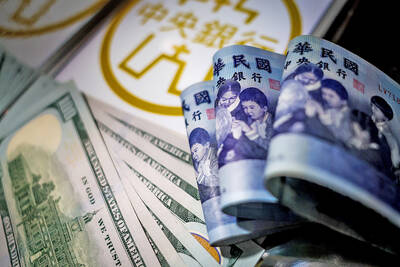
The New Taiwan dollar yesterday fell sharply against the US dollar to close at its lowest level since May 22 amid a massive outflow of funds from the country because of investors panicking over global equity markets. The NT dollar ended at NT$31.580 against the US dollar, slightly lower than its close of NT$31.568 on May 22, after moving between NT$31.5 and NT$31.648 on combined turnover of US$3.062 billion on the Taipei Foreign Exchange and the Cosmos Foreign Exchange. The NT dollar received a significant hit in the morning session, slumping as much as NT$0.173 at a time when other Asian currencies
Taiwan Semiconductor Manufacturing Co (TSMC, 台積電) is now ranked ninth among the world’s 100 most valuable companies after its market capitalization more than doubled over the past year, PricewaterhouseCoopers (PwC) Taiwan said in a report last month. TSMC’s market capitalization surged 101 percent year-on-year to US$1.427 trillion as of March 31, the accounting and consulting firm’s 2026 Global Top 100 Companies by Market Capitalization report said. The gain catapulted the world’s largest contract chipmaker from 12th place to ninth in the rankings, and it was the fastest-growing among the global top 10, it said. TSMC was the only Taiwanese company among the top
Taiwan Semiconductor Manufacturing Co (TSMC, 台積電) yesterday reported record revenue of NT$416.975 billion (US$13.17 billion) for last month, putting the world’s largest contract chipmaker on track to set a record for quarterly revenue. Last month’s figure surpassed March’s record NT$415.19 billion and represented increases of 1.5 percent from April and 30.1 percent from a year earlier. For the first five months of the year, TSMC generated NT$1.96 trillion in revenue, up 30 percent year-on-year, it said in a statement. TSMC has forecast second-quarter revenue of between US$39 billion and US$40.2 billion, representing sequential growth of about 10 percent and year-on-year growth of about


 RSS
RSS