


The scene on the street did not look like much, just the comings and goings of small groups of women from their factory dormitory, with a few lingering here and there in knots to discuss their situation.
Since last Friday, though, work has stopped inside the Uniden factory's walls here, where 12,000 workers, mostly young women from China's poor interior provinces, make wireless phones, which the Japanese manufacturer supplies in large number to the giant US retailer Wal-Mart.

PHOTO: THE NEW YORK TIMES
China's laws tightly proscribe public demonstrations, so the women found another way to vent their anger over their wages and what they said were many other abusive work conditions. They met secretly to draw up a list of demands, and then walked off the job.
Wal-Mart has been much in the news recently in China, with the government insisting that the retailer do what it refuses to do in the US: allow all its workers to join unions.
But what the scene at the Uniden plant here in Shenzhen, the very heartland of China's export-led resurgence, reveals is a situation much more typical in this country's booming new economy, where the government has been reluctant to enforce laws that would oblige foreign companies to allow unions, for fear of losing overseas investment.
The young women employed here say they are required to work 11-hour days, including three hours of mandatory overtime, in order to earn a basic monthly salary of 484 yuan, or about US$58.
The women say they must spend nearly half their wage on the drab company dormitories where, as migrants, they must live. They laughed ruefully when asked if they were able to save any money, or send money back to their families.
"No, I haven't been able to save any money," Liu Shuangyan said outside the factory gates. "You have to eat. You buy a few clothes, and then there's nothing left."
"If you get sick," added Liu, a native of Hunan Province, "they won't give you leave unless it is very serious."
A friend and fellow worker from Hunan, Wang Lifang, then spoke up to say, "They have a small clinic, but you have to pay, and the medicines they give you are much more expensive than outside."
Workers said the strike began when a senior Japanese manager was overheard saying to a Chinese supervisor that the employees would be foolish to accept the terms of a new contract being offered them. Others said it was caused by abusive dismissals of workers with seniority to make way for cheaper, more pliable replacements.
Japanese officials at the company, reached by telephone, refused to comment, passing the phone to a Chinese manager. The manager, who declined to identify himself, said, "A group of workers' contracts have reached termination, and the company, in conformance with labor laws, did not offer them a new contract."
Believing the questions were coming from a caller in New York, the Chinese manager said the strike had ended, early in the afternoon, and the situation had returned to normal.
"If you could get into a spaceship right now and come over, you'd see for yourself," he said, laughing.
Meanwhile, plainclothes security agents milled outside of the plant. As soon as a foreigner began taking photographs of the continuing work stoppage, they called the police.
Analysts of China's labor scene say strikes like this are becoming far more common as younger migrant workers exposed to the wealth of China's relatively rich eastern cities grow increasingly angry over what many see as their exploitation. Although few are unionized, communication and coordination among them is growing, often through the sending of coded messages to each other by cell phone.
"The migrant workers have learned to protest with their feet, they are more capable of negotiating, and they can choose not to work," said Liu Kaiming, who studies conditions of migrant workers in Guangdong Province.

ENERGY ISSUES: The TSIA urged the government to increase natural gas and helium reserves to reduce the impact of the Middle East war on semiconductor supply stability Chip testing and packaging service provider ASE Technology Holding Co (日月光投控) yesterday said it planned to invest more than NT$100 billion (US$3.15 billion) in building a new advanced chip testing facility in Kaohsiung to keep up with customer demand driven by the artificial intelligence (AI) boom. That would be included in the company’s capital expenditure budget next year, ASE said. There is also room to raise this year’s capital spending budget from a record-high US$7 billion estimated three months ago, it added. ASE would have six factories under construction this year, another record-breaking number, ASE chief operating officer Tien Wu

The EU and US are nearing an agreement to coordinate on producing and securing critical minerals, part of a push to break reliance on Chinese supplies. The potential deal would create incentives, such as minimum prices, that could advantage non-Chinese suppliers, according to a draft of an “action plan” seen by Bloomberg. The EU and US would also cooperate on standards, investments and joint projects, as well as coordinate on any supply disruptions by countries like China. The two sides are additionally seeking other “like-minded partners” to join a multicountry accord to help create these new critical mineral supply chains, which feed into

For weeks now, the global tech industry has been waiting for a major artificial intelligence (AI) launch from DeepSeek (深度求索), seen as a benchmark for China’s progress in the fast-moving field. More than a year has passed since the start-up put Chinese AI on the map in early last year with a low-cost chatbot that performed at a similar level to US rivals. However, despite reports and rumors about its imminent release, DeepSeek’s next-generation “V4” model is nowhere in sight. Speculation is also swirling over the geopolitical implications of which computer chips were chosen to train and power the new
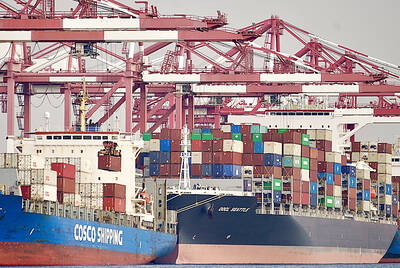
TECH WINNERS: Taiwan and South Korea reported robust trade, which suggests that they have critical advantages in the rapidly expanding AI supply chain, an official said Exports last month surged to a new high, as booming demand tied to artificial intelligence (AI) infrastructure fueled shipments of advanced technology components, underscoring the nation’s pivotal role in the global semiconductor supply chain. Outbound shipments climbed to US$80.18 billion, the highest ever for a single month, rising 61.8 percent from a year earlier and marking the 29th consecutive month of growth, the Ministry of Finance said yesterday. “The surge was driven primarily by global investment in AI infrastructure,” Department of Statistics Director-General Beatrice Tsai (蔡美娜) said. The mass production of next-generation AI computing systems has accelerated procurement across the semiconductor supply


 RSS
RSS