


The Bush administration has decided that it will impose a quota on sock imports from China -- the latest round of an increasingly bitter trade dispute with Beijing -- showing a willingness to protect US workers ahead of the election.
Trade has become a hot issue on the campaign trail with President George W. Bush, an unrepentant free trader, accusing his Democratic opponent Senator John Kerry of being an "economic isolationist." Kerry has countered that Bush has not done enough to protect US workers from unfair foreign competition.
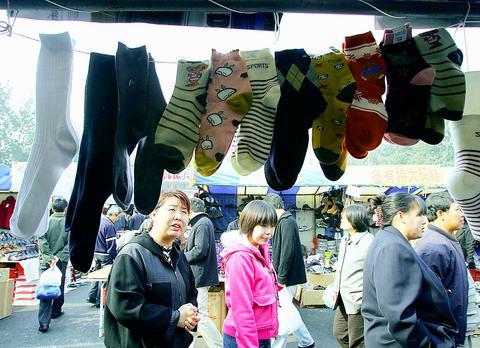
PHOTO: AP
The US trade deficit with China hit an all-time high for any country of US$124 billion last year and is running at an even higher US$140 billion rate this year. Seeking to reduce the deficit, the Bush administration has been pushing China to ease its pegged currency system. US manufacturers say the system, which keeps the yuan as much as 40 percent undervalued, gives Chinese products a tremendous competitive advantage.
The interagency Committee for the Implementation of Textile Agreements, chaired by the Commerce Department, ruled on Friday that sock imports from China are disrupting the US market and there is a risk of further disruption. The committee will seek talks with China to try to ease or avoid any disruption.
Once consultations are sought, the department said, "a quota will be put in place to limit US imports of socks from China" to an increase between 6 percent and 7.5 percent over current import levels, a far smaller increase than has occurred in recent years.
"The United States will make every effort to reach a mutually satisfactory agreement with the Government of China to ease or avoid the disruption in the US market within 90 days of such a request," the department said.
If talks fail, the quota will remain in effect for a year, the department said.
Besides socks, US textile and clothing manufacturers asked the administration on Oct. 12 to protect them against a surge of Chinese imports next year when worldwide quotas are removed under World Trade Organization rules. The petitions covers cotton and synthetic trousers, wool trousers, cotton and synthetic knit shirts and underwear.
The administration will have to make an initial ruling on the technical merits of the cotton trousers petition Nov. 1, one day before Election Day.
US manufacturers have been concerned they could be ruined by a flood of low-cost socks from China as import quotas expire at the end of the year. So they led an industry call last summer for the administration to help. Alabama Representative Robert Aderholt, a Republican, joined the effort by the Hosiery Association and asked the Commerce Department to help shield the sock industry from Chinese imports in a letter signed by Aderholt and 22 other members of Congress from both parties.
In 2002, Aderholt said, 69.6 million pairs of Chinese socks were imported. Last year, that number jumped 370 percent to 265 million pairs. Fort Payne, Alabama, is the self-proclaimed Sock Capital of the World, employing 6,200 workers in 95 factories that produce 14 million pairs a week.
Some retailers, large manufacturers and importing companies blasted the sock decision, which followed a move earlier this year to limit the import of nightgowns and brassieres from China.
Laura Jones, executive director of the US Association of Importers of Textiles and Apparel, said the decision is "totally political and has nothing to do with reality."
"Today's decision only perpetuates the failed protectionist policies that have discouraged the US textile industry from becoming competitive, innovative and responsive to their customers, which in turn has exacerbated job losses in the industry," she said.
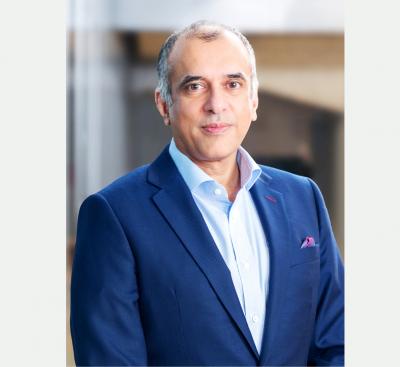
HSBC Holdings PLC is deepening its commitment to Taiwan as the economy emerges as one of the bank’s fastest-growing markets globally, driven by an artificial intelligence (AI) investment boom, expanding cross-border trade, and rising wealth creation. “The advantage that Taiwan has is a growth story linked to the semiconductor and broader AI industries, strong underlying corporate performance, and wealth creation,” said Surendra Rosha, HSBC’s co-chief executive for Asia and the Middle East, in an exclusive interview with the Taipei Times on June 2, during this year’s HSBC Taiwan Conference. That combination has helped HSBC cement its position as the most profitable international
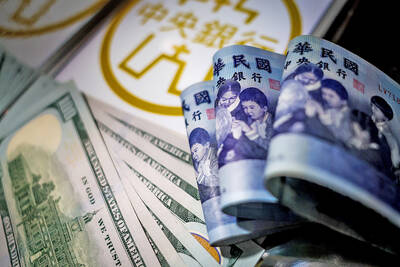
The New Taiwan dollar yesterday fell sharply against the US dollar to close at its lowest level since May 22 amid a massive outflow of funds from the country because of investors panicking over global equity markets. The NT dollar ended at NT$31.580 against the US dollar, slightly lower than its close of NT$31.568 on May 22, after moving between NT$31.5 and NT$31.648 on combined turnover of US$3.062 billion on the Taipei Foreign Exchange and the Cosmos Foreign Exchange. The NT dollar received a significant hit in the morning session, slumping as much as NT$0.173 at a time when other Asian currencies
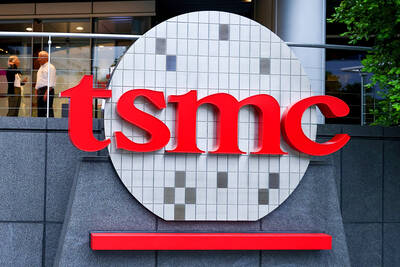
Taiwan Semiconductor Manufacturing Co (TSMC, 台積電) is now ranked ninth among the world’s 100 most valuable companies after its market capitalization more than doubled over the past year, PricewaterhouseCoopers (PwC) Taiwan said in a report last month. TSMC’s market capitalization surged 101 percent year-on-year to US$1.427 trillion as of March 31, the accounting and consulting firm’s 2026 Global Top 100 Companies by Market Capitalization report said. The gain catapulted the world’s largest contract chipmaker from 12th place to ninth in the rankings, and it was the fastest-growing among the global top 10, it said. TSMC was the only Taiwanese company among the top
Taiwan Semiconductor Manufacturing Co (TSMC, 台積電) yesterday reported record revenue of NT$416.975 billion (US$13.17 billion) for last month, putting the world’s largest contract chipmaker on track to set a record for quarterly revenue. Last month’s figure surpassed March’s record NT$415.19 billion and represented increases of 1.5 percent from April and 30.1 percent from a year earlier. For the first five months of the year, TSMC generated NT$1.96 trillion in revenue, up 30 percent year-on-year, it said in a statement. TSMC has forecast second-quarter revenue of between US$39 billion and US$40.2 billion, representing sequential growth of about 10 percent and year-on-year growth of about


 RSS
RSS