


BenQ Corp (
In the own-brand business, BenQ in July relinquished its long-held third-place position in the nation's mobile phone market to Inventec Appliances Corp (英華達), which owns the OKWAP handset brand.
Danny Yao (
"Two of our grayscale models were being phased out of the market at the time, while we were still cooking up new low-end cell phones to fill the gap," Yao said.
BenQ also makes cellphones for Motorola on a contract basis and is expected to start supplying Nokia, with shipment of 1.5 million handsets by the end of 2004. BenQ aims to ship 16 million handsets overall this year, up from 13 million last year.
Yao made the remarks during a press conference yesterday to launch the company's latest model, the A500, a clamshell with a built-in 0.3 mega-pixel camera. The rollout was more than two months behind the original schedule, the company said.
"We'll make it up by accelerating the push for fresh models later this year. In September alone, we'll have four models on the market, including one high-range camera phone with resolution enhanced to 1.3 megapixels," Yao said.
"September will be a crucial point for us to regain lost ground. There will be a confrontation," he said.
With its improving handset lineup, BenQ aims to recapture the 12 percent market share it had in the past three quarters, he said. In July, its market position weakened to a rare low of 9.6 percent.
The 9.6 percent figure brought its market share slightly below Inventec's 9.7 percent. Inventec's figure was an improvement from the 8 percent share it held over the past several quarters.
Despite the market share setback, BenQ is confident it will hit its sales target of 1 million cellphones for 2004. The Taiwan market is expected to total 6 million phones in 2004.
In the first eight months of the year, BenQ sold 600,000 cellphones to local consumers.
Commenting on the battle between the two local brands, Bruce Chiu (
BenQ and Inventec will take similar market shares of 12 percent, respectively, possibly at the expense of Dbtel Inc (
The market share of local brands will remain capped by a 30 percent ceiling, as international handset vendors have a firm hold on the remaining 70 percent, Chiu said.
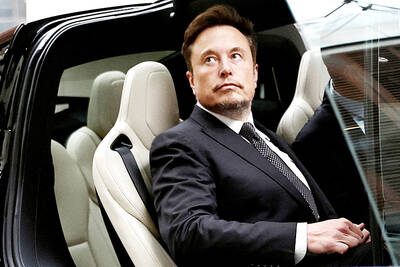
purpose: Tesla’s CEO sought to meet senior Chinese officials to discuss the rollout of its ‘full self-driving’ software in China and approval to transfer data they had collected Tesla Inc CEO Elon Musk arrived in Beijing yesterday on an unannounced visit, where he is expected to meet senior officials to discuss the rollout of "full self-driving" (FSD) software and permission to transfer data overseas, according to a person with knowledge of the matter. Chinese state media reported that he met Premier Li Qiang (李強) in Beijing, during which Li told Musk that Tesla's development in China could be regarded as a successful example of US-China economic and trade cooperation. Musk confirmed his meeting with the premier yesterday with a post on social media platform X. "Honored to meet with Premier Li
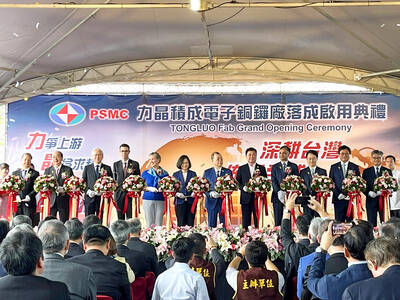
ARTIFICIAL INTELLIGENCE: The chipmaker last month raised its capital spending by 28 percent for this year to NT$32 billion from a previous estimate of NT$25 billion Contract chipmaker Powerchip Semiconductor Manufacturing Corp (力積電子) yesterday launched a new 12-inch fab, tapping into advanced chip-on-wafer-on-substrate (CoWoS) packaging technology to support rising demand for artificial intelligence (AI) devices. Powerchip is to offer interposers, one of three parts in CoWoS packaging technology, with shipments scheduled for the second half of this year, Powerchip chairman Frank Huang (黃崇仁) told reporters on the sidelines of a fab inauguration ceremony in the Tongluo Science Park (銅鑼科學園區) in Miaoli County yesterday. “We are working with customers to supply CoWoS-related business, utilizing part of this new fab’s capacity,” Huang said, adding that Powerchip intended to bridge
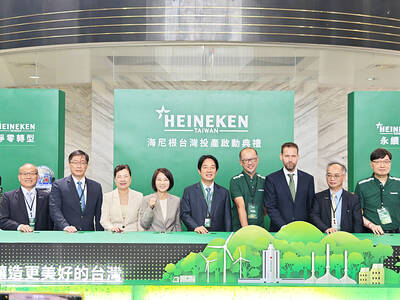
Dutch brewing company Heineken NV on Friday announced an investment of NT$13.5 billion (US$414.62 million) over the next five years in Taiwan. The first multinational brewing company to operate in Taiwan, Heineken made the statement at a ceremony held at its brewery in Pingtung County. It also outlined its efforts to make the brewery “net zero” by 2030. Heineken has been in the Taiwanese market for 20 years, Heineken Taiwan managing director Jeff Wu (吳建甫) said. With strong support from local consumers, the Dutch brewery decided to transition from sales to manufacturing in the country, Wu said. Heineken assumed majority ownership and management rights

Microsoft Corp yesterday said that it would create Thailand’s first data center region to boost cloud and artificial intelligence (AI) infrastructure, promising AI training to more than 100,000 people to develop tech. Bangkok is a key economic player in Southeast Asia, but it has lagged behind Indonesia and Singapore when it comes to the tech industry. Thailand has an “incredible opportunity to build a digital-first, AI-powered future,” Microsoft chairman and chief executive officer Satya Nadella said at an event in Bangkok. Data center regions are physical locations that store computing infrastructure, allowing secure and reliable access to cloud platforms. The global embrace of AI


 RSS
RSS