


Standard Chartered Plc, which makes two-thirds its profit in Asia, plans to make an acquisition in China to help it expand faster to compete for a slice of that nation's US$1.4 trillion in household savings.
The UK-based lender, which is also traded in Hong Kong, is in talks with many banks in China, said Peter Wong, Standard Chartered's Hong Kong chief executive officer.
Wong declined to give a time-table for an acquisition.
"China is too big," said Wong at a press briefing. "With that landscape and such diversity in terms of cities and wealth of the nation, we would like to have a much better way than just organic growth. It will be very difficult."
HSBC Holdings Plc, Citigroup Inc and global rivals are expanding in China, the fastest-growing among the world's 20 biggest economies, where more people are buying insurance and taking loans to purchase homes and cars.
Overseas banks will be able to lend and accept yuan deposits from domestic customers at the end of 2006, when China fulfils a pledge when it joined the World Trade Organization in December 2001.
HSBC, Europe's biggest bank by market value, last week said it is paying 14.46 billion yuan (US$1.75 billion) for a 19.9 percent stake in the Bank of Communications (
Citigroup, the world's largest financial services company, bought an 8.3 percent stake in Shanghai Pudong Development Bank Co (
Standard Chartered is in talks to buy a stake in China Everbright Bank, the nation's eighth largest lender, which is controlled by China's Cabinet, according to media reports. Wong declined to comment on that.
Standard Chartered opened its first branch in China in 1858 and now has seven branches there besides its Hong Kong offices. HSBC plans to open its tenth branch later this year.
Opening branches at the currently allowed pace of one a year would take foreign banks too long to catch up with local lenders, analysts said. Industrial & Commercial Bank of China has 25,960 branches countrywide and Agricultural Bank of China, the smallest of the big four state banks, has 50,000 outlets.
Starting in September, the one-branch-a-year rule will be relaxed to allow multiple openings in a 12-month period, the China Banking Regulatory Commission said last week.
"If you look at competition that we are facing inside China, most of the four state-owned banks have at least 15,000 branches, and have national licenses -- we don't," Wong said. "They have the customer base, we don't. To build a customer base will take a long time."

Among the rows of vibrators, rubber torsos and leather harnesses at a Chinese sex toys exhibition in Shanghai this weekend, the beginnings of an artificial intelligence (AI)-driven shift in the industry quietly pulsed. China manufactures about 70 percent of the world’s sex toys, most of it the “hardware” on display at the fair — whether that be technicolor tentacled dildos or hyper-realistic personalized silicone dolls. Yet smart toys have been rising in popularity for some time. Many major European and US brands already offer tech-enhanced products that can enable long-distance love, monitor well-being and even bring people one step closer to

Malaysia’s leader yesterday announced plans to build a massive semiconductor design park, aiming to boost the Southeast Asian nation’s role in the global chip industry. A prominent player in the semiconductor industry for decades, Malaysia accounts for an estimated 13 percent of global back-end manufacturing, according to German tech giant Bosch. Now it wants to go beyond production and emerge as a chip design powerhouse too, Malaysian Prime Minister Anwar Ibrahim said. “I am pleased to announce the largest IC (integrated circuit) Design Park in Southeast Asia, that will house world-class anchor tenants and collaborate with global companies such as Arm [Holdings PLC],”
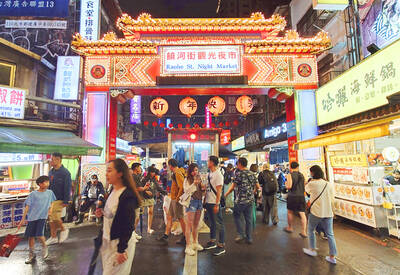
Sales in the retail, and food and beverage sectors last month continued to rise, increasing 0.7 percent and 13.6 percent respectively from a year earlier, setting record highs for the month of March, the Ministry of Economic Affairs said yesterday. Sales in the wholesale sector also grew last month by 4.6 annually, mainly due to the business opportunities for emerging applications related to artificial intelligence (AI) and high-performance computing technologies, the ministry said in a report. The ministry forecast that retail, and food and beverage sales this month would retain their growth momentum as the former would benefit from Tomb Sweeping Day
Thousands of parents in Singapore are furious after a Cordlife Group Ltd (康盛人生集團), a major operator of cord blood banks in Asia, irreparably damaged their children’s samples through improper handling, with some now pursuing legal action. The ongoing case, one of the worst to hit the largely untested industry, has renewed concerns over companies marketing themselves to anxious parents with mostly unproven assurances. This has implications across the region, given Cordlife’s operations in Hong Kong, Macau, Indonesia, the Philippines and India. The parents paid for years to have their infants’ cord blood stored, with the understanding that the stem cells they contained


 RSS
RSS