


The GDP -- the broad measure of output -- is the ultimate headline number for an economy. Everything from presidential election strategies to marketing plans for a new brand of shaving cream can hinge on the quarterly GDP figures.
Accordingly, economists on Wall Street, in corporate America and in academia spend much time plugging data into their meticulously designed models and producing precise forecasts. The Wall Street Journal, the Federal Reserve Bank of Philadelphia and the newsletter Blue Chip Indicators are just a few of the organizations that compile and publish their predictions. But their collective vision is so murky that it seems as if economists are looking into a tankard of pitch-black Guinness' Ale instead of a crystal ball.
At the end of last year, the 54 economists polled by The Wall Street Journal concluded that the GDP would grow at an annual rate of 4.5 percent in the first quarter this year. The number came in at 3.9 percent. The participants' calls ranged from the laughably low -- Edward Leamer of the University of California, Los Angeles, predicted 2.7 percent -- to the absurdly high. Brian Wesbury of Griffin, Kubik, Stephens & Thompson Inc and Lawrence Kudlow of Kudlow & Co -- supply-siders both -- predicted growth of 6.3 percent and 6.1 percent, respectively.
If Al Roker foretold the weather with such accuracy on the Today show, he might be relegated to a Sunday morning daybreak slot. (Kudlow is still co-host of a prime-time program on CNBC.)
And there is little consistency. John Lonski, chief economist at Moody's Inc. and the reigning champion of The Wall Street Journal's survey, has been substantially off base in some surveys.
"It's a bit disconcerting to note that for some reason you do not find individuals repeating with any frequency in the top spot among forecasts," he said.
Why can social scientists' forecasts go awry? "It's like driving ahead while looking in your mirror," said Gene Huang, chief economist at the Federal Express Corp.
The statistics that economists receive today often describe conditions from one or two months ago. What's more, many numbers -- including those for the GDP -- are routinely revised several times after they are issued.
But the data aren't the only problem. Economists, like most other humans, tend to forecast by extrapolating existing trends. That's fine when things tend to keep moving in the same direction. But when there is a shift, look out.
Two economists, James Stock of Harvard and Mark Watson of Princeton, found that professional forecasters surveyed by the Fed-eral Reserve Bank of Philadelphia had all the short-term vision of Mr. Magoo when the business cycle turned. In the fourth quarter of 2000, amid a long-running expansion, the three dozen economists in the survey projected that the economy would grow in the first quarter of 2001 at an annual rate of 3.3 percent; instead, it contracted at a 0.6 percent annual rate.
In the fourth quarter of 2001, they said the economy would grow at a 0.1 percent annual rate in the first quarter of 2002. Oops. The actual figure was 5 percent.
Acting on those forecasts would have left a business going full steam ahead when the bottom fell out, and idling while the economy was burning rubber.
Some economists say we shouldn't expect perfection.
"Over the long term what we as a profession can offer is consistently being pretty close most of the time," said Benjamin Herzon, senior economist at Macroeconomic Advisers, a consulting firm based in St. Louis.
But if that's the best they can do, why should we pay attention? Well, consensus forecasts tend to produce better results than individual ones. A study published last year by the Federal Reserve Bank of Atlanta concluded that the Blue Chip forecast, on average, "performs better than any individual forecaster."
And Huang, a member of the WSJ panel, argues that consensus forecasts "serve as a collective wisdom of market perception."
Of course, the market isn't always right. Last month, the evidence was abundant, from lower job-creation figures to limp sales at Wal-Mart, that the economy's growth was slowing. But forecasters -- perhaps influenced by several quarters of decent growth -- collectively believe that the pace of the economy is accelerating.
The WSJ's 55 Nostradami believe that GDP will grow at an annual rate of 4.4 percent for the second and third quarters, and at a 4.2 percent clip in the fourth. The Philadelphia Fed crowd forecasts a 4.5 percent pace for the second quarter, and 4 percent in the second half of the year.
If economists are still looking in the rear-view mirror, it may be time to gently apply the brakes.
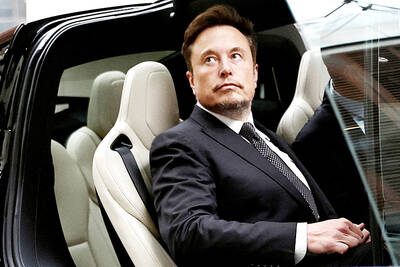
purpose: Tesla’s CEO sought to meet senior Chinese officials to discuss the rollout of its ‘full self-driving’ software in China and approval to transfer data they had collected Tesla Inc CEO Elon Musk arrived in Beijing yesterday on an unannounced visit, where he is expected to meet senior officials to discuss the rollout of "full self-driving" (FSD) software and permission to transfer data overseas, according to a person with knowledge of the matter. Chinese state media reported that he met Premier Li Qiang (李強) in Beijing, during which Li told Musk that Tesla's development in China could be regarded as a successful example of US-China economic and trade cooperation. Musk confirmed his meeting with the premier yesterday with a post on social media platform X. "Honored to meet with Premier Li
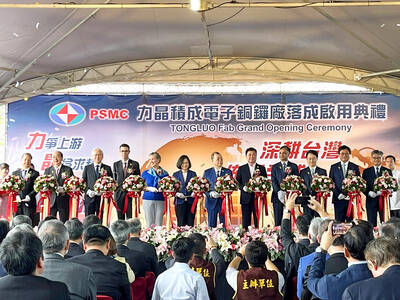
ARTIFICIAL INTELLIGENCE: The chipmaker last month raised its capital spending by 28 percent for this year to NT$32 billion from a previous estimate of NT$25 billion Contract chipmaker Powerchip Semiconductor Manufacturing Corp (力積電子) yesterday launched a new 12-inch fab, tapping into advanced chip-on-wafer-on-substrate (CoWoS) packaging technology to support rising demand for artificial intelligence (AI) devices. Powerchip is to offer interposers, one of three parts in CoWoS packaging technology, with shipments scheduled for the second half of this year, Powerchip chairman Frank Huang (黃崇仁) told reporters on the sidelines of a fab inauguration ceremony in the Tongluo Science Park (銅鑼科學園區) in Miaoli County yesterday. “We are working with customers to supply CoWoS-related business, utilizing part of this new fab’s capacity,” Huang said, adding that Powerchip intended to bridge
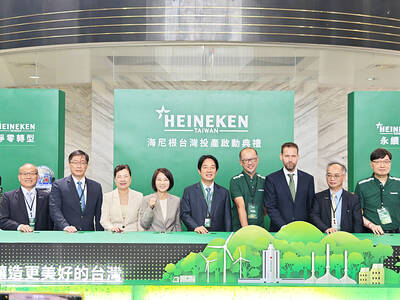
Dutch brewing company Heineken NV on Friday announced an investment of NT$13.5 billion (US$414.62 million) over the next five years in Taiwan. The first multinational brewing company to operate in Taiwan, Heineken made the statement at a ceremony held at its brewery in Pingtung County. It also outlined its efforts to make the brewery “net zero” by 2030. Heineken has been in the Taiwanese market for 20 years, Heineken Taiwan managing director Jeff Wu (吳建甫) said. With strong support from local consumers, the Dutch brewery decided to transition from sales to manufacturing in the country, Wu said. Heineken assumed majority ownership and management rights

Microsoft Corp yesterday said that it would create Thailand’s first data center region to boost cloud and artificial intelligence (AI) infrastructure, promising AI training to more than 100,000 people to develop tech. Bangkok is a key economic player in Southeast Asia, but it has lagged behind Indonesia and Singapore when it comes to the tech industry. Thailand has an “incredible opportunity to build a digital-first, AI-powered future,” Microsoft chairman and chief executive officer Satya Nadella said at an event in Bangkok. Data center regions are physical locations that store computing infrastructure, allowing secure and reliable access to cloud platforms. The global embrace of AI


 RSS
RSS