


The lack of quality, not quantity, of the nation's biotech professionals has become the bottleneck keeping the fledgling sector from moving forward, government officials said yesterday.
"The quantity [of domestic talent] is not a problem to the nation's developing biotech industry, but the quality is," Minister without Portfolio Lin Ferng-ching (林逢慶) said at a forum on the nation's biotech policy yesterday.
The forum was one of the programs held to coincide with the the four-day BioTaiwan 2004 Exhibition organized by the Taiwan Bio Industry Organization (
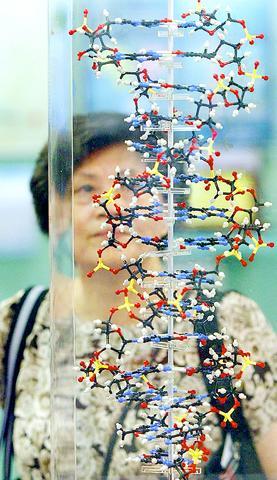
PHOTO: CNA
The show, a significant event to the nation's biotech sector, kicked off yesterday at the first exhibition hall of the Taipei World Trade Center. It runs through Saturday.
National Science Council Deputy Chairman Liao Chun-chen (
How to nurture local talent and attract overseas specialists are the issues the government and the industry have to address, Liao said.
Taiwan produces around 2,000 university graduates, more than 1,000 postgraduates and about 150 doctorates in the biotechnology field a year, according to figures by Ministry of Education.
In a bid to elevate the quality of these graduates, the ministry subsidizes universities that invite foreign professors and offer more courses on biotechnology-related management or legal affairs, said Liu Wen-huei (
The ministry would also urge universities and graduate schools to monitor trends in the industry in order to provide students with the skills needed by the industry, she said.
Critics say education is fundamental, but may be a slow remedy for the problem at the moment.
Tight regulations on the import of foreign professionals have made it difficult for local biotech companies, Li Wen-sen (
Li complained at the time about Ministry of Finance's efforts to tax experts who receive stock in lieu of payment -- a form particularly popular in the biotech sector -- saying that this has also made it difficult to lure overseas specialists.
Bowing to the pressure, the finance ministry decided in late May to conditionally delay such taxation for five years. The decision, however, only applies to the firms that are in the emerging and strategic industries approved by the Ministry of Economic Affairs and whose shares paid to experts exceeds 20 percent of their total, the finance ministry said.

Among the rows of vibrators, rubber torsos and leather harnesses at a Chinese sex toys exhibition in Shanghai this weekend, the beginnings of an artificial intelligence (AI)-driven shift in the industry quietly pulsed. China manufactures about 70 percent of the world’s sex toys, most of it the “hardware” on display at the fair — whether that be technicolor tentacled dildos or hyper-realistic personalized silicone dolls. Yet smart toys have been rising in popularity for some time. Many major European and US brands already offer tech-enhanced products that can enable long-distance love, monitor well-being and even bring people one step closer to

Malaysia’s leader yesterday announced plans to build a massive semiconductor design park, aiming to boost the Southeast Asian nation’s role in the global chip industry. A prominent player in the semiconductor industry for decades, Malaysia accounts for an estimated 13 percent of global back-end manufacturing, according to German tech giant Bosch. Now it wants to go beyond production and emerge as a chip design powerhouse too, Malaysian Prime Minister Anwar Ibrahim said. “I am pleased to announce the largest IC (integrated circuit) Design Park in Southeast Asia, that will house world-class anchor tenants and collaborate with global companies such as Arm [Holdings PLC],”

TRANSFORMATION: Taiwan is now home to the largest Google hardware research and development center outside of the US, thanks to the nation’s economic policies President Tsai Ing-wen (蔡英文) yesterday attended an event marking the opening of Google’s second hardware research and development (R&D) office in Taiwan, which was held at New Taipei City’s Banciao District (板橋). This signals Taiwan’s transformation into the world’s largest Google hardware research and development center outside of the US, validating the nation’s economic policy in the past eight years, she said. The “five plus two” innovative industries policy, “six core strategic industries” initiative and infrastructure projects have grown the national industry and established resilient supply chains that withstood the COVID-19 pandemic, Tsai said. Taiwan has improved investment conditions of the domestic economy

MAJOR BENEFICIARY: The company benefits from TSMC’s advanced packaging scarcity, given robust demand for Nvidia AI chips, analysts said ASE Technology Holding Co (ASE, 日月光投控), the world’s biggest chip packaging and testing service provider, yesterday said it is raising its equipment capital expenditure budget by 10 percent this year to expand leading-edge and advanced packing and testing capacity amid strong artificial intelligence (AI) and high-performance computing chip demand. This is on top of the 40 to 50 percent annual increase in its capital spending budget to more than the US$1.7 billion to announced in February. About half of the equipment capital expenditure would be spent on leading-edge and advanced packaging and testing technology, the company said. ASE is considered by analysts


 RSS
RSS