


At 7am in Taipei City's Nankang District, Chang Shang-hsian (
After sorting out their delivery sheets and placing them in the order of their route, these "sales-drivers" join the early morning heavy traffic heading toward downtown Taipei, where some companies and households are awaiting the packages to be delivered to their doorstep.
"We are always racing with time," Chang, 25, said. He is a two-year veteran at President Transnet Corp (統一速達), which manages the Japanese home-delivery service Takkyubin (宅急便) in Taiwan.

PHOTO: JACKIE LIN, TAIPEI TIMES
On an average day, Chang has to deliver 70 to 80 packages per morning, and the number always soars above 100 during holidays such as Valentine's Day, Mother's Day, the Lunar New Year, the Dragon Boat Festival and the Mid-Autumn Festival.
"We are called `SD,' or `sales-drivers,' because we are also responsible for developing business," Chang said as he jumped onto the driver's seat.
With 808 Takkyubin vans running around the nation each day, the market for delivery services, or chai pei (
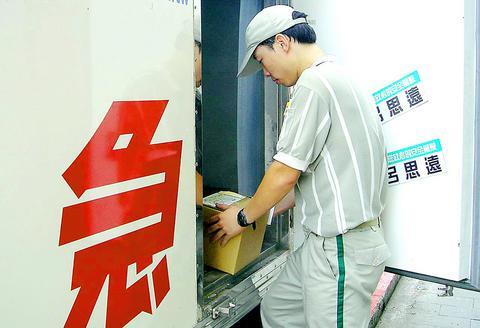
PHOTO: JACKIE LIN, TAIPEI TIMES
In addition to normal package and letter deliveries, President Transnet -- a subsidiary of President Chain Store Corp (
"In the past few weeks we have transported many boxes of lychees from central and southern Taiwan to the north," Chang said, as he unloaded two cartons of the seasonal fruit from the refrigerator installed in the van.
President Transnet focuses mostly on C2C (customer-to-customer) transactions, which account for over 50 percent of its business, while Taiwan Pelican's business is comprised of 80 percent B2C (business to customer) transactions and 20 percent C2C transactions.
Taiwan Pelican's marketing manager, Ann Chien (
President Transnet has more than 15,000 locations where customers can consign packages to the more than 3,500 7-Eleven outlets that have helped it secure advantages in the growing market.
The trademark of the Takkyubin service -- flags featuring two black cats -- can also be seen in the nation's Niko Mart (
Taiwan Pelican -- with a white pelican logo -- has also expanded its network of pick-up sites to 14,000 locations nationwide, with a fleet of 600 vans and motorbikes.
A joint venture between Taiwan's Teco Electric and Machinery Co (東元電機) and Japan's Nippon Express, Taiwan Pelican started offering delivery services in July 2000, three months before the "black cats" were running on Taiwan's streets.
Chien said that as the sector has developed in the nation for four years, it is believed that there is more potential to be tapped.
In Japan, around 20 packages are delivered per person through home-delivery services each year, she said. But in Taiwan, the figure is less than one.
"We're not trying to be greedy. But just think about making that figure grow three to five times. That indicates there are a plenty of business opportunities to be developed," she said.
Even though both companies have painted a rosy picture of the sector's outlook, they have yet to taste success, as their financial statements are still in the red.
At President Chain's investor conference in April, the company reported shrinking losses in President Transnet's revenues for last year.
"We are optimistic that the company will turn a profit this year," Wu Wen-chi (
Taiwan Pelican expects to break even this year. Chien said the company hopes to achieve NT$1.6 billion in revenues by December, up from last year's NT$1.2 billion.
Even as these two companies have made chai pei a familiar term among local shoppers, they have forced the nation's postal service to adapt.
"Since this new kind of demand has emerged, we have to offer diversified services to fight for market share," said Beggy Yeh (葉淑美), a section chief at state-run Chunghwa Post Co (中華郵政), which operates 1,316 post offices around the country.
Yeh noted that, after home-delivery companies were established, the number of packages handled by post offices has dropped.
"The lack of chai pei services for fresh foodstuffs has dragged down our business," she added.
According to the Ministry of Transportation and Communications' statistics, post offices delivered 17.2 million packages in 2000. The figure dropped to 10.6 million in 2001 and continued to plunge to a record-low 8 million in 2002.
To remedy this situation, Chunghwa Post also jumped on the chai pei bandwagon, and launched home-delivery services for frozen and perishable goods earlier this year.
At the initial stage, the service was limited to major cities such as Taipei, Taichung, Kaohsiung, Hsinchu and Tainan.
Since July 1, the network has been expanded nationwide, but as of now only 13 main post offices can receive consignments of perishable goods.
Alisa Lin (
In addition, over 10,000 regular postal vans and motorcycles will also be equipped with mobile refrigeration devices to facilitate delivery of perishable goods.
"The public response has been very positive. We're confident we can challenge private companies with our high-quality service," Yeh said.
It remains to be seen whether or not these delivery service providers can turn a profit soon.
But one thing is for sure: the increased competition leaves customers as the biggest winners.
All three companies offer pick-up and delivery services 365 days a year.
"I like to serve people. And this is clear proof: healthy competition boosts quality of service," Chang said.
And what was the worst obstacle Chang encountered in his daily rounds?
"I hate it when my van gets towed away. It's a waste of time," he said.

Among the rows of vibrators, rubber torsos and leather harnesses at a Chinese sex toys exhibition in Shanghai this weekend, the beginnings of an artificial intelligence (AI)-driven shift in the industry quietly pulsed. China manufactures about 70 percent of the world’s sex toys, most of it the “hardware” on display at the fair — whether that be technicolor tentacled dildos or hyper-realistic personalized silicone dolls. Yet smart toys have been rising in popularity for some time. Many major European and US brands already offer tech-enhanced products that can enable long-distance love, monitor well-being and even bring people one step closer to

Malaysia’s leader yesterday announced plans to build a massive semiconductor design park, aiming to boost the Southeast Asian nation’s role in the global chip industry. A prominent player in the semiconductor industry for decades, Malaysia accounts for an estimated 13 percent of global back-end manufacturing, according to German tech giant Bosch. Now it wants to go beyond production and emerge as a chip design powerhouse too, Malaysian Prime Minister Anwar Ibrahim said. “I am pleased to announce the largest IC (integrated circuit) Design Park in Southeast Asia, that will house world-class anchor tenants and collaborate with global companies such as Arm [Holdings PLC],”

TRANSFORMATION: Taiwan is now home to the largest Google hardware research and development center outside of the US, thanks to the nation’s economic policies President Tsai Ing-wen (蔡英文) yesterday attended an event marking the opening of Google’s second hardware research and development (R&D) office in Taiwan, which was held at New Taipei City’s Banciao District (板橋). This signals Taiwan’s transformation into the world’s largest Google hardware research and development center outside of the US, validating the nation’s economic policy in the past eight years, she said. The “five plus two” innovative industries policy, “six core strategic industries” initiative and infrastructure projects have grown the national industry and established resilient supply chains that withstood the COVID-19 pandemic, Tsai said. Taiwan has improved investment conditions of the domestic economy

MAJOR BENEFICIARY: The company benefits from TSMC’s advanced packaging scarcity, given robust demand for Nvidia AI chips, analysts said ASE Technology Holding Co (ASE, 日月光投控), the world’s biggest chip packaging and testing service provider, yesterday said it is raising its equipment capital expenditure budget by 10 percent this year to expand leading-edge and advanced packing and testing capacity amid strong artificial intelligence (AI) and high-performance computing chip demand. This is on top of the 40 to 50 percent annual increase in its capital spending budget to more than the US$1.7 billion to announced in February. About half of the equipment capital expenditure would be spent on leading-edge and advanced packaging and testing technology, the company said. ASE is considered by analysts


 RSS
RSS