


The local capital market has a chance of becoming a gateway to Chinese markets if the Democratic Progressive Party government allows Taiwanese businesses based in China to list on the local bourse, commentators said yesterday at a seminar.
"The formula for business success today [in the greater China region] can be summarized as Chinese markets, Taiwanese business management expertise plus international capital," said Wang Kuei-ching (王貴清), chief financial officer of the Ho Tung Group (和桐集團), the nation's first investment holding company, at a seminar organized by the Epoch Foundation (時代基金會) yesterday that discussed the capital-raising capabilities of multinational firms.
Wang, a former chief financial officer of Ting Hsin International Group (頂新集團), yesterday urged the government to divest itself of its "rigid mentality of fearing China" and allow the local capital market to prosper "as a turnpike for China-bound multinational investors."
Edward Tsai (蔡松棋), a certified public accountant at KPMG (安侯建業), agreed, saying that compared to neighboring capital markets, the local stock market enjoys the advantages of a lower price-earnings ratio, lower listing costs and high liquidity, which makes it a market with great potential for China-based Taiwanese businesses to trade on.
But Du Ying-tzyong (
Du said that few of his clients have expressed interest in listing on the local stock market, since most of their money is bound for China and the stock market in Hong Kong is usually their bourse of choice.
Compared to other neighboring capital markets, Taiwan has set up a tighter capital-flow hurdle that scares away multinationals, Du said, adding that if this hurdle was removed, Taiwan could then facilitate its goal of becoming the region's capital-raising hub.
According to Du, other obstacles include the fact that multinationals are restricted from moving more than 20 percent of capital raised in Taiwan to China while also enduring a lock-up period as long as five years and a 10-day underwriting period when trying to buy local shares.
Other panelists, including Peter Kurz, dubbed "Mr. Taiwan" by the local media, and Huang Chi-yuan (
The challenge facing the majority of local businesses now, however, is further consolidation or expansion by mergers and acquisitions, Huang said.
Huang yesterday encouraged local businesses to branch out by taking over overseas business units before mulling plans to become listed companies.
After witnessing the completion of a number of government-motivated mergers among financial institutions, Kurz said that he was expecting to see more mergers and acquisitions driven by the private sector to create business synergy.

Among the rows of vibrators, rubber torsos and leather harnesses at a Chinese sex toys exhibition in Shanghai this weekend, the beginnings of an artificial intelligence (AI)-driven shift in the industry quietly pulsed. China manufactures about 70 percent of the world’s sex toys, most of it the “hardware” on display at the fair — whether that be technicolor tentacled dildos or hyper-realistic personalized silicone dolls. Yet smart toys have been rising in popularity for some time. Many major European and US brands already offer tech-enhanced products that can enable long-distance love, monitor well-being and even bring people one step closer to

Malaysia’s leader yesterday announced plans to build a massive semiconductor design park, aiming to boost the Southeast Asian nation’s role in the global chip industry. A prominent player in the semiconductor industry for decades, Malaysia accounts for an estimated 13 percent of global back-end manufacturing, according to German tech giant Bosch. Now it wants to go beyond production and emerge as a chip design powerhouse too, Malaysian Prime Minister Anwar Ibrahim said. “I am pleased to announce the largest IC (integrated circuit) Design Park in Southeast Asia, that will house world-class anchor tenants and collaborate with global companies such as Arm [Holdings PLC],”

TRANSFORMATION: Taiwan is now home to the largest Google hardware research and development center outside of the US, thanks to the nation’s economic policies President Tsai Ing-wen (蔡英文) yesterday attended an event marking the opening of Google’s second hardware research and development (R&D) office in Taiwan, which was held at New Taipei City’s Banciao District (板橋). This signals Taiwan’s transformation into the world’s largest Google hardware research and development center outside of the US, validating the nation’s economic policy in the past eight years, she said. The “five plus two” innovative industries policy, “six core strategic industries” initiative and infrastructure projects have grown the national industry and established resilient supply chains that withstood the COVID-19 pandemic, Tsai said. Taiwan has improved investment conditions of the domestic economy
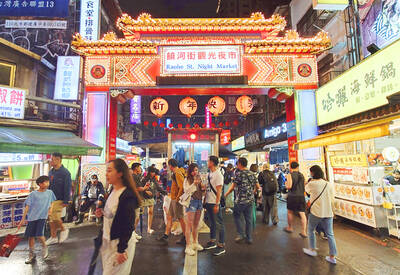
Sales in the retail, and food and beverage sectors last month continued to rise, increasing 0.7 percent and 13.6 percent respectively from a year earlier, setting record highs for the month of March, the Ministry of Economic Affairs said yesterday. Sales in the wholesale sector also grew last month by 4.6 annually, mainly due to the business opportunities for emerging applications related to artificial intelligence (AI) and high-performance computing technologies, the ministry said in a report. The ministry forecast that retail, and food and beverage sales this month would retain their growth momentum as the former would benefit from Tomb Sweeping Day


 RSS
RSS