


Premier Yu Shyi-kun yesterday led his economic and finance ministers to a meeting with leaders of six business groups, agreeing to facilitate seven of the business community's proposals.
"I am here to re-emphasize the President Chen Shui-bian (
He also said that that he would be attending the bi-monthly meetings himself in the future, instead of sending his vice premier. Former vice premier Lin Hsin-i (
According to Yu, the Cabinet will soon establish a timetable to accelerate the inking of a free-trade agreement with the US.
Washington's concerns over Taiwan's improvement in dealing with intellectual property rights (IPR) and IPR violations has been cited as one factor delaying such an accord.
The US's other concerns also include Taiwan's progress in opening up its rice, medicine and telecommunication markets.
Yu said that he would assign Council for Economic Planning and Development Chairman Hu Sheng-cheng (胡勝正) to work out the details for the accord's facilitation.
Yu also reiterated the government's promises to capitalize the credit guarantee fund for small and medium enterprises (SMEs) with an annual budget of NT$10 billion while strengthening the micro-loan services for SMEs.
In addition, he agreed to work to build the nation into a capital-raising center in the Asia-Pacific region while accelerating the local financial market's internationalization and liberalization.
Upon a suggestion from Gary Wang (
Securitization of real estate refers to the process of converting properties into marketable equities for sale to investors.
Such investors can then become shareholders in multi-million-dollar skyscrapers with a small amount of money and benefit from such profit-making building's revenues and dividends.
When the bill was passed last July, private property developers were excluded from the securitization plan and they have complained.
Meanwhile, upon a suggestion made by Chinese National Federation of Industries (
The federation said that the nation should try to take advantage of the waters 200m below the surface, with the government helping the private sector in developing commercially-utilized products using deep-sea water.
Wrapping up the meeting, Yu vowed to step up the government's efforts to help the tourism indus-try's finances and improve the local investment environment to attract bio-technology investors and talent.
Among those attending the meeting from the government were Minister of Finance Lin Chuan (林全) and central bank Governor Perng Fai-nan (彭淮南).
The business leaders included Theodore Huang (黃茂雄), chairman of the Chinese National Association of Industry and Commerce (工商協進會), Rock Hsu (許勝雄), chairman of the Taiwan Electrical and Electronic Manufacturers Association (電電公會), and Day Sheng-tung (戴勝通), chairman of the National Association of Small & Medium Enterprises (中小企業協會).

Among the rows of vibrators, rubber torsos and leather harnesses at a Chinese sex toys exhibition in Shanghai this weekend, the beginnings of an artificial intelligence (AI)-driven shift in the industry quietly pulsed. China manufactures about 70 percent of the world’s sex toys, most of it the “hardware” on display at the fair — whether that be technicolor tentacled dildos or hyper-realistic personalized silicone dolls. Yet smart toys have been rising in popularity for some time. Many major European and US brands already offer tech-enhanced products that can enable long-distance love, monitor well-being and even bring people one step closer to

Malaysia’s leader yesterday announced plans to build a massive semiconductor design park, aiming to boost the Southeast Asian nation’s role in the global chip industry. A prominent player in the semiconductor industry for decades, Malaysia accounts for an estimated 13 percent of global back-end manufacturing, according to German tech giant Bosch. Now it wants to go beyond production and emerge as a chip design powerhouse too, Malaysian Prime Minister Anwar Ibrahim said. “I am pleased to announce the largest IC (integrated circuit) Design Park in Southeast Asia, that will house world-class anchor tenants and collaborate with global companies such as Arm [Holdings PLC],”

TRANSFORMATION: Taiwan is now home to the largest Google hardware research and development center outside of the US, thanks to the nation’s economic policies President Tsai Ing-wen (蔡英文) yesterday attended an event marking the opening of Google’s second hardware research and development (R&D) office in Taiwan, which was held at New Taipei City’s Banciao District (板橋). This signals Taiwan’s transformation into the world’s largest Google hardware research and development center outside of the US, validating the nation’s economic policy in the past eight years, she said. The “five plus two” innovative industries policy, “six core strategic industries” initiative and infrastructure projects have grown the national industry and established resilient supply chains that withstood the COVID-19 pandemic, Tsai said. Taiwan has improved investment conditions of the domestic economy
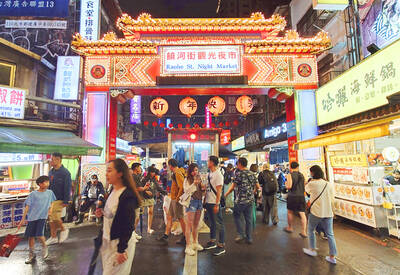
Sales in the retail, and food and beverage sectors last month continued to rise, increasing 0.7 percent and 13.6 percent respectively from a year earlier, setting record highs for the month of March, the Ministry of Economic Affairs said yesterday. Sales in the wholesale sector also grew last month by 4.6 annually, mainly due to the business opportunities for emerging applications related to artificial intelligence (AI) and high-performance computing technologies, the ministry said in a report. The ministry forecast that retail, and food and beverage sales this month would retain their growth momentum as the former would benefit from Tomb Sweeping Day


 RSS
RSS