


Computer vendors will be offering large discounts on their notebook computers in a trade show that opened yesterday to lower stocks that have built up in the first quarter this year, industry officials said yesterday.
"We saw slack sales of notebooks this quarter because of the election and the political disputes afterward that caused sales to drop by up to 70 percent," said Danny Yao (
The company offered discounts of up to NT$7,000 and free batteries to buyers of its notebook series -- including the Joybook 5000 and Joybook 6000 launched in January, which the maker boasted were the world's first 12-inch wide-screen laptops -- in the Softex software and computer exhibition.
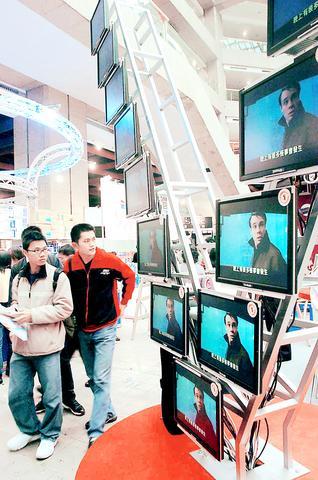
PHOTO: CHIANG YING-YING, TAIPEI TIMES
"We hope the price cuts and promotions can boost sales by about 60 percent from the roughly 600 units we sold in the multimedia show that ended last month," Yao said.
This year's Softex show has attracted 200 exhibitors occupying 1,000 booths in the Taipei World Trade Center Exhibition Hall.
The Taipei Computer Association (台北市電腦公會), the exhibition's organizer, expected to lure 20 percent to 30 percent more visitors than the average 300,000 in previous shows, association specialist Shannon Yeh (葉小菱) said last week.
Participating exhibitors, however, were conservative about the exhibition's appeal to consumers, as too many similar shows have taken place in the previous few months, reducing people's appetite for computer products.
"There are none of the incentives to spur people's consumption during this period -- such as year-end bonuses or red envelopes -- as there were in the multimedia show last month or the IT Month before the Lunar New year," said Kate Hsu (許玉佩), a public relations manager at Hewllet-Packard Taiwan Ltd.
The company has launched six new types of notebook since mid-March to meet soaring demand in Taiwan and to keep up with its headquarters' global roadmap, she said.
Portable computers are estimated to account for 37 percent of the 1.5 million personal computers that will be sold in Taiwan this year. The ratio will probably climb to 42 percent in 2008, according to figures by International Data Corporation (IDC) Taiwan.
In a bid to attract consumers, HP is offering a NT$2,000 discount off its Presario 2100 laptop, Hsu said. Buyers can get between NT$2,000 and NT$5,000 off HP's other laptops.
Another exhibitor, Genuine C&C Inc (
The result as been less enthusiasm for computer exhibitions, the company's marketing manager, Sophia Hsu, said.
Genuine is hoping to attract customers with its "solution on demand" service for digital entertainment and computing systems, as well as the chance to win NT$200,000 worth of home theater equipment.
To attract the growing purchasing power of female consumers, the organizer for the first time has created a zone catering to women's tastes for electronics that are smaller, have modern designs and use vivid colors.
Women who wear red on Saturday and yellow on Sunday can visit free of charge.
The show opened yesterday and runs to Sunday at the Taipei World Trade Center Exhibition Hall from 10am to 6pm. Admission is NT$150.

The domestic unit of the Chinese-owned, Dutch-headquartered chipmaker Nexperia BV will soon be able to produce semiconductors locally within China, according to two company sources. Nexperia is at the center of a global tug-of-war over critical semiconductor technology, with a Dutch court in February ordering a probe into alleged mismanagement at the company. The geopolitical tussle has disrupted supply chains, with some carmakers reportedly forced to cut production due to chip shortages. Local production would allow Nexperia’s domestic arm, Nexperia Semiconductors (China) Ltd (安世半導體中國), to bypass restrictions in place since October on the supply of silicon wafers — etched with tiny components to

Singapore-based ride-hailing and delivery giant Grab Holdings Ltd has applied for regulatory approval to acquire the Taiwan operations of Germany-based Delivery Hero SE's Foodpanda in a deal valued at about US$600 million. Grab submitted the filing to the Fair Trade Commission on Friday last week, with the transaction subject to regulatory review and approval, the company said in a statement yesterday. Its independent governance structure would help foster a healthy and competitive market in Taiwan if the deal is approved, Grab said. Grab, which is listed on the NASDAQ, said in the filing that US-based Uber Technologies Inc holds about 13 percent of

Taiwan Semiconductor Manufacturing Co (TSMC, 台積電) yesterday received government approval to deploy its advanced 3-nanometer (3nm) process at its second fab currently under construction in Japan, the Ministry of Economic Affairs said in a news release. The ministry green-lit the plan for the facility in Kumamoto, which is scheduled to start installing equipment and come online in 2028 with a monthly production capacity of 15,000 12-inch wafers, the ministry said. The Department of Investment Review in June 2024 authorized a US$5.26 billion investment for the facility, slated to manufacture 6- to 12nm chips, significantly less advanced than 3nm process. At a meeting with

Taiwan’s food delivery market could undergo a major shift if Singapore-based Grab Holdings Ltd completes its planned acquisition of Delivery Hero SE’s Foodpanda business in Taiwan, industry experts said. Grab on Monday last week announced it would acquire Foodpanda’s Taiwan operations for US$600 million. The deal is expected to be finalized in the second half of this year, with Grab aiming to complete user migration to its platform by the first half of next year. A duopoly between Uber Eats and Foodpanda dominates Taiwan’s delivery market, a structure that has remained intact since the Fair Trade Commission (FTC) blocked Uber Technologies Inc’s


 RSS
RSS