


At first glance, this modest town of aging textile mills set by a river in a bowl of hills seems an unlikely link in a chain of commerce that stretches from the pastures of Inner Mongolia to the designer boutiques of New York, Paris and London.
Yet, for many decades, Hawick and other places in the Scottish Borders region have traced the fortunes of one of the great alchemies of the luxury goods market: the transformation of the soft underfleece of a breed of Asian goat into cashmere scarves and sweaters, twin sets and V-necks bearing labels like Ralph Lauren or Chanel.
Now, in a situation similar to the migration of jobs from the US to Asia, the Scottish cashmere business that sustained companies like Johnstons, Dawson International and Pringle faces its own challenge from the distant continent that was once no more than its source of raw materials.
"There's no doubt that the industry is going through the same pain as America, in a way," said James Sugden, managing director of Johnstons in Elgin, Scotland, and head of the Scottish Textile Manufacturers Association. "China is now a huge factor, and there have been a number of job losses."
For several years, Chinese manufacturers with easy access to both a low-wage work force and the world's leading source of cashmere fiber have been building the technology and the skills needed to displace traditional European manufacturers, mainly in Scotland and Italy, from whole swaths of the cashmere market.
Moreover, at the end of this year, changes in World Trade Organization rules will mean that the last of the quotas limiting the global textile industry will be removed, and Chinese cashmere manufacturers will gain unfettered access to major Western markets.
From 19 percent of the overall world textile trade today, according to the organization's figures, China's share may then start growing rapidly, to reach 50 percent or even 75 percent by some forecasts.
The Chinese advance in the cashmere industry represents a reversal of history. Cashmere first became known to the West when Scottish travelers and British colonialists of the 19th century encountered it in the elegant shawls worn by the Indian elite; the material took its name from mountainous Kashmir in India's far north, the main home of the long-horned goats before the nomadic herders who kept them moved to Inner Mongolia.
Now, by contrast, said Karl Spilhaus, president of the Cashmere and Camel Hair Manufacturers Institute, an industry group in Boston that keeps track of the quality of cashmere goods in retail stores, Chinese producers "are having their day as far as manufacturing goes, and they have the raw materials, so they control the whole shooting match."
So far the Chinese mills have made inroads mainly at the less-expensive end of the market. Manufacturers here are responding by concentrating increasingly on high-end niche lines, which can still command premium prices on the strength of exclusivity and the cachet of Scottish production.
"China is getting better and better, and we have to market our product better and better to justify the premium," Sugden said. That makes the market niche narrow indeed: "We are aiming for the tip of the tip of the pyramid," he said.
He even forecast that as Chinese entrepreneurs themselves become wealthy consumers, China will become a good market for up-market designer brands from Europe that stand as an emblem of prosperity.
But some experts say it is only a matter of time before Chinese manufacturers develop the design and marketing skills needed to satisfy the top of the cashmere market as well.
"The handwriting is on the wall," Spilhaus said in a telephone interview from Boston.

purpose: Tesla’s CEO sought to meet senior Chinese officials to discuss the rollout of its ‘full self-driving’ software in China and approval to transfer data they had collected Tesla Inc CEO Elon Musk arrived in Beijing yesterday on an unannounced visit, where he is expected to meet senior officials to discuss the rollout of "full self-driving" (FSD) software and permission to transfer data overseas, according to a person with knowledge of the matter. Chinese state media reported that he met Premier Li Qiang (李強) in Beijing, during which Li told Musk that Tesla's development in China could be regarded as a successful example of US-China economic and trade cooperation. Musk confirmed his meeting with the premier yesterday with a post on social media platform X. "Honored to meet with Premier Li
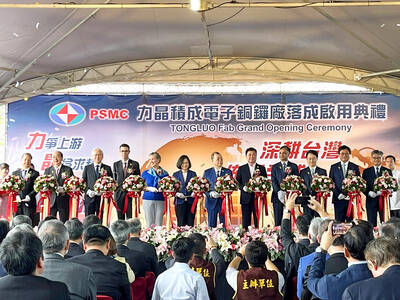
ARTIFICIAL INTELLIGENCE: The chipmaker last month raised its capital spending by 28 percent for this year to NT$32 billion from a previous estimate of NT$25 billion Contract chipmaker Powerchip Semiconductor Manufacturing Corp (力積電子) yesterday launched a new 12-inch fab, tapping into advanced chip-on-wafer-on-substrate (CoWoS) packaging technology to support rising demand for artificial intelligence (AI) devices. Powerchip is to offer interposers, one of three parts in CoWoS packaging technology, with shipments scheduled for the second half of this year, Powerchip chairman Frank Huang (黃崇仁) told reporters on the sidelines of a fab inauguration ceremony in the Tongluo Science Park (銅鑼科學園區) in Miaoli County yesterday. “We are working with customers to supply CoWoS-related business, utilizing part of this new fab’s capacity,” Huang said, adding that Powerchip intended to bridge

Dutch brewing company Heineken NV on Friday announced an investment of NT$13.5 billion (US$414.62 million) over the next five years in Taiwan. The first multinational brewing company to operate in Taiwan, Heineken made the statement at a ceremony held at its brewery in Pingtung County. It also outlined its efforts to make the brewery “net zero” by 2030. Heineken has been in the Taiwanese market for 20 years, Heineken Taiwan managing director Jeff Wu (吳建甫) said. With strong support from local consumers, the Dutch brewery decided to transition from sales to manufacturing in the country, Wu said. Heineken assumed majority ownership and management rights

Microsoft Corp yesterday said that it would create Thailand’s first data center region to boost cloud and artificial intelligence (AI) infrastructure, promising AI training to more than 100,000 people to develop tech. Bangkok is a key economic player in Southeast Asia, but it has lagged behind Indonesia and Singapore when it comes to the tech industry. Thailand has an “incredible opportunity to build a digital-first, AI-powered future,” Microsoft chairman and chief executive officer Satya Nadella said at an event in Bangkok. Data center regions are physical locations that store computing infrastructure, allowing secure and reliable access to cloud platforms. The global embrace of AI


 RSS
RSS