


Supermarkets' own brands, long frowned upon by customers, are set for a boost this year.
Wellcome Supermarket (
Wellcome hopes sales of the 500 products sold under these two brands will rise from 3 percent of sales last year to 5 percent this year and 10 percent the year after, according to Shane Neal, head of its own-brand business division.
Neal said own-brand products make up 22 percent of total supermarket sales in Europe and 16 percent in North America, but just 4 percent in the Asia-Pacific region. He expects this sector to grow about 14 percent growth in Asia-Pacific this year.
Carrefour Taiwan, the nation's largest hypermarket chain with 31 outlets, introduced its second own-brand, "No. 1," earlier this month. It already has its Carrefour-branded items on the shelves.
While retailers have high expectations for own-brand sales, they will have to overcome the lack of confidence consumers have in the quality of such brands.
"Though retailers offer their own brands at lower prices than the renowned brands, I still question the quality as I had a few unpleasant experiences before," said Eleanor Chen (
"I once bought retailers' cooked meat stew which tasted stale and their own-branded mutton hotpot that tasted awful," she said. "I now only buy private-label necessities such as tissues, but not fresh or cooked foods."
Another consumer said she only bought retailer-branded sundries, such as cleansers or goods that did not require high quality, such as cheap clothes for work.
"When it comes to food or things concerning health, I would have higher confidence in the own-brands of reputed foreign retailers like Costco or Tesco," said Pan Su-lan (潘素蘭), a 56 year-old hospital worker who shops in hypermarkets twice a month and spends about NT$5,000 each time.
Tesco Taiwan has 300 kinds of imported private-label goods and 150 kinds of locally made own-brand items. The UK-based retailer said consumers were worried about the own-brand products, according to customer surveys.
"Our local manufacturers all have ISO certification and comply with national hygiene standards, like CAS, and customers' confidence in our own-brand products has risen, as shown by our survey sampling more than 2,600 customers last year," said Sarah Wu (
To assuage consumers' concerns, Carrefour said it would not sacrifice quality just to reduce prices.
"We can save on the huge advertising costs of brand names and, as a result, are able to offer own-brand products at lower prices," said Allan Tien (田中玉), Carrefour's spokesman.
But Tien acknowledged that it may take time to develop consumers' confidence in the quality of own brands.
"We inspect manufacturers of our own-brand goods at least four times to ensure our customers get high quality," he said.

BUSINESS UPDATE: The iPhone assembler said operations outlook is expected to show quarter-on-quarter and year-on-year growth for the second quarter Hon Hai Precision Industry Co (鴻海精密) yesterday reported strong growth in sales last month, potentially raising expectations for iPhone sales while artificial intelligence (AI)-related business booms. The company, which assembles the majority of Apple Inc’s smartphones, reported a 19.03 percent rise in monthly sales to NT$510.9 billion (US$15.78 billion), from NT$429.22 billion in the same period last year. On a monthly basis, sales rose 14.16 percent, it said. The company in a statement said that last month’s revenue was a record-breaking April performance. Hon Hai, known also as Foxconn Technology Group (富士康科技集團), assembles most iPhones, but the company is diversifying its business to
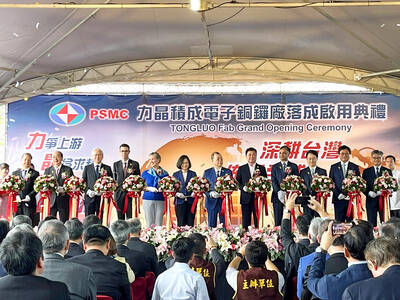
ARTIFICIAL INTELLIGENCE: The chipmaker last month raised its capital spending by 28 percent for this year to NT$32 billion from a previous estimate of NT$25 billion Contract chipmaker Powerchip Semiconductor Manufacturing Corp (力積電子) yesterday launched a new 12-inch fab, tapping into advanced chip-on-wafer-on-substrate (CoWoS) packaging technology to support rising demand for artificial intelligence (AI) devices. Powerchip is to offer interposers, one of three parts in CoWoS packaging technology, with shipments scheduled for the second half of this year, Powerchip chairman Frank Huang (黃崇仁) told reporters on the sidelines of a fab inauguration ceremony in the Tongluo Science Park (銅鑼科學園區) in Miaoli County yesterday. “We are working with customers to supply CoWoS-related business, utilizing part of this new fab’s capacity,” Huang said, adding that Powerchip intended to bridge

Qualcomm Inc, the world’s biggest seller of smartphone processors, gave an upbeat forecast for sales and profit in the current period, suggesting demand for handsets is increasing after a two-year slump. Revenue in the three months ended in June will be US$8.8 billion to US$9.6 billion, the company said in a statement Wednesday. Excluding certain items, earnings will be US$2.15 to US$2.35 a share. Analysts had projected sales of US$9.08 billion and earnings of US$2.16 a share. The outlook signals that the smartphone market has begun to bounce back, tracking with Qualcomm’s forecast that demand would gradually recover this year. The San

Clambering hand-over-hand, sweat dripping into his eyes, a durian laborer expertly slices a cumbersome fruit from a tree before tossing it down to land with a soft thump in his colleague’s waiting arms about 15m below. Among Thailand’s most famous and lucrative exports, the pungent “king of fruits” is as distinctive in its smell as its spiky green-brown carapace, and has been farmed in the kingdom for hundreds of years. However, a vicious heat wave engulfing Southeast Asia has resulted in smaller yields and spiraling costs, with growers and sellers increasingly panicked as global warming damages the industry. “This year is a crisis,”


 RSS
RSS