


What will 2004 hold for the nation's computer and consumer electronics retailers? Far from being the Year of the Monkey, industry insiders predict it will be the Year of War.
"Competition between E-Life Mall Co (
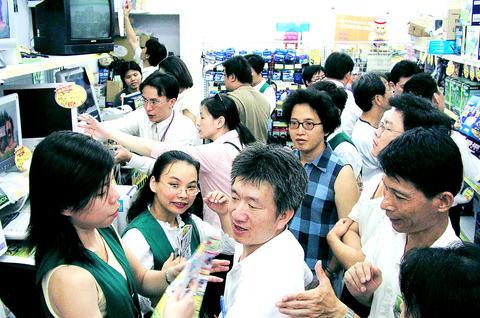
TAIPEI TIMES FILE PHOTO
"Competition will continue this year and it will involve all of the nation's computer and electronics chain retailers," Huang said.
E-Life, the nation's leading consumer electronics retailer with 222 stores, and Tsann Kuen, which has 134 outlets, are offering deferred payment plans and no-interest 12-month installment programs in a bid to secure their customer base in a market that analysts and industry veterans said has reached saturation point.
Computer and consumer electronics retail chains emerged in Taiwan in the early 1990s. The establishment of Nova Plaza computer shopping center in 1987 near the Taipei Railway Station (
Over the years, the size of the computer and consumer electronics retail market, worth more than NT$200 billion, has to a virtual standstill with little space for growth, said Hsieh Wei-hsiung (謝維雄), E-life's assistant vice president of merchandise and marketing.
"Only retailers that offer customers attractive promotions, quality products at preferential prices and prompt services can make progress in this industry," Hsieh said.
Promotions, in particular, have become a must-do to boost sales.
"We found an obvious decrease in our sales during the period of no promotion activities," said Eileen Shou (
Retailers have also banked on plans to diversify their product category to woo different segment of customers and thus increase their customer base.
Take E-Life. The company decided earlier this month to team up with Hewlett Packard Taiwan in marketing HP-brand computers and peripherals, targeting young office employees. Currently, home appliances account for 90 percent of E-life's product lineup, with computers and consumer electronics making the remainder. The company may keep enhancing its electronic products to echo consumers' needs.
E-Life achieved a 35-percent increase in annual sales at NT$9.5 billion last year.
"With the new strategy, we hope to reach similar growth rate this year, with the opening of 40 more outlets," Hsieh said.
Unlike E-Life, Tsann Kuen said it would shift its focus to expanding its retail business in China.
"Eyeing the estimated 7-percent GDP growth in China, 10-percent rise in its retailing and the 30-percent increase in the electronics and home appliance market there, we plan to open more than 100 outlets in China in 2004," Wu Tsann-kuen (
Tsann Kuen started its retail business in China in the mid-2002 and has opened around 40 stores for now. It hopes to expand the outlet number to more than 160 in Taiwan and 100 in China's eastern and northern regions by the end of this year.
The group generated NT$37 billion in sales last year, an increase of about 40 percent compared to the previous year.
"We aim to create annual sales of NT$80 billion in 2004 and NT$400 billion by 2009, with 1,000 outlets on both sides of the Taiwan Strait," Wu said.
E-Life said it has no plans to get into China any time soon.
"As we are going to be listed on the stock market this September, we will put more stress on the business here in Taiwan," Hsieh said.
Regardless of what marketing strategies or promotion tactics retailers are using, the trend is toward fewer but stronger and bigger players in this industry.
"There would be no more than three major players -- who have efficient management and good control of cost -- to survive in this line of business over the next three years at the earliest or eight years at the latest," Tomorrow World's Huang said.
A strong driver behind the industry consolidation is that consumers are getting used to selecting consumer electronics and home appliances from large retailers with supportive after-sale services.
In this regard, Nova Plaza and stores located in the Kwang Hwa Market may face marginalization amid the harsh competition, Huang said.
The 12-year old Tomorrow World, which primarily sells computers and electronic products like digital cameras, saw annual sale grow 28 percent from a year ago to NT$1.8 billion last year. The company plans to expand its outlets to 70 this year on an annual sale of NT$2.5 billion.
"Retailers that cannot keep up with the three biggest companies could easily get neglected by consumers in the future no matter what promotions they utilize," Huang said. "Strong players become increasingly stronger while the weaker ones get eliminated by market forces."

ISSUES: Gogoro has been struggling with ballooning losses and was recently embroiled in alleged subsidy fraud, using Chinese-made components instead of locally made parts Gogoro Inc (睿能創意), the nation’s biggest electric scooter maker, yesterday said that its chairman and CEO Horace Luke (陸學森) has resigned amid chronic losses and probes into the company’s alleged involvement in subsidy fraud. The board of directors nominated Reuntex Group (潤泰集團) general counsel Tamon Tseng (曾夢達) as the company’s new chairman, Gogoro said in a statement. Ruentex is Gogoro’s biggest stakeholder. Gogoro Taiwan general manager Henry Chiang (姜家煒) is to serve as acting CEO during the interim period, the statement said. Luke’s departure came as a bombshell yesterday. As a company founder, he has played a key role in pushing for the

China has claimed a breakthrough in developing homegrown chipmaking equipment, an important step in overcoming US sanctions designed to thwart Beijing’s semiconductor goals. State-linked organizations are advised to use a new laser-based immersion lithography machine with a resolution of 65 nanometers or better, the Chinese Ministry of Industry and Information Technology (MIIT) said in an announcement this month. Although the note does not specify the supplier, the spec marks a significant step up from the previous most advanced indigenous equipment — developed by Shanghai Micro Electronics Equipment Group Co (SMEE, 上海微電子) — which stood at about 90 nanometers. MIIT’s claimed advances last

CROSS-STRAIT TENSIONS: The US company could switch orders from TSMC to alternative suppliers, but that would lower chip quality, CEO Jensen Huang said Nvidia Corp CEO Jensen Huang (黃仁勳), whose products have become the hottest commodity in the technology world, on Wednesday said that the scramble for a limited amount of supply has frustrated some customers and raised tensions. “The demand on it is so great, and everyone wants to be first and everyone wants to be most,” he told the audience at a Goldman Sachs Group Inc technology conference in San Francisco. “We probably have more emotional customers today. Deservedly so. It’s tense. We’re trying to do the best we can.” Huang’s company is experiencing strong demand for its latest generation of chips, called

GLOBAL ECONOMY: Policymakers have a choice of a small 25 basis-point cut or a bold cut of 50 basis points, which would help the labor market, but might reignite inflation The US Federal Reserve is gearing up to announce its first interest rate cut in more than four years on Wednesday, with policymakers expected to debate how big a move to make less than two months before the US presidential election. Senior officials at the US central bank including Fed Chairman Jerome Powell have in recent weeks indicated that a rate cut is coming this month, as inflation eases toward the bank’s long-term target of two percent, and the labor market continues to cool. The Fed, which has a dual mandate from the US Congress to act independently to ensure


 RSS
RSS