


South Korea's LG Card Co, on the brink of bankruptcy in November, ousted US-controlled Korea First Bank as its main banker and chose state-owned Woori Bank instead. Woori helped Korea's biggest credit-card company secure a 2 trillion won (US$1.7 billion) emergency loan 10 days later, and led a 5 trillion won bailout earlier this month.
"They had to get the foreigner out of there to clinch the bailout," said James Rooney, president of Seoul-based Market Force Co, which advises overseas investors in South Korea, and former president of Templeton Investment Trust Management Co in Seoul. "It's a Korean solution."
LG Card's rescue shows that South Korean companies still rely on support from local banks and the government, even after the nation threw its banks open to overseas investment after the 1997-1998 financial crisis. Foreigners own 30 percent of Korea's US$662 billion banking market from 1 percent in 1997.
Some Korean bankers and regulators caution against letting that share grow as the government completes the sale of banks it bailed out during the crisis. On the block this year are a 22 percent stake in Hana Bank, Korea's fourth-largest lender, and 15 percent of No. 3 Woori Bank's parent company.
"It would be prudent to think twice before handing over major financial institutions," Hana Bank Chief Executive Officer Kim Seung Yu told reporters last month. "It would be difficult to manage policy and the foreign-exchange market if a major domestic bank is owned by foreign interests."
Standard Chartered Plc and HSBC Holdings Plc have said they want to expand in Asia's No. 3 commercial banking market, where household lending has more than doubled since 1997.
Korean law requires investors to seek regulatory approval to buy more than 4 percent of a domestic bank. The government waived that requirement for overseas buyers during the crisis, allowing funds such as San Francisco-based Newbridge Capital Ltd -- Korea First Bank's owner -- to take controlling stakes in ailing Korean lenders.
Jun Kwang Woo, vice chairman of Woori Bank's parent company, voiced concerns.
"Some Korean bankers are concerned about the leakage of internal information to foreign investors," Jun told reporters on Dec. 10. "I partially share that view."
Former finance minister Lee Hun Jai, who helped pull South Korea out of the Asian crisis by selling Korean assets to international investors, is now trying to keep Woori Bank and Hana Bank in Korean hands.
He said on Jan. 9 he aims to raise at least 3 trillion won for the first-ever domestic fund to buy bank stakes.
Regulators may be concerned that foreign-owned lenders will be less likely to follow government orders, according to Eugen Loeffler, chief executive officer of Hana Allianz Investment Trust Management Co, a venture between Germany's Allianz AG and South Korea's Hana Bank.
"I understand why the government isn't comfortable to see foreign market shares rise because that means it would be difficult to control banks," Loeffler said.

Among the rows of vibrators, rubber torsos and leather harnesses at a Chinese sex toys exhibition in Shanghai this weekend, the beginnings of an artificial intelligence (AI)-driven shift in the industry quietly pulsed. China manufactures about 70 percent of the world’s sex toys, most of it the “hardware” on display at the fair — whether that be technicolor tentacled dildos or hyper-realistic personalized silicone dolls. Yet smart toys have been rising in popularity for some time. Many major European and US brands already offer tech-enhanced products that can enable long-distance love, monitor well-being and even bring people one step closer to

Malaysia’s leader yesterday announced plans to build a massive semiconductor design park, aiming to boost the Southeast Asian nation’s role in the global chip industry. A prominent player in the semiconductor industry for decades, Malaysia accounts for an estimated 13 percent of global back-end manufacturing, according to German tech giant Bosch. Now it wants to go beyond production and emerge as a chip design powerhouse too, Malaysian Prime Minister Anwar Ibrahim said. “I am pleased to announce the largest IC (integrated circuit) Design Park in Southeast Asia, that will house world-class anchor tenants and collaborate with global companies such as Arm [Holdings PLC],”

TRANSFORMATION: Taiwan is now home to the largest Google hardware research and development center outside of the US, thanks to the nation’s economic policies President Tsai Ing-wen (蔡英文) yesterday attended an event marking the opening of Google’s second hardware research and development (R&D) office in Taiwan, which was held at New Taipei City’s Banciao District (板橋). This signals Taiwan’s transformation into the world’s largest Google hardware research and development center outside of the US, validating the nation’s economic policy in the past eight years, she said. The “five plus two” innovative industries policy, “six core strategic industries” initiative and infrastructure projects have grown the national industry and established resilient supply chains that withstood the COVID-19 pandemic, Tsai said. Taiwan has improved investment conditions of the domestic economy
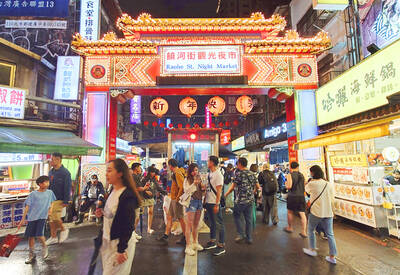
Sales in the retail, and food and beverage sectors last month continued to rise, increasing 0.7 percent and 13.6 percent respectively from a year earlier, setting record highs for the month of March, the Ministry of Economic Affairs said yesterday. Sales in the wholesale sector also grew last month by 4.6 annually, mainly due to the business opportunities for emerging applications related to artificial intelligence (AI) and high-performance computing technologies, the ministry said in a report. The ministry forecast that retail, and food and beverage sales this month would retain their growth momentum as the former would benefit from Tomb Sweeping Day


 RSS
RSS