


While the ready-to-eat Lunar New Year's feasts have become increasingly popular, up to 94 percent of their catalogs failed to provide a clear indication of nutrition information for consumer reference, the Consumers' Foundation (消基會) said yesterday.
"Most vendors did not include enough or clear nutrition information as well as other relevant information in the catalogs," Cheng Jen-hung (
Worried that insufficient information could lead people to purchase unsuitable products, the foundation last month undertook a survey of the 32 kinds of ready-to-eat Lunar New Year feasts sold through the nation's convenience stores, supermarkets and hypermarkets.
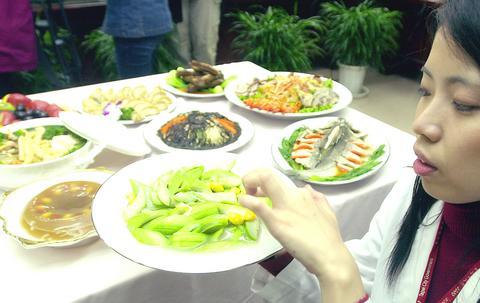
PHOTO: CHIEN JUNG-FENG, TAIPEI TIMES
The foundation found that up to 94 percent of the catalogs, except the ones provided by RT-Mart (
Around 69 percent of the catalogs, including Carrefour's and Far Eastern Geant's (
"Aside from the color advertisements with photos of the feasts -- as shown at the foundation's press conference -- we do provide customers with A4-sized leaflets with a written description of each dish in black ink, containing information about ingredients, nutrition and methods of preparation," a Geant official said in response to the foundation's statements.
In addition to requiring clearer nutritional information, consumers should also consider the price when purchasing the feasts. The price of the most expensive feast included in the survey was 5.6 times the cheapest one, according to the foundation.
"The Lunar New Year feasts provided by United Hotel (國聯飯店) cost NT$12,000 per set, which is not a reasonable price for a take-away feast, because shoppers are not using any of the hotel's services or admiring its decorations," Cheng said.
The hotel defended itself, saying the high price had been set to reflect the cost of the gift baskets used to contain the feasts, which have a limited quantity of 30 sets.
"We invited two graffiti artists to hand-paint monkey patterns on the baskets for our New Year feasts that can become collector's items. It was this which raised the price of the ready-made feasts," said Joanne Hsieh (
Cheng said the foundation last year received around 50 consumer complaints regarding the ready-to-eat Lunar New Year feasts. The complaints were primarily about late delivery, or the failure of the vendor to deliver the meal and only notifying the customer of the cancellation a short time prior to dinner.
"Vendors should notify customers of a cancellation a minimum of two days prior and compensate customers with alternatives, like a restaurant booking," Cheng said.
"If the vendors deliberately accept orders that exceed their capacity, after knowing that they lack the necessary cooking materials, consumers can ask for punitive damages triple their financial losses, aside from conventional compensation," he added.

Among the rows of vibrators, rubber torsos and leather harnesses at a Chinese sex toys exhibition in Shanghai this weekend, the beginnings of an artificial intelligence (AI)-driven shift in the industry quietly pulsed. China manufactures about 70 percent of the world’s sex toys, most of it the “hardware” on display at the fair — whether that be technicolor tentacled dildos or hyper-realistic personalized silicone dolls. Yet smart toys have been rising in popularity for some time. Many major European and US brands already offer tech-enhanced products that can enable long-distance love, monitor well-being and even bring people one step closer to

Malaysia’s leader yesterday announced plans to build a massive semiconductor design park, aiming to boost the Southeast Asian nation’s role in the global chip industry. A prominent player in the semiconductor industry for decades, Malaysia accounts for an estimated 13 percent of global back-end manufacturing, according to German tech giant Bosch. Now it wants to go beyond production and emerge as a chip design powerhouse too, Malaysian Prime Minister Anwar Ibrahim said. “I am pleased to announce the largest IC (integrated circuit) Design Park in Southeast Asia, that will house world-class anchor tenants and collaborate with global companies such as Arm [Holdings PLC],”
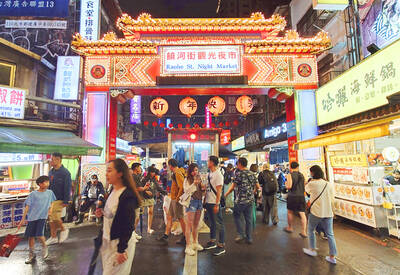
Sales in the retail, and food and beverage sectors last month continued to rise, increasing 0.7 percent and 13.6 percent respectively from a year earlier, setting record highs for the month of March, the Ministry of Economic Affairs said yesterday. Sales in the wholesale sector also grew last month by 4.6 annually, mainly due to the business opportunities for emerging applications related to artificial intelligence (AI) and high-performance computing technologies, the ministry said in a report. The ministry forecast that retail, and food and beverage sales this month would retain their growth momentum as the former would benefit from Tomb Sweeping Day
Thousands of parents in Singapore are furious after a Cordlife Group Ltd (康盛人生集團), a major operator of cord blood banks in Asia, irreparably damaged their children’s samples through improper handling, with some now pursuing legal action. The ongoing case, one of the worst to hit the largely untested industry, has renewed concerns over companies marketing themselves to anxious parents with mostly unproven assurances. This has implications across the region, given Cordlife’s operations in Hong Kong, Macau, Indonesia, the Philippines and India. The parents paid for years to have their infants’ cord blood stored, with the understanding that the stem cells they contained


 RSS
RSS