


Taiwanese businesses invested US$129.54 billion in China last year -- a figure higher than the government's estimated US$35 billion, a survey released yesterday by the Chinese-language Fortune China Monthly (
"The number of registered China-based Taiwanese businesses has amounted to 68,115 while actual investments totaled US$77.36 billion," Lee Mon-chou (李孟洲), publisher of the Fortune China Monthly, said yesterday.
China's economic authorities said that contracts of China-bound Taiwanese investments are worth US$65 billion while actual investments amount to US$35.1 billion, according to the magazine.
According to the magazine's survey on Taiwanese businesses in 31 Chinese provinces, Jiangsu, Guangdong, Fujian and Zhejiang provinces as well as Shanghai city are the top five destinations for Taiwanese business capital.
A total of 53 Chinese cities are home to over 100 Taiwanese businesses, including the top five cities: Suzhou, Dongguan, Zhangzhou, Guangzhou and Wuxi, the survey found.
"Formosa Plastics Group's (台塑) Zhangzhou power plant and Tsann Kuen (China) Enterprise Co's (燦坤) Zhangzhou-based investments contributed to the city's emerging economic importance to Taiwanese businesses," Lee said.
He yesterday concluded that over 70 percent of Taiwanese businesses in China are clustered in 10 south-eastern Chinese coastal provinces.
Despite the huge discrepancy between the survey's findings and the government's statistics, pundits at a discussion held by the magazine yesterday agreed that the survey's total of US$129.54 billion in investments is closer to reality.
Vincent Siew (蕭萬長), chairman of the Chunghua Institution for Economic Research (中經院), yesterday said that some Taiwanese businesspeople made indirect investments worth around US$80 billion in China. The government's statistics failed to include this fact.
Tony Huang (黃慶堂), executive secretary of the Investment Commission, however, yesterday said that the government adopts different standards in calculating China-based investments. Despite calling statistics provided by Chinese authorities into question, Huang said that the emerging domestic-demand and service-oriented markets in China are a great attraction to Taiwanese businesses.
Stressing the importance of greater China markets, Siew, who is also convener of President Chen Shui-bian's (
Siew said that the framework, based on the free-trade Closer Economic Partnership Arrangement (CEPA) pact between Hong Kong and China, has been proposed on the basis that "Taiwan will never accept the CEPA model under `one country, two systems.'"
He said that, under the CEOF, Taiwan can steer clear of political interference and reinforce its economically strategic importance in the greater China market.
As Asia has recently started heated regional economic integration, Siew said that Taiwan should make efforts to avoid being marginalized or economically isolated in the boisterous regional economic activities.

Among the rows of vibrators, rubber torsos and leather harnesses at a Chinese sex toys exhibition in Shanghai this weekend, the beginnings of an artificial intelligence (AI)-driven shift in the industry quietly pulsed. China manufactures about 70 percent of the world’s sex toys, most of it the “hardware” on display at the fair — whether that be technicolor tentacled dildos or hyper-realistic personalized silicone dolls. Yet smart toys have been rising in popularity for some time. Many major European and US brands already offer tech-enhanced products that can enable long-distance love, monitor well-being and even bring people one step closer to

Malaysia’s leader yesterday announced plans to build a massive semiconductor design park, aiming to boost the Southeast Asian nation’s role in the global chip industry. A prominent player in the semiconductor industry for decades, Malaysia accounts for an estimated 13 percent of global back-end manufacturing, according to German tech giant Bosch. Now it wants to go beyond production and emerge as a chip design powerhouse too, Malaysian Prime Minister Anwar Ibrahim said. “I am pleased to announce the largest IC (integrated circuit) Design Park in Southeast Asia, that will house world-class anchor tenants and collaborate with global companies such as Arm [Holdings PLC],”
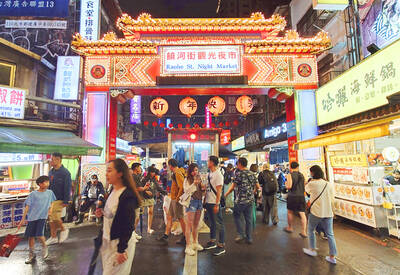
Sales in the retail, and food and beverage sectors last month continued to rise, increasing 0.7 percent and 13.6 percent respectively from a year earlier, setting record highs for the month of March, the Ministry of Economic Affairs said yesterday. Sales in the wholesale sector also grew last month by 4.6 annually, mainly due to the business opportunities for emerging applications related to artificial intelligence (AI) and high-performance computing technologies, the ministry said in a report. The ministry forecast that retail, and food and beverage sales this month would retain their growth momentum as the former would benefit from Tomb Sweeping Day
Thousands of parents in Singapore are furious after a Cordlife Group Ltd (康盛人生集團), a major operator of cord blood banks in Asia, irreparably damaged their children’s samples through improper handling, with some now pursuing legal action. The ongoing case, one of the worst to hit the largely untested industry, has renewed concerns over companies marketing themselves to anxious parents with mostly unproven assurances. This has implications across the region, given Cordlife’s operations in Hong Kong, Macau, Indonesia, the Philippines and India. The parents paid for years to have their infants’ cord blood stored, with the understanding that the stem cells they contained


 RSS
RSS