


Stocks rebounded this year from a three-year bear market that produced some of the biggest losses in decades. Shares of companies that stand to benefit most from accelerating economic growth led the gains.
"Purse strings started to loosen up, the mood changed and the investing public became enamored with buying companies that suddenly seemed like they weren't going out of business," said John Piccard, who helps manage US$400 billion for J.P. Morgan Fleming Asset Management in New York.
Technology companies were the year's best performers, such as Corning Inc, the world's largest maker of fiber-optic cable; ARM Holdings Plc, a designer of semiconductors used in two-thirds of the world's mobile phones; and Softbank Corp, Japan's second-largest provider of high-speed Internet access.
Producers of raw materials, including Inco Ltd and Phelps Dodge Corp, became market leaders in the second half. Their shares rose along with commodity prices, which surged amid growing demand from countries such as China.
Morgan Stanley Capital International Inc's World Index, a benchmark for companies based in 23 developed countries, gained 31 percent for the year.
small companies and emerging markets
Smaller companies and emerging markets were even more rewarding. The MSCI World Small-Cap Index, whose members are valued at US$200 million to US$1.5 billion, climbed 56 percent. The MSCI Emerging Markets Free Index, tracking companies based in 26 countries, advanced 51 percent.
The MSCI World index had fallen for the previous three years, and had lost half of its value during the decline. The string of losses was the longest since its introduction in 1970.
In the US, the benchmark Standard & Poor's 500 Index sank 49 percent between March 2000 and October 2002. The retreat was the biggest for any bear market since 1937-38, when the country was recovering from the Great Depression.
Stocks started last year by failing to extend a recovery from their October lows. The MSCI World hit bottom on March 12 at 710.79, about seven points above the six-year low reached on Oct. 9, 2002.
Europe's Dow Jones Stoxx 50 Index and the Euro Stoxx 50, a measure for the 12 countries in the euro region, also set their 2003 lows on March 12. The S&P 500 did so a day earlier. Prices then began climbing as US-led forces took control of Iraq.
For the year, the S&P 500 added 26 percent and the Dow Jones Industrial Average climbed 25. The Nasdaq Composite Index gained 50 percent. After accounting for a rise in the value of European currencies against the dollar, the Stoxx 50 advanced 32 percent and the Euro Stoxx 50 rallied 39 percent.
Germany's DAX Index jumped 64 percent in dollar terms, the biggest gain for Western Europe's 17 national markets. France's CAC 40 rose 39 percent. The UK's FTSE 100 added 26 percent.
Asian markets joined the rally at the end of April after withstanding "Sony shock." Shares of Japan's Sony Corp, the world's second-largest maker of consumer electronics, plummeted 27 percent in two days after the company reported a fourth-quarter loss that was about triple analysts' estimates.
The MSCI Asia-Pacific Index, tracking companies in 14 developed and emerging markets, closed April 28 at the lowest level in its 16-year history. On the same day, Japan's Nikkei 225 Stock Average dropped to a two-decade low and the Topix index came within 0.3 percentage point of a low set March 11.
increasing demand from overseas
Demand from overseas contributed to the change of direction.
In Japan, international investors purchased more shares than they sold for 23 straight weeks between May and September, according to figures from the Tokyo Stock Exchange. The streak was the longest since 1996.
As funds flowed into the region, the MSCI Asia-Pacific recovered to show a 38 percent gain for last year. The Nikkei 225 matched the rally in dollar terms; the Topix rose 37 percent.
Hong Kong's Hang Seng Index added 36 percent. Thailand's SET Index, the region's best performer, more than doubled.
Optimism that the US will lead a global economic rebound lifted stocks in Asia and elsewhere. The world's largest economy expanded in the third quarter at an 8.2 percent annual rate, the fastest pace in two decades.
"The one thing I am looking at is whether US growth will sustain [itself] going into the next year," said Marc Desmidt, who helps manage the equivalent of US$7.4 billion at Merrill Lynch Investment Managers Co in Tokyo. "The question is: Can growth stabilize at a high level, around say 4 percent?"

Among the rows of vibrators, rubber torsos and leather harnesses at a Chinese sex toys exhibition in Shanghai this weekend, the beginnings of an artificial intelligence (AI)-driven shift in the industry quietly pulsed. China manufactures about 70 percent of the world’s sex toys, most of it the “hardware” on display at the fair — whether that be technicolor tentacled dildos or hyper-realistic personalized silicone dolls. Yet smart toys have been rising in popularity for some time. Many major European and US brands already offer tech-enhanced products that can enable long-distance love, monitor well-being and even bring people one step closer to

Malaysia’s leader yesterday announced plans to build a massive semiconductor design park, aiming to boost the Southeast Asian nation’s role in the global chip industry. A prominent player in the semiconductor industry for decades, Malaysia accounts for an estimated 13 percent of global back-end manufacturing, according to German tech giant Bosch. Now it wants to go beyond production and emerge as a chip design powerhouse too, Malaysian Prime Minister Anwar Ibrahim said. “I am pleased to announce the largest IC (integrated circuit) Design Park in Southeast Asia, that will house world-class anchor tenants and collaborate with global companies such as Arm [Holdings PLC],”

TRANSFORMATION: Taiwan is now home to the largest Google hardware research and development center outside of the US, thanks to the nation’s economic policies President Tsai Ing-wen (蔡英文) yesterday attended an event marking the opening of Google’s second hardware research and development (R&D) office in Taiwan, which was held at New Taipei City’s Banciao District (板橋). This signals Taiwan’s transformation into the world’s largest Google hardware research and development center outside of the US, validating the nation’s economic policy in the past eight years, she said. The “five plus two” innovative industries policy, “six core strategic industries” initiative and infrastructure projects have grown the national industry and established resilient supply chains that withstood the COVID-19 pandemic, Tsai said. Taiwan has improved investment conditions of the domestic economy
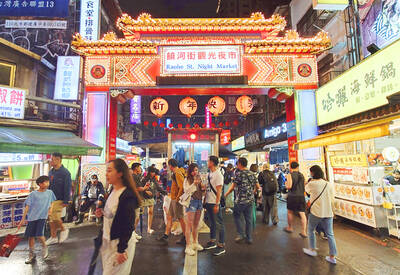
Sales in the retail, and food and beverage sectors last month continued to rise, increasing 0.7 percent and 13.6 percent respectively from a year earlier, setting record highs for the month of March, the Ministry of Economic Affairs said yesterday. Sales in the wholesale sector also grew last month by 4.6 annually, mainly due to the business opportunities for emerging applications related to artificial intelligence (AI) and high-performance computing technologies, the ministry said in a report. The ministry forecast that retail, and food and beverage sales this month would retain their growth momentum as the former would benefit from Tomb Sweeping Day


 RSS
RSS