


From freezing shoppers in Shanghai to schoolchildren doing their homework by candlelight in Hunan, the Chinese are preparing for a winter season rendered cold and dark by frequent energy shortfalls.
China's economy is rumbling ahead, and power suppliers have great difficulties keeping up, with potentially dire consequences for an increasingly energy-dependent economy.
"The shortage will have a strong impact on the Chinese economy, no doubt about it," said Xiao Yunhan, an energy expert at the Chinese Academy of Science.

PHOTO: AFP
"Aluminum makers, who depend much on electricity, will suffer a lot while the impact to parts of the chemical industry will be disastrous," he said.
In one indication of how bad the situation is, officials in China's northeastern rust-belt have even had to buy power from impoverished North Korea this year.
In China's largest city Shanghai, shopping malls and departments stores will turn off their central heating systems every day between 10am and noon to avoid the peak daily power usage period.
The measure is meant to ease an expected power shortfall of two million kilowatts in the winter season resulting from coal supply shortages and a seasonal drought.
This is only the latest measure by the Shanghai authorities, who have also shut down all small fertilizer factories and drastically curbed the operations of energy-guzzling, low-added-value companies such as small steel plants.
To a certain extent, energy shortages are just part of the price China has to pay for becoming a richer society, analysts said.
"The economy is growing and people's lifestyle is changing," said Wei Zhihong, an energy researcher at Beijing's Tsinghua University. "Many urban residents are moving from burning coal to using electricity, and that inevitably creates bottlenecks."
Nationwide, the energy demand has risen 15.6 percent so far this year from the same period last year, forcing 21 provinces to limit power consumption, up from 12 provinces last year.
No other place is worse hit at the moment than central China's Hunan province, where droughts have caused hydropower plants to reduce their production.
In the provincial capital of Changsha, the different districts are being forced to share the burden, having their power cut off every four days.
Many energy-dependent shops and production lines in the city have to close down temporarily during blackouts.
Chronic power shortages are likely to continue for at least another two years in some provinces, the state media have warned.
While the power shortage reflects rising demand for electricity, resulting from 8.5 percent economic growth this year, there are also decisive factors on the supply side, according to Xinhua.
The coal supply has shrunk because the government has stepped up efforts to shut down illegal coal mines after a series of fatal accidents this year.
This matters, because small and medium-sized coal mines -- the main targets in this campaign -- account for about 40 percent of total coal production in China.
Under mounting strain because of the coal shortage, seven large power companies recently appealed to the government about the severity of the situation, according to state media.
China will need a whopping US$2.3 trillion for investment in energy-related projects in the period until 2030, according to the International Energy Agency.
But at least China should learn from this year's energy shortage, according to Xiao from the Chinese Academy of Sciences.
"Construction in the energy sector has been ignored for a long time," he said. "On the contrary, we have paid too much attention to the hi-tech industry."

HSBC Holdings PLC is deepening its commitment to Taiwan as the economy emerges as one of the bank’s fastest-growing markets globally, driven by an artificial intelligence (AI) investment boom, expanding cross-border trade, and rising wealth creation. “The advantage that Taiwan has is a growth story linked to the semiconductor and broader AI industries, strong underlying corporate performance, and wealth creation,” said Surendra Rosha, HSBC’s co-chief executive for Asia and the Middle East, in an exclusive interview with the Taipei Times on June 2, during this year’s HSBC Taiwan Conference. That combination has helped HSBC cement its position as the most profitable international

The New Taiwan dollar yesterday fell sharply against the US dollar to close at its lowest level since May 22 amid a massive outflow of funds from the country because of investors panicking over global equity markets. The NT dollar ended at NT$31.580 against the US dollar, slightly lower than its close of NT$31.568 on May 22, after moving between NT$31.5 and NT$31.648 on combined turnover of US$3.062 billion on the Taipei Foreign Exchange and the Cosmos Foreign Exchange. The NT dollar received a significant hit in the morning session, slumping as much as NT$0.173 at a time when other Asian currencies

Taiwan Semiconductor Manufacturing Co (TSMC, 台積電) is now ranked ninth among the world’s 100 most valuable companies after its market capitalization more than doubled over the past year, PricewaterhouseCoopers (PwC) Taiwan said in a report last month. TSMC’s market capitalization surged 101 percent year-on-year to US$1.427 trillion as of March 31, the accounting and consulting firm’s 2026 Global Top 100 Companies by Market Capitalization report said. The gain catapulted the world’s largest contract chipmaker from 12th place to ninth in the rankings, and it was the fastest-growing among the global top 10, it said. TSMC was the only Taiwanese company among the top
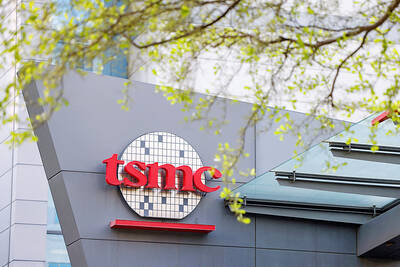
Taiwan Semiconductor Manufacturing Co (TSMC, 台積電) yesterday reported record revenue of NT$416.975 billion (US$13.17 billion) for last month, putting the world’s largest contract chipmaker on track to set a record for quarterly revenue. Last month’s figure surpassed March’s record NT$415.19 billion and represented increases of 1.5 percent from April and 30.1 percent from a year earlier. For the first five months of the year, TSMC generated NT$1.96 trillion in revenue, up 30 percent year-on-year, it said in a statement. TSMC has forecast second-quarter revenue of between US$39 billion and US$40.2 billion, representing sequential growth of about 10 percent and year-on-year growth of about


 RSS
RSS