


Taiwan Salt Co (Taisalt,
Taisalt shares have risen to NT$28.80 from NT$19.28 per share, or an increase of 49.4 percent, since the company started trading on the TAIEX on Nov. 18. During the same period, the TAIEX has dropped 2.9 percent from 6,044.77 on Nov. 18 to 5870.17 yesterday.
The company, which sells its products under the Taiyen brand, officially completed privatization on Nov. 13 after the government released 59.35 percent of its shares to the public.
"There is little room for Taisalt shares to go up further," said Juvin Chou (周曉萍), a stock analyst with Capital Securities Corp (群益證券). "What the former state-run company has shown over the past two weeks was largely a reflection of political factors."
Taisalt chairman Cheng Po-ching (
Taisalt has reported profitable sales of its skincare products, but its poor market reach may cause it to lose out to rivals such as Formosa Petrochemical Corp (台塑石化), Taiwan Sugar Corp (Taisugar, 台糖), and Taiwan's largest food company, Uni-President Group (統一集團), Chou said.
"So far, Taisalt only has over 100 outlets or department store counters nationwide, which is not enough to compete with over 3,000 7-Eleven stores," Chou said.
Taisalt admitted that marketing is its biggest weakness.
"We have contracted Tait Marketing & Distribution Co (德記洋行) to distribute our products, but the sales figure is far from being satisfactory," Taisalt's general manager, Chiu Wen-an (邱文安) told the Taipei Times.
In the first 10 months of this year, Taisalt reported NT$3.2 billion in sales, up from NT$2.8 billion in the previous year, due to a good market response to its collagen-rich line of skincare products, Chiu said. Sales of these Taisalt products have grown tenfold from NT$40 million in June to NT$400 million at the end of last month, he added.
The company's pre-tax revenues reached NT$670 million during the same period, an increase of 6.4 percent from its original forecast of NT$630 million.
Another analyst expects Taisalt shares to rise as high as NT$35 per share by the end of the year.
"The company's bullish sales figures is the main reason driving up its shares," said Daniel Kao (高憲容), an analyst at Marbo Securities Consultant Co (萬寶證券).
"If Taisalt does not have to pay NT$700 million in pensions to employees who were forced into early retirement in 1976 and 1982, I think the company will be even more profitable this year," Kao said.

Among the rows of vibrators, rubber torsos and leather harnesses at a Chinese sex toys exhibition in Shanghai this weekend, the beginnings of an artificial intelligence (AI)-driven shift in the industry quietly pulsed. China manufactures about 70 percent of the world’s sex toys, most of it the “hardware” on display at the fair — whether that be technicolor tentacled dildos or hyper-realistic personalized silicone dolls. Yet smart toys have been rising in popularity for some time. Many major European and US brands already offer tech-enhanced products that can enable long-distance love, monitor well-being and even bring people one step closer to

Malaysia’s leader yesterday announced plans to build a massive semiconductor design park, aiming to boost the Southeast Asian nation’s role in the global chip industry. A prominent player in the semiconductor industry for decades, Malaysia accounts for an estimated 13 percent of global back-end manufacturing, according to German tech giant Bosch. Now it wants to go beyond production and emerge as a chip design powerhouse too, Malaysian Prime Minister Anwar Ibrahim said. “I am pleased to announce the largest IC (integrated circuit) Design Park in Southeast Asia, that will house world-class anchor tenants and collaborate with global companies such as Arm [Holdings PLC],”

Sales in the retail, and food and beverage sectors last month continued to rise, increasing 0.7 percent and 13.6 percent respectively from a year earlier, setting record highs for the month of March, the Ministry of Economic Affairs said yesterday. Sales in the wholesale sector also grew last month by 4.6 annually, mainly due to the business opportunities for emerging applications related to artificial intelligence (AI) and high-performance computing technologies, the ministry said in a report. The ministry forecast that retail, and food and beverage sales this month would retain their growth momentum as the former would benefit from Tomb Sweeping Day
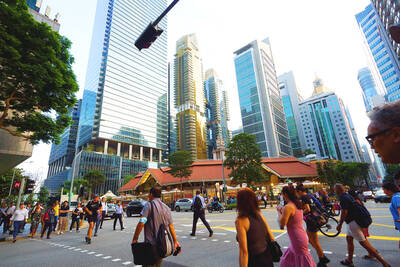
Thousands of parents in Singapore are furious after a Cordlife Group Ltd (康盛人生集團), a major operator of cord blood banks in Asia, irreparably damaged their children’s samples through improper handling, with some now pursuing legal action. The ongoing case, one of the worst to hit the largely untested industry, has renewed concerns over companies marketing themselves to anxious parents with mostly unproven assurances. This has implications across the region, given Cordlife’s operations in Hong Kong, Macau, Indonesia, the Philippines and India. The parents paid for years to have their infants’ cord blood stored, with the understanding that the stem cells they contained


 RSS
RSS